

Zero-days are beating Windows patches—users are stuck in the gap
The accelerating cycle of Windows zero-day exploit disclosure and delayed security patches is creating a widening security gap where attackers can reliably abuse unpatched flaws while ordinary users wait for fixes. In practice, this gap is driven by public proofs-of-concept released by frustrated researchers, slow or opaque vendor responses, and underlying systems like Secure Boot that remain vulnerable for years, turning each Patch Tuesday into a partial, not decisive, victory for defenders.
The RoguePlanet vulnerability in the Microsoft Malware Protection Engine is a case in point: it allowed a race-condition exploit to spawn a SYSTEM-level command prompt on fully patched Windows 10 and Windows 11 machines, even when real-time protection was disabled. Microsoft eventually fixed CVE-2026-50656 via an engine update, but only weeks after exploit code and technical details were published. During that window, RoguePlanet joined a growing list of unpatched Windows zero-day exploit releases from the same researcher, while Microsoft was still publicly “investigating” rather than shipping a patch. That kind of security patch delay is no longer rare—it is becoming the norm, and it leaves Windows users exposed by design.
LegacyHive shows Patch Tuesday can’t keep up with privilege escalation
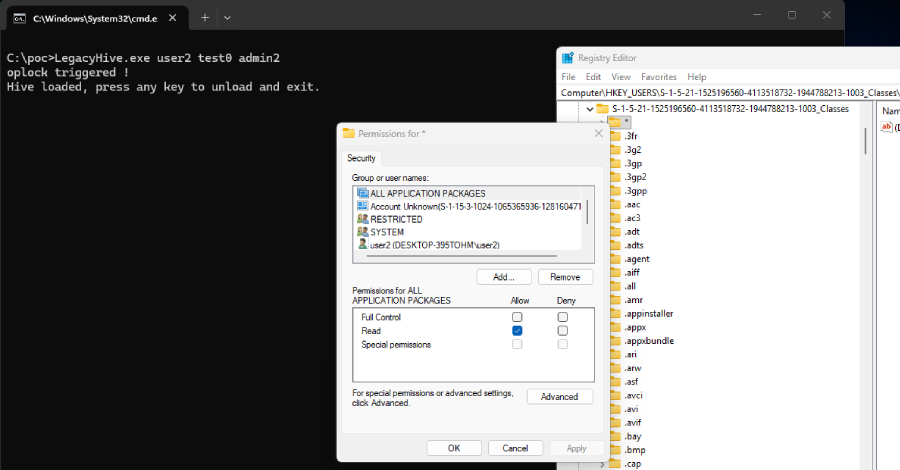
If RoguePlanet exposed the lag between exploit release and patch, LegacyHive exposes something worse: a privilege escalation vulnerability that survives the latest update cycle unscathed. LegacyHive is a Windows User Profile Service (ProfSvc) arbitrary hive load elevation of privileges vulnerability that lets an attacker mount another user’s registry hive, including administrator hives, into their own user classes root. That makes it a textbook privilege escalation vulnerability: a standard account can pivot into far more powerful territory once the exploit succeeds.
The researcher released a stripped proof-of-concept that still requires another standard user credential and a third username, which can be an administrator account, but stressed that the original exploit did not require extra credentials and was not limited to the usrclass.dat hive. Crucially for Windows defenders, the PoC remains functional on all supported desktop and server versions of Windows, including systems running the latest July Patch Tuesday update. When exploit code continues to work immediately after a major update cycle, it is hard to argue that Patch Tuesday is keeping pace with zero-day disclosure.

Secure Boot bypasses expose the deeper problem: trust that never expires
While zero-days like RoguePlanet and LegacyHive highlight tactical patch delays, the recent Secure Boot bypasses reveal a strategic failure: long-term trust in components that should have been revoked years ago. Researchers found that 11 vulnerable UEFI shim bootloaders, some dating back to 2013, remained signed and accepted by systems enforcing Secure Boot, meaning attackers could bypass Secure Boot on both Windows and Linux machines with little difficulty. In effect, these shims were a built-in Secure Boot bypass for anyone with a copy and minimal knowledge of how UEFI shims work.
Secure Boot exists to ensure that every piece of boot code is signed by a trusted authority, with Microsoft acting as the root of trust for its own bootloader and shims used by other software. That trust model only works if vulnerable shims are revoked once flaws are found; in this case, they were not. Systems that have installed recent updates are no longer vulnerable on Windows, and Linux users are advised to confirm protections with their distributions or tools such as fwupd. But this episode shows that security patch delay is not just days or weeks—it can quietly stretch into years when signature validation and revocation are neglected.

Researcher PoCs have turned vulnerability disclosure into a live-fire race
The harsh reality is that public proof-of-concept releases are turning each new Windows zero-day exploit into a live-fire race between attackers and patch teams. Nightmare Eclipse, also known as Chaotic Eclipse, has dropped more than half a dozen zero-days in Microsoft products, including Microsoft Defender bugs like BlueHammer, RedSun, UnDefend, GreenPlasma, RoguePlanet, YellowKey, and GreatXML, and several of these Defender vulnerabilities were under active exploitation shortly after public disclosure. As one industry engineer put it, Patch Tuesday has shifted from years of relative stability into “significant turbulence” as Microsoft faces AI-fuelled growth in vulnerability reporting and disclosures timed to cause maximum discomfort.
Official messaging continues to emphasize coordinated vulnerability disclosure and commitments to investigate, validate, and update impacted products to safeguard customers. Meanwhile, security agencies are adding actively exploited privilege escalation vulnerabilities in SharePoint Server and Active Directory Federation Services to their Known Exploited Vulnerabilities catalogs and mandating rapid patching deadlines for agencies. This is the race-condition in plain sight: researchers drop PoCs, attackers move fast, vendors investigate, and users sit unprotected until a patch finally lands. In that sequence, the attacker’s timeline is the only one that consistently wins.
How Windows users can respond to the widening security gap
Windows users cannot fix the patch pipeline, but they can stop pretending it fully protects them. For RoguePlanet, Microsoft has quietly shipped an update to the Microsoft Malware Protection Engine, and customers are told to ensure they are running the latest engine version to receive the fix. For the Secure Boot shims, systems that have installed the relevant updates are no longer vulnerable on Windows, and Linux users should check with their distributions or use fwupd to confirm their boot chain is protected. Those are the minimum steps; they are not enough on their own.
A more realistic stance for Windows defenses now assumes that privilege escalation vulnerabilities and Secure Boot bypass risks may exist between disclosures and patches. That means hardening local accounts, limiting administrator access, and monitoring for suspicious registry hive activity on endpoints in anticipation of exploits like LegacyHive, which remain functional across all supported desktop and server Windows versions even after Patch Tuesday. It also means tracking vendor advisories and agency KEV listings that signal active exploitation of SharePoint Server and other components so that critical patches are applied on their timelines, not on the attacker’s. The conclusion is blunt: treating Patch Tuesday as a complete shield is no longer safe. Windows security now demands assuming exposure, reducing the blast radius of privilege escalation, and patching as if every delay is an opportunity for a zero-day exploit to become an in-the-wild attack.