
Apple’s New Mac Chip Roadmap, in Plain Terms
Apple’s M6 and M7 chips mark a major shift in the Mac chip roadmap, with Apple planning only a base M6 and jumping its professional‑tier designs directly to M7, signaling a faster push toward higher memory bandwidth, stronger on‑device AI, and far larger unified memory pools in future Macs.
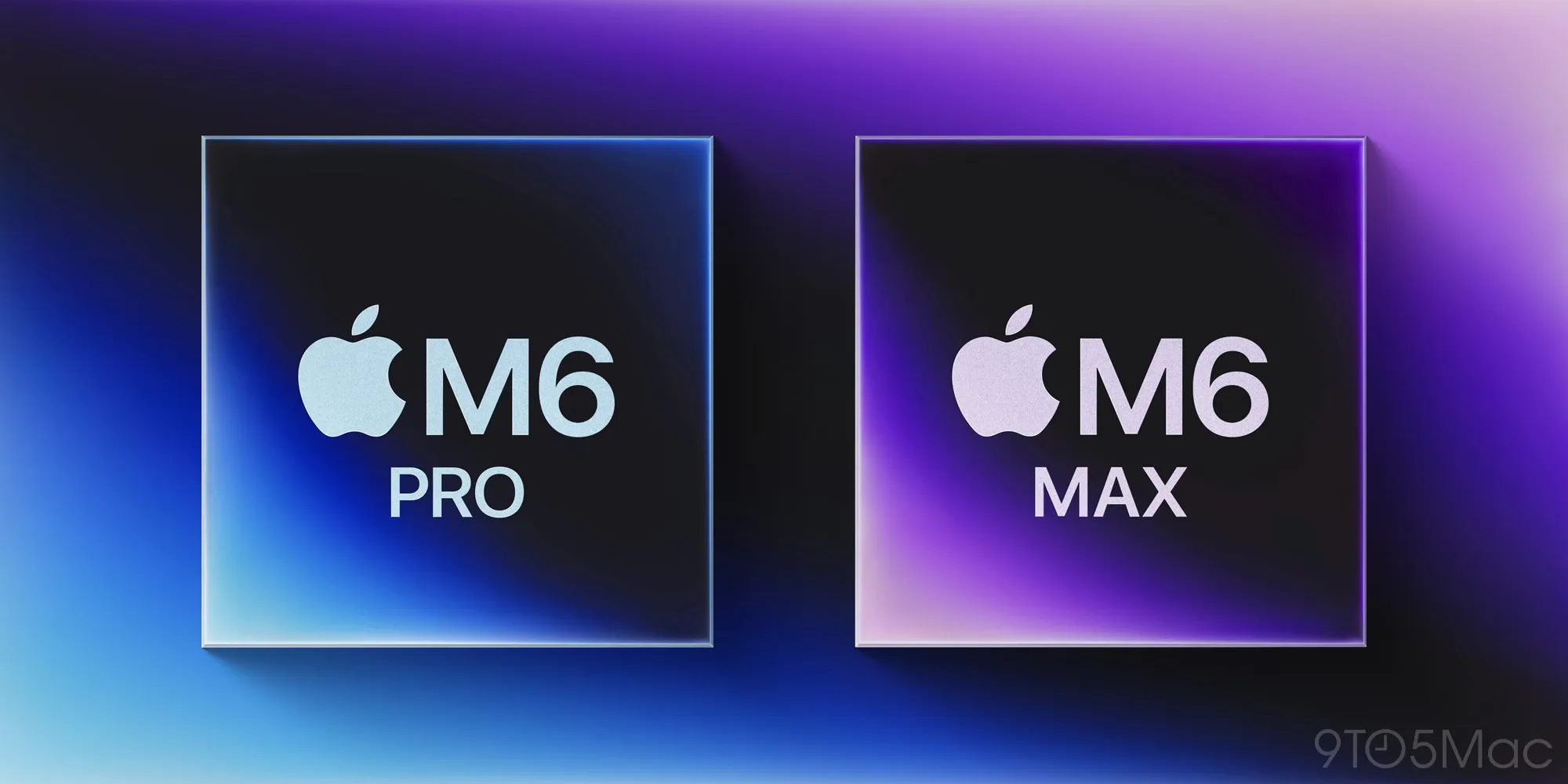
The central move is blunt: Apple will reportedly ship only baseline M6 processors for Macs released this year, while skipping M6 Pro, M6 Max, and any M6 Ultra variants entirely. Higher‑end machines instead jump to the Apple M6 M7 chip transition, with M7‑based Macs expected in the first half of 2027. That gives the M6 a short life and makes M7 the real destination for pro hardware. This is not a minor tweak; it breaks Apple’s familiar pattern of base, Pro, Max, and Ultra versions each generation and shows that Apple sees its next meaningful Apple processor upgrade arriving with M7, not M6.
According to Mark Gurman, Apple will only release the base‑model M6 processor and will not release any higher‑end Pro, Max, or Ultra variants in this generation.
What Changes from M5 to M6 and M7
On paper, M6 is a solid step up from M5, but M7 is where Apple aims to reset expectations. The M6 chip reportedly upgrades its memory architecture to deliver around 200 GB/s of bandwidth, up from 153 GB/s on M5. That, plus a new Neural Engine, redesigned GPU with up to 12 graphics cores instead of 10, and faster CPU cores, means better on‑device AI, smoother gaming, faster video encoding and decoding, and improved performance in GPU‑accelerated apps.
M7 goes further: Apple is reportedly focusing more on AI performance, with M7‑series devices expected to reach around 240 GB/s of memory bandwidth and stronger on‑device AI capabilities alongside extra memory performance enhancements. In other words, M6 is an evolutionary Apple processor upgrade, while M7 is the beginning of a more AI‑centric Mac chip roadmap. Apple reportedly decided that the scale of these M7 improvements was notable enough to skip most of the M6 lineup entirely.
| Spec | M5 | M6 (reported) / M7 (reported) |
|---|---|---|
| Max memory bandwidth | 153 GB/s (M5) | 200 GB/s M6, ~240 GB/s M7 |
| GPU cores (base chip) | Up to 10 (M5) | Up to 12 (M6) |
| Focus areas | General performance | AI, GPU, memory bandwidth; stronger AI again on M7 |
The M7 Ultra Memory Play and Pro Macs
The boldest part of this roadmap is the M7 Ultra memory story. Apple’s current high‑end Ultra configuration supports up to 512 GB of unified memory in the M3 generation, while the upcoming M5 Ultra is reportedly planned to support up to 768 GB. With its M7 Ultra, Apple can reportedly build configurations with as much as 1.5 TB of unified memory, a 3x increase over the current 512 GB ceiling and a 2x jump over the planned 768 GB M5 Ultra, though offering that maximum will depend on DRAM supply and industry conditions near launch.
That planned M7 Ultra memory capacity transforms how we should read this Mac chip roadmap. Apple is no longer iterating gently on its professional‑tier Macs; it is lining them up for a substantial M7 Ultra memory leap. M7‑based Macs are reportedly set for the first half of 2027, with M7 Pro and M7 Max arriving later that year and M7 Ultra following in 2028. Beyond that, an M8 chip on a 1.4 nm process is also reportedly due in 2028. The clear message: Apple wants its next serious pro tier to start with M7, not M6.
Why This Roadmap Shift Matters for Future Mac Buyers
Apple’s choice to skip M6 Pro and M6 Max is a public sign of what it thinks matters next: memory bandwidth and AI. By planning only a baseline M6 now and pushing professional‑tier designs to M7, Apple is signaling that its idea of a meaningful Apple processor upgrade has tightened. An incremental boost to 200 GB/s bandwidth and a slightly larger GPU is not enough to define the next pro era; a jump to ~240 GB/s, stronger AI engines, and potentially 1.5 TB of unified memory in M7 Ultra is.
The practical impact for ordinary users is that M6‑based Macs should feel faster and more responsive than M5, especially for on‑device AI features, video work, and GPU‑accelerated tasks. But the long‑term Mac chip roadmap clearly revolves around the Apple M6 M7 chip transition and, in particular, the M7 Ultra memory ceiling and AI‑oriented design. If you care about how long your next Mac stays relevant to emerging workloads, the story is no longer about every generation; it is about waiting for the generations Apple itself treats as truly new.
Conclusion: A Short M6 Era Before the Real Jump
Apple’s decision to give the M6 a short, base‑only life while sending all professional‑tier Macs to M7 is more than a scheduling quirk. It is a statement that the next meaningful shift in Mac performance, especially for memory‑intensive and AI‑driven workloads, begins with M7 and peaks with a potential 1.5 TB M7 Ultra. M6 still matters for near‑term machines and brings welcome bandwidth, GPU, and AI gains over M5. But the company’s own roadmap makes clear that the long game for high‑end Macs now runs through M7, its AI‑first design, and that striking M7 Ultra memory target.