
Verdict: A Small Form Factor Workstation That Means Business
The Lenovo ThinkStation P3 Ultra SFF Gen 2 is a compact professional workstation built in a 3.9L mini-PC chassis that balances multiple PCIe expansion slots, professional GPU support, and dense I/O in a space-saving design aimed at creative and engineering workflows. From the first impression, this is not a toy-sized box; it is a deliberate attempt to bridge classic tower capabilities with the footprint of a mini PC. In practical terms, that balance works. You get workstation-grade CPU and GPU options, multiple displays, and room for add-in cards, all without taking over your desk. The trade-off is that some high-end features—like faster Ethernet and full-speed Thunderbolt—are missing. For studios and offices where space is tight but workloads are serious, it feels purpose-built; for bleeding-edge connectivity enthusiasts, it will feel slightly compromised.
Design, Build, and Everyday Desk Presence
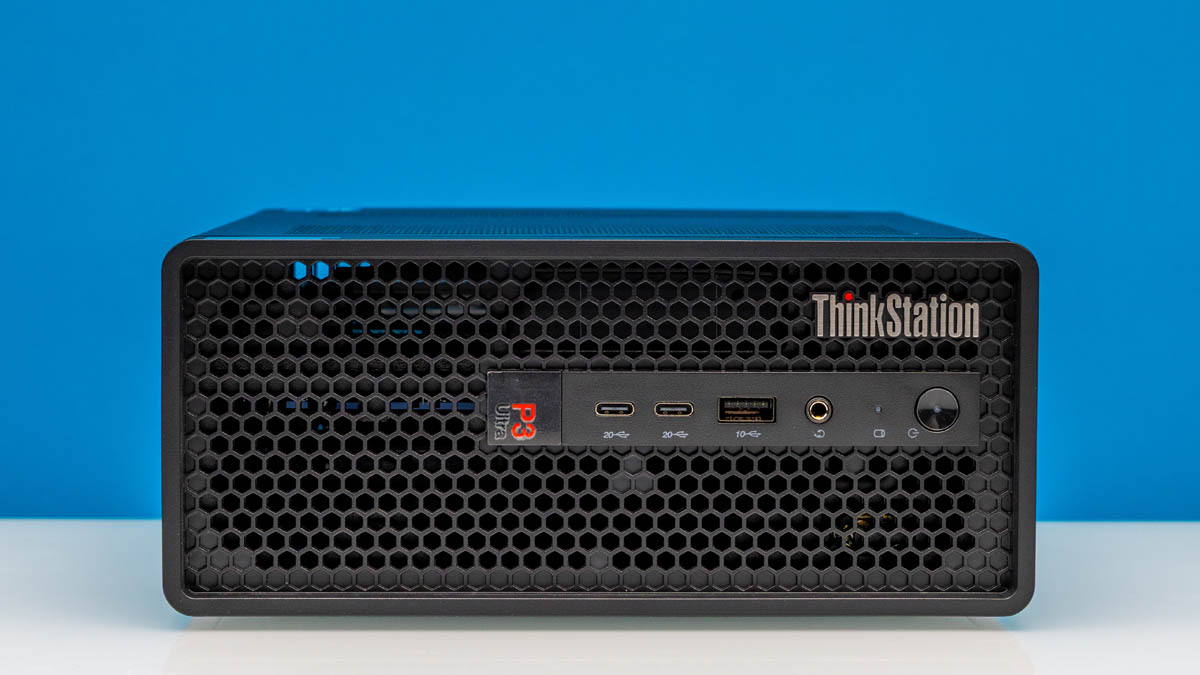
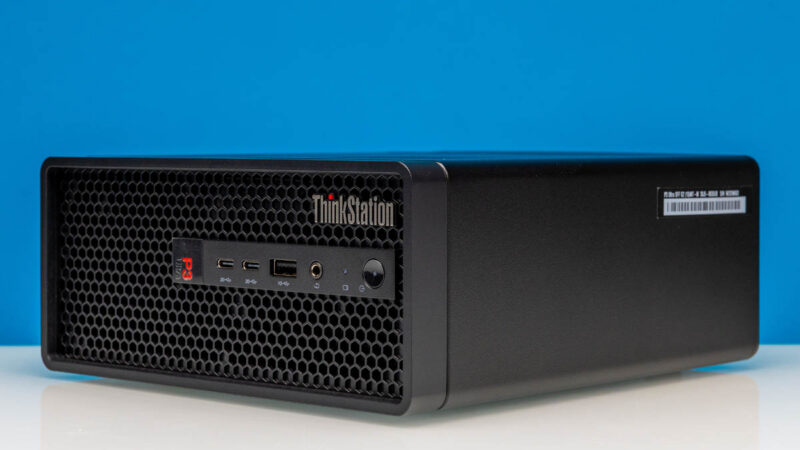
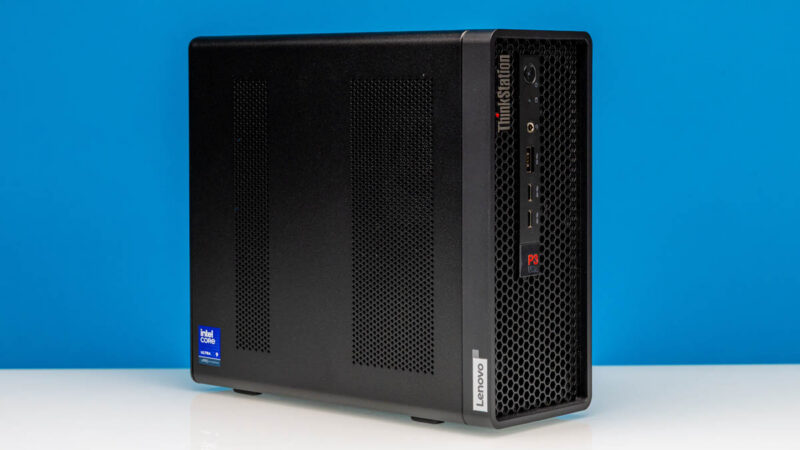
This ThinkStation P3 Ultra review focuses first on the chassis, because that is where Lenovo’s design intent is clearest. The system is 202 x 87 x 223 mm, with a 3.9L volume and a weight of 1.8 kg, putting it at the upper end of mini-PC territory while remaining a small form factor workstation by any reasonable standard. The front is almost entirely perforated grating, prioritising airflow and cooling over flashy aesthetics. It can lie horizontally or stand vertically like a tiny tower, with rubber feet for both orientations, which matters when every centimetre of desk space counts. This is the kind of compact professional workstation you can tuck behind a monitor or stack on a shelf without sacrificing serviceability or thermals. In studio racks or dense office layouts, the physical footprint is a clear strength.
Specs and Expansion: Mini PC, Big Ambitions
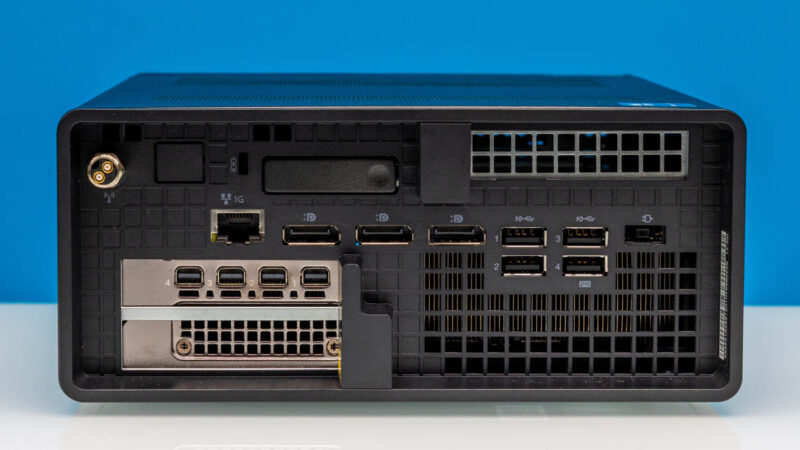
Under the grille, the P3 Ultra SFF Gen 2 is configured like a serious workstation rather than a dressed-up office PC. It can be equipped with an Intel Core Ultra 9 285 processor with 8 performance cores and 16 efficiency cores boosting up to 5.6GHz, paired with 64GB of DDR5-6400 (2x32GB CSO-DIMM) and a 1TB PCIe Gen5 x4 M.2 2280 SSD. Graphics options include Intel Xe-LPG integrated graphics and an NVIDIA RTX 4000 Ada SFF GPU with 20GB of GDDR6, driven by a 330W external power supply. The key differentiator is expansion: there is one low-profile PCIe x16 slot (Gen4 x16 electrical) and one low-profile PCIe x8 slot (Gen4 x4 electrical), allowing additional professional GPUs, storage, or I/O cards within the tight 3.9L envelope. That combination gives this compact machine more headroom than most mini PCs.
| Component | Key Detail |
|---|---|
| Processor | Intel Core Ultra 9 285, 8P + 16E (up to 5.6GHz) |
| Memory | 64GB DDR5-6400 (2x32GB CSO-DIMM) |
| Storage | 1TB PCIe Gen5 x4 M.2 2280 SSD |
| GPU | Intel Xe-LPG iGPU + NVIDIA RTX 4000 Ada SFF, 20GB GDDR6 |
| PCIe Slots | 1x LP x16 (Gen4 x16), 1x LP x8 (Gen4 x4) |
| Form Factor | Mini-PC, 3.9L, 202 x 87 x 223 mm, 1.8 kg |
| PSU | 330W external power supply |
| Wireless | Wi‑Fi 7 + Bluetooth 5.4 (Intel BE200) |
Ports, Connectivity, and Real-World Trade-Offs
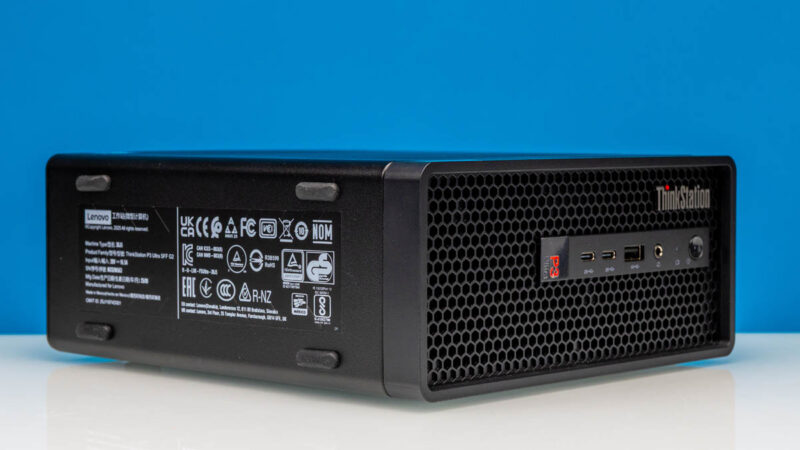
I/O is another area where this small form factor workstation feels more like a downsized tower than an overgrown mini PC. On the front, you get two USB-C ports rated at 20Gbps USB4, a 10Gbps USB-A port, and a 3.5mm audio jack, along with power and activity lights. On the rear, there are four more 10Gbps USB-A ports, three full-size DisplayPort 1.4 outputs wired to the Intel graphics, and a single RJ45 Ethernet port. One quotable detail: “the system itself features three full-size DisplayPorts (DP 1.4 protocol)… a larger number of DisplayPorts than we normally see in a mini-PC.” The trade-offs show up in networking and high-speed peripherals: despite its workstation billing and 2025 release window, wired networking tops out at 1GbE, with no 2.5GbE or 10GbE option, and those USB-C ports do not use the platform’s full 40Gbps Thunderbolt 4 capability.
Pros
- Compact 3.9L chassis that still qualifies as a mini PC while offering workstation-grade capabilities.
- Multiple low-profile PCIe slots, including a Gen4 x16 slot, for GPUs or high-end expansion in a tiny footprint.
- Three full-size DisplayPort 1.4 outputs, more than most mini PCs and ideal for multi-monitor creative setups.
Cons
- Only 1GbE wired networking, with no 2.5GbE or 10GbE option despite its workstation positioning.
- Front USB-C ports limited to 20Gbps USB4, not the full 40Gbps Thunderbolt 4 supported by the platform.
Who This Compact Workstation Is For
The ThinkStation P3 Ultra SFF Gen 2 is built for users who cannot compromise on professional features but must optimise every bit of desk or rack space. With its AI workstation positioning and ability to host multiple low-profile PCIe cards, it bridges the gap between traditional mini PCs and small towers for creative professionals, engineers, and technical teams. It is a strong candidate as a compact professional workstation or as a small form factor workstation node in dense environments where space and thermals are as important as raw performance. For high-res multi-display setups, the trio of DisplayPorts removes the need for dongle juggling. If you care more about neat cabling, space efficiency, and clean integration than about maximal networking speed or Thunderbolt bandwidth, this machine fits well. Availability is straightforward too, with configurations listed through major online retailers via an affiliate link.
- Buy the Lenovo ThinkStation P3 Ultra SFF Gen 2 if you want a compact professional workstation that still supports multiple low-profile PCIe cards and a dedicated NVIDIA RTX 4000 Ada SFF GPU.
- Skip the Lenovo ThinkStation P3 Ultra SFF Gen 2 if you need faster wired networking than 1GbE, such as 2.5GbE or 10GbE, for your workflows.
- Buy the Lenovo ThinkStation P3 Ultra SFF Gen 2 if your studio or office has limited desk space but you still require multi-display support via three full-size DisplayPort 1.4 outputs.
- Skip the Lenovo ThinkStation P3 Ultra SFF Gen 2 if you rely on full-speed 40Gbps Thunderbolt 4 connectivity for external GPUs or ultra-fast storage arrays, since its USB-C ports top out at 20Gbps.
- Buy the Lenovo ThinkStation P3 Ultra SFF Gen 2 if you are building a small form factor workstation fleet where consistency, expandability, and space optimisation matter more than every last high-end feature.