

Gen Z Health Wearables: Less Hype, More Honest Help
Gen Z health wearables are digital devices such as watches and rings that younger consumers use to track steps, heart rate, sleep, and other signals so they can understand patterns in their bodies, guide everyday choices, and decide which health and wellness products feel trustworthy versus which ones feel like a scam.
The key takeaway from new consumer data is blunt: Gen Z and Gen Alpha want wearables that respect their intelligence. Over 57% of Gen Next already has a wearable on their wrist or on their wishlist, but their adoption is not driven by flashy biohacking claims. It is driven by whether the device helps them make sense of their own lives, echoing the personal-science ethos of learning to observe yourself instead of being told who you are by a dashboard. In an era when wellness ads sound increasingly like a scam, wearables that earn trust through clear limits and useful feedback are winning Gen Z’s loyalty.
What 1,400 Young Consumers Say They Track—and Why It Matters
A new report built from 240 hours of private text and voice notes with more than 1,400 Gen Z and Gen Alpha participants cuts through the marketing noise. They were asked how they spend in wellness, what they trust, and which products start to feel like a scam. According to the report, “Gen Z and Gen Alpha are spending on wellness, but they are increasingly skeptical of vague claims, paid creators, AI-sounding ads, and shortcut messaging.”
On wearables, the priorities are clear. Over 57% want one or already wear one, and when they look at the data, steps and heart rate top the list, with one in seven also naming sleep as a key metric. This is not a quantified-self fantasy of tracking everything for its own sake. Young users say the value is practical: the data helps them see patterns in mood and energy, and “sets the dial for lifestyle and behavior” rather than offering miracle fixes. That aligns with a broader movement toward personal observation in health, where empirical self-research is seen as a learnable skill rather than the domain of experts.
From Steps to Recovery: How Health Metrics Are Being Re‑Ranked
Industry marketing still leans on old fitness storylines—calories burned, step streaks, and competition—but the conversations among younger users point elsewhere. When asked what data they care about, they do mention steps and heart rate first, yet they quickly move into more nuanced territory like sleep and how well their body is recovering over time. One participant summed it up: they care less about chasing numbers than about using things like heart rate variability, resting heart rate, and sleep consistency to avoid overtraining and adjust intensity.
This is a quiet but important shift in health monitoring adoption. Traditional fitness metrics still matter, but they sit alongside recovery, readiness, and long-term adaptation in younger users’ mental models. The pattern mirrors the personal-science view that meaningful self-tracking is about learning to observe cause and effect in your own life, not competing with a leaderboard. For brands, that means the next wave of Gen Z health wearables will be judged less on how many graphs they show and more on whether those graphs match how the wearer experiences their body day to day.
Wearable Brand Loyalty: Identity First, Features Second
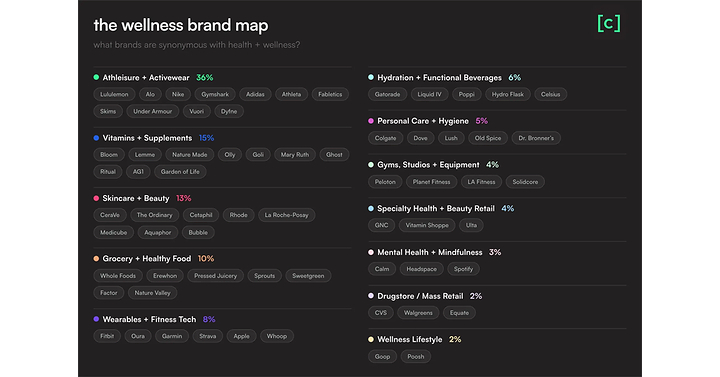
If you listen to young consumers, wearable brand loyalty is about identity fit as much as sensor specs. The same report shows how Gen Z maps the top devices to personas: Apple Watch corresponds to “life integration,” Oura to “fashionable,” Whoop to “athletic identity,” Garmin to “the serious runner watch,” and Fitbit to an “entry point” device. In other words, the device is a statement: about how you see yourself and how you want to be seen.
This matters in a market where wellness marketing is starting to sound like a scam to younger buyers. They distrust anything that feels too perfect, too fast, or too sure of itself, and they explicitly reward brands that admit limits, show proof, and clarify what effort the user still has to bring. The result is a paradox: they may be skeptical of trendy shortcuts such as GLP-1s and peptides—72% said they would not add GLP-1s to their health plan and 85% of Gen Z females reject peptides—while still showing strong attachment to wearables that feel aligned with their values and day-to-day life.
Trust, Personal Science, and What Comes Next
The most striking theme in this consumer intelligence is not the love of gadgets but the demand for honest tools. Young people are asking if drugs that promise fast change are fair, safe, or culturally healthy, and many are saying no. At the same time, they are turning to devices that help them pay closer attention to themselves, echoing the broader movement to revive spaces and resources for empirical self-research, newsletters, and even potential reunion conferences built around learning to observe.
We are likely heading toward a split future for health and wellness: products that oversell and under-explain will keep losing ground, while wearables and services that support long-term self-observation will deepen their foothold. One upcoming newsletter on using heart rate variability for self-observation, based on a proven framework, points to how this might look in practice. The brands that win Gen Z health wearables are not the loudest; they are the ones that help people become better observers of their own lives—and have the humility to say what their products cannot do.