
OLED vs mini-LED: what this gaming monitor showdown is about
OLED and mini-LED gaming monitors are two advanced display technologies that use different ways of controlling light—per-pixel emission versus dense backlight zones—to deliver higher contrast, improved HDR, and faster response times than traditional LCD panels for modern PC gaming. In short, OLED is the picture-quality purist, mini-LED is the bright workhorse, and both are now within reach at mid-range budgets as prices fall. If you play a lot of dark, cinematic games and care about motion clarity, OLED pulls ahead; if you need searing brightness, long sessions, and peace of mind about longevity, mini-LED makes more sense.
Manufacturers have pushed OLED and mini-LED gaming monitors down to prices where many mid-range PC builds can finally match their GPU with a premium screen. Recent 27-inch 1440p examples of both technologies can be had for under USD 350 (approx. ₱19,600), turning what used to be luxury gear into realistic upgrades for mainstream rigs. At the same time, panel supply is ramping sharply: one major producer has started mass production at a new OLED plant expected to ship 10 million panels in its first year alone. This wave of supply is already helping smaller OLED gaming monitors drop to more reasonable pricing and should keep high refresh rate monitors trending cheaper over time.
| Spec | KTC M27T6S (mini-LED) | Alienware AW2726DM (OLED) |
|---|---|---|
| Panel tech | Mini-LED IPS LCD with local dimming zones | QD-OLED with per-pixel lighting control |
| Size & resolution | 27-inch, 2560 x 1440 (1440p) | 27-inch, 2560 x 1440 (1440p) |
| Approx. price | Around USD 290 (approx. ₱16,240) | Around USD 350 (approx. ₱19,600) |
| Max refresh rate | 200 Hz native, 210 Hz overclocked | 240 Hz |
| Claimed response time | 1 ms (MPRT) IPS | 0.03 ms (grey-to-grey) OLED |
| Full-screen brightness | Can exceed 1,000 nits in some mini-LED models | Under 350 nits full-screen even on the latest OLEDs |
| HDR behaviour | Extremely bright in large bright scenes; can look harsh in SDR at full power | Superb perceived contrast in dark scenes; HDR "pop" drops on large bright areas |
| Burn-in risk | No burn-in risk; backlight-based longevity advantage | Potential burn-in over very long term, though evidence suggests most users are safe for years |
Image quality and HDR: contrast king vs brightness brute
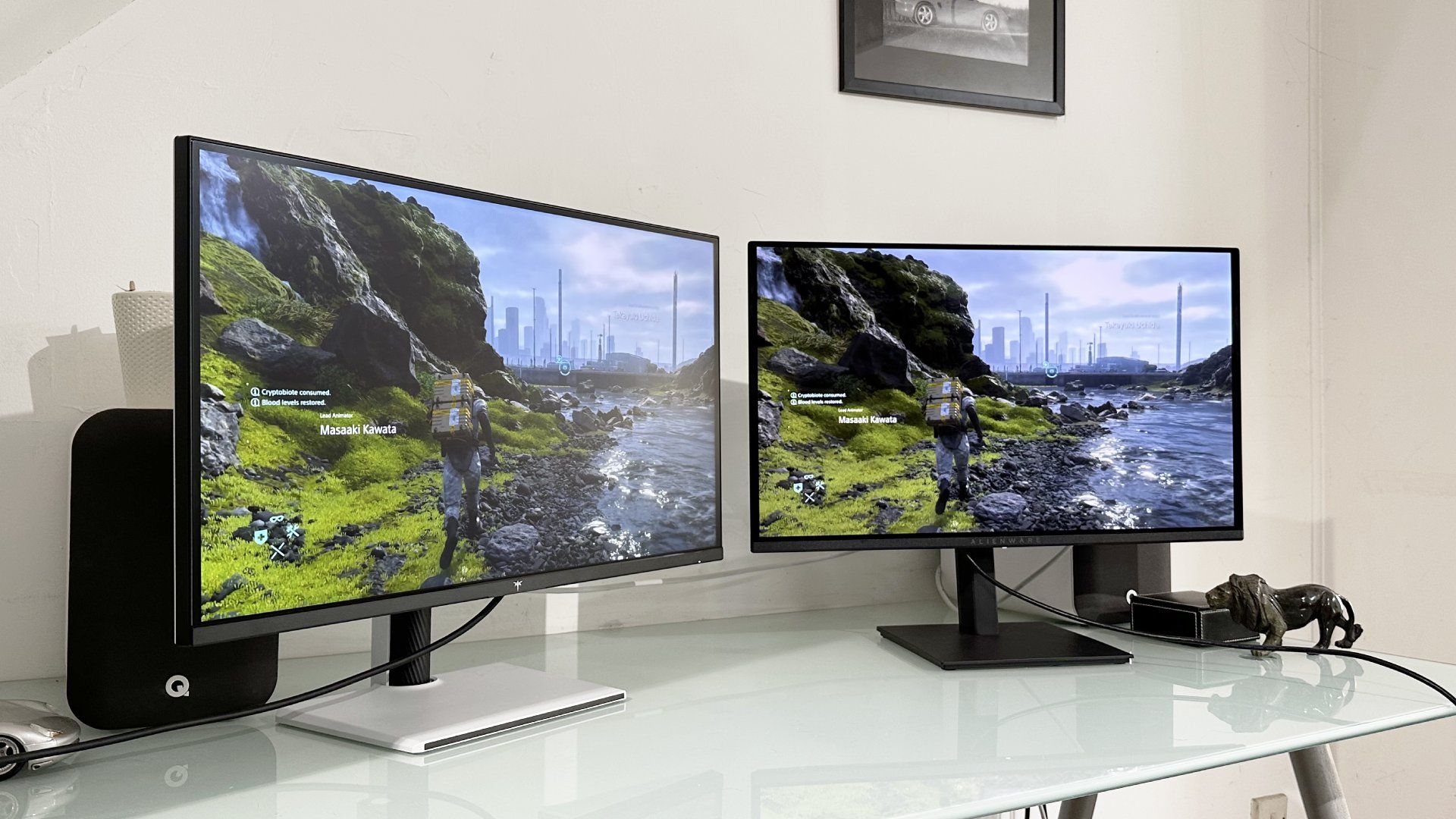
If you care most about image quality, this is where the mini-LED display comparison gets interesting. OLED gaming monitors like the Alienware AW2726DM control light on a per-pixel basis, so each of the 3.7 million pixels on a 1440p panel can switch off completely for perfect blacks. Mini-LED, as seen in the KTC M27T6S, still uses an LCD layer but adds roughly 1,000–2,000 independently controlled backlight zones for better local dimming. That sounds dense, yet each dimming zone still covers thousands of pixels, so in very dark scenes with small bright highlights, OLED pulls far ahead: the QD-OLED panel can “absolutely hammer” the mini-LED in shadowy game moments thanks to its deep blacks and lack of blooming around bright objects.
Brightness flips the script. The latest OLED gaming monitors tend to top out below 350 nits when the whole screen is bright. Mini-LED, on the other hand, can go far higher; some mini-LED monitors exceed 1,000 nits full-screen. In practice, desert scenes and sun-blasted environments show how mini-LED can “render the afternoon so bright that it almost hurts your eyes,” with the KTC staying retina-searingly bright while the OLED looks comparatively dull when lighting up most of the panel. The trade-off is comfort: in SDR content at full power, the KTC can be too bright for daily use, while both displays share a weakness in pixel density at 27-inch 1440p, making text and fonts less crisp than you might hope.
Speed, responsiveness, and who needs which performance
On paper, OLED wins the pure speed race. The Alienware AW2726DM runs at 240 Hz and uses a Samsung-supplied QD-OLED panel with a claimed 0.03 ms grey-to-grey response time. The KTC M27T6S mini-LED monitor hits 200 Hz, or 210 Hz if you enable its overclock, and lists a 1 ms response time using the more forgiving MPRT metric for its IPS panel. Those numbers point to a decisive edge for OLED in high refresh rate monitors, and it does feel snappier. Motion blur is lower, and input latency benefits slightly from the higher refresh ceiling, which matters if you aim for high frame rates with a powerful GPU.
In play, however, the gap is smaller than the specs suggest. The IPS panel in the KTC is quick enough that the difference to OLED is noticeable but not night-and-day. If the mini-LED were better in every other area, its slightly slower response would not be a deal-breaker. The exception is the most competitive esports scene, where raw latency is king. For players who live in fast online shooters, even these advanced 1440p gaming monitor technologies are not ideal: you are better off with the fastest 1080p TN high refresh rate monitors you can find at similar budgets, because for that use case speed beats everything else. For a mix of gaming and content creation, both OLED and mini-LED are fast enough; image trade-offs matter more than milliseconds.
Value, longevity, and the impact of cheap panels
Value is where mini-LED quietly fights back against the OLED hype. The KTC M27T6S sits around USD 290 (approx. ₱16,240), while the Alienware AW2726DM OLED gaming monitor lands closer to USD 350 (approx. ₱19,600). Both are strikingly affordable for 27-inch 1440p high refresh rate monitors with advanced backlighting and HDR-capable panels, especially considering that not long ago you had to pay far more to taste either technology. According to FlatpanelsHD, one new 8.6-generation OLED plant alone is expected to churn out 10 million OLED panels in its first year of mass production. Vast numbers of high-spec panels entering the market should keep pressure on prices, and we are already seeing smaller OLED gaming monitors drop to more reasonable levels over the last few months.
Longevity is the other part of the value story. Mini-LED relies on an LCD layer and a backlight array, so there is essentially no risk of burn-in; you can leave static HUDs, desktop elements, or editing timelines on screen without stress. OLED panels, in contrast, still carry a burn-in risk over long periods, even though evidence is building that most users are unlikely to see problems for many years with typical use patterns. For creators who leave UI elements or logos on screen all day, that peace of mind matters. On the flip side, OLED’s perfect blacks and fast response give it a higher “wow factor” in dark games and films, which might be worth the slight price premium if your usage is mostly cinematic gaming rather than static desktop workload.
Buy if / Skip if
- Buy the Alienware AW2726DM if you want the best contrast and dark-scene HDR for single-player and cinematic games, and can live with lower full-screen brightness.
- Skip the Alienware AW2726DM if you worry about OLED burn-in from static UI or run bright desktop workloads all day long.
- Buy the KTC M27T6S if you value extreme brightness, punchy HDR in wide bright scenes, and a lower price while still getting modern gaming monitor technology.
- Skip the KTC M27T6S if your room is dim and you are sensitive to eye strain from very bright SDR output even at moderate settings.
- Buy the Alienware AW2726DM if you want slightly higher refresh (240 Hz) and near-instant response for high frame rate play without stepping down to 1080p esports panels.
- Skip the Alienware AW2726DM if pure competitive performance in shooters is your only priority, because a cheaper 1080p TN esports monitor will still be faster overall.
- Buy the KTC M27T6S if you need a versatile screen for gaming plus content creation where longevity, no burn-in risk, and strong HDR in bright scenes matter more than perfect blacks.
- Skip the KTC M27T6S if you mainly play dark, atmospheric titles and care most about deep blacks without blooming, where OLED is clearly ahead.