
A Five-Year-Old GPU Becomes the New “New”
The RTX 3060 re-release is the return of Nvidia’s 2021 mid-range graphics processor in revised board designs like Palit’s GeForce RTX 3060 Infinity 2 OC, marketed anew to budget gamers as an affordable, memory-rich option despite relying on an older architecture and feature set.
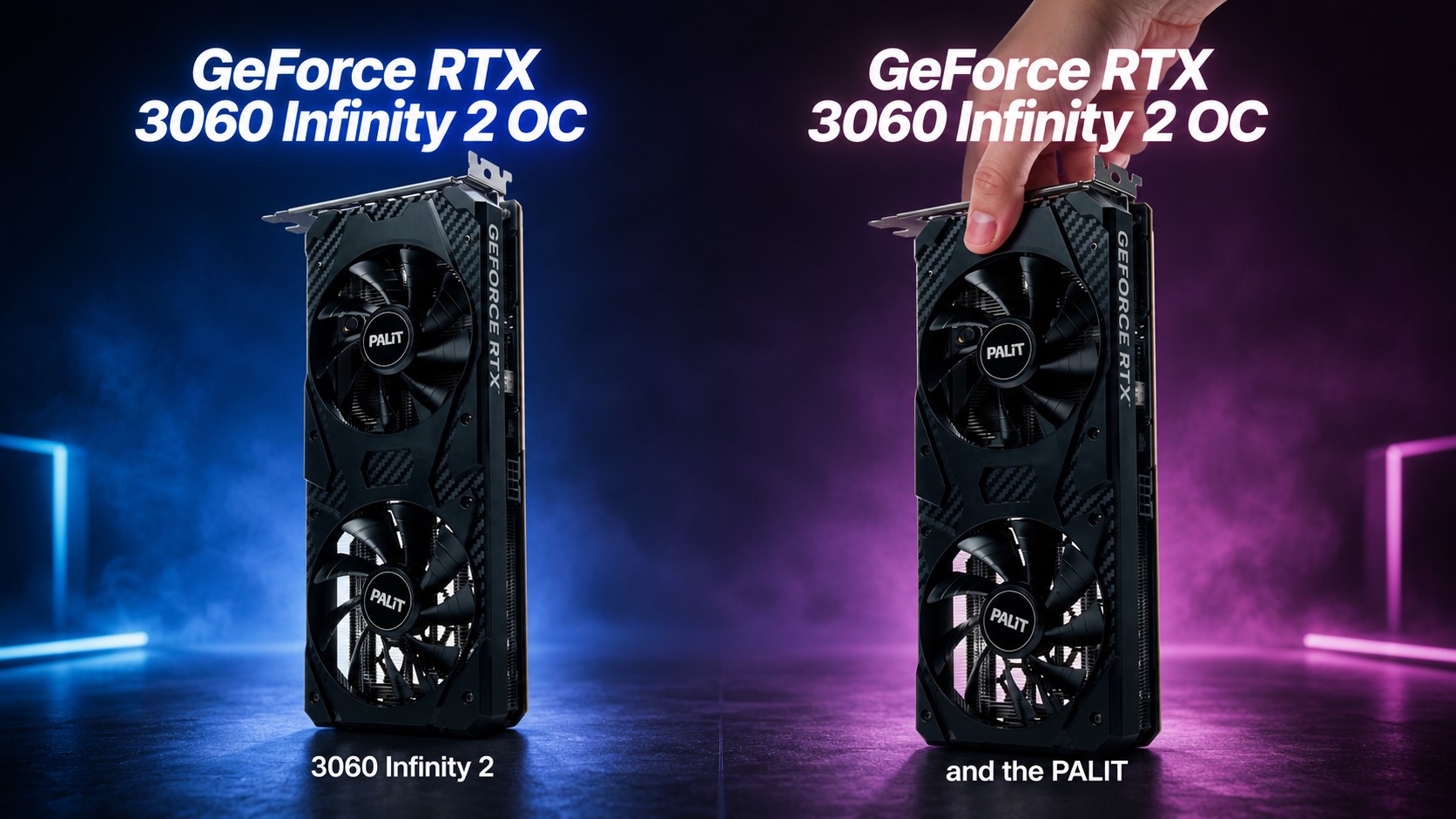
Palit Microsystems has officially announced the GeForce RTX 3060 Infinity 2 OC, a card built on Nvidia’s previous-generation RTX 3060 GPU that first launched in 2021. This is not a fresh architecture—it is a re-engineered board around the same 3,584 CUDA core chip, 192‑bit bus, and 12 GB of GDDR6 memory. The Infinity 2 adds a dual-fan cooler with a 0 dB silent mode under low load and a protective backplate to avoid PCB warping, but the underlying silicon is unchanged. What makes this noteworthy is not the specs; it is the context. Nvidia has effectively brought a five-year-old design back into production, and multiple partners including Colorful, Gigabyte, Manli, and now Palit are stepping in to sell it again.
In other words, Palit Infinity 2 is less a new product and more a symptom of a stressed GPU ecosystem trying to plug a growing hole at the low end.
AI Demand, Memory Squeeze, and the Strange Economics of Old Silicon
The real story behind the RTX 3060 re-release is not nostalgia; it is triage. Nvidia has revived a five-year-old architecture because the AI boom has twisted the semiconductor supply chain and made modern memory and advanced process capacity too valuable to waste on cheaper gaming cards. Explosive AI workloads are soaking up high-margin HBM and cutting-edge GDDR7, pushing manufacturers to prioritize data center parts over entry-level gaming products.
That is why the RTX 3060, built on Samsung’s older 8 nm process, suddenly looks attractive again. According to one analysis, this node offers better yields than TSMC’s pricey 5 nm (N5), giving vendors a cheaper, more predictable way to keep budget graphics cards on shelves while top-tier capacity is funneled into AI accelerators. It is telling that the idea of reviving last-generation cards reportedly surfaced after a journalist directly pressed Nvidia’s CEO at a major trade show—and production of the RTX 3060 then resumed. This is not a carefully planned product roadmap; it is an emergency workaround.
Palit’s Infinity 2 OC is being framed openly as a pragmatic "emergency stopgap" for a market distorted by AI-driven demand, not as the future of gaming.
Why a 12 GB RTX 3060 Still Matters for Budget Gamers
If the RTX 3060 is old, why resurrect it? Because mainstream gamers are voting with their wallets. The RTX 3060 is currently the most popular desktop GPU on Steam, with nearly 4% market share, while newer RTX 50 cards like the RTX 5060 sit below 3%. That kind of installed base is a blunt reminder: for 1080p players, "good enough" performance at a sane price beats bleeding-edge features.
Palit claims the RTX 3060 Infinity 2 OC delivers smooth, “ultra-stable” frame rates at 1080p, and that lines up with the chip’s proven history in modern games. Its 12 GB of VRAM is still a strong selling point in the entry-to-mid range, especially when many new titles are creeping past 8 GB usage with higher textures or ray tracing. The newer RTX 5060 and RTX 5060 Ti cap out at 8 GB, even though they are faster overall and far more efficient. According to one benchmark hierarchy, the RTX 5060 and 5060 Ti consistently outperform the RTX 3060 outside of 4K gaming.
So the trade-off is stark: more memory on a slower, older card, versus less memory paired with faster silicon and the latest features. For texture-heavy 1080p gaming without ray tracing, the Infinity 2’s 12 GB can still be compelling.

Pricing, Compromises, and Who Should Actually Buy Palit Infinity 2
Price is where the RTX 3060 re-release tries to earn its keep. One report notes that the RTX 3060 12 GB remains viable when you can find it under USD 300 (approx. ₱16,800). Another estimates Palit’s Infinity 2 OC will land around USD 329 (approx. ₱18,400), based on similar models. Meanwhile, the newer RTX 5060 is selling for around USD 350 (approx. ₱19,600), and the more powerful RTX 5060 Ti is available at about USD 369 (approx. ₱20,700).
On paper, that puts Palit’s card squarely in the budget graphics cards conversation. In practice, the value is trickier. The RTX 3060 lacks Nvidia’s latest tech such as frame generation and multi-frame generation, features that the RTX 50 series brings alongside DLSS 4.5 and better power efficiency. One report warns that many gamers may regret choosing an RTX 3060 that "does nothing except for bringing 4 GB more memory" over those newer options. For buyers who care about long-term support, that criticism hits home.
If your budget ceiling is rigid and you find an RTX 3060 Infinity 2 close to or below that sub‑USD‑300 mark, it can still be a rational purchase. But once pricing drifts toward RTX 50‑series territory, the smarter move is clear: look at an RTX 5060, RTX 5060 Ti, or even a used RTX 40 series card instead.
What Palit’s Move Signals About the Next Phase of the GPU Market
Palit’s Infinity 2 OC is not an isolated curiosity; it is a signal of how GPU makers will respond whenever AI crashes into gaming supply. As memory costs spike and state-of-the-art processes are reserved for high-margin accelerators, expect more "throwback" boards built on older nodes to backfill the low end. Samsung’s 8 nm process and the mature RTX 3060 design give vendors a safety valve when newer wafers and GDDR7 are too scarce or too expensive to waste on cheap cards.
From the consumer side, that means budget builders will see more Franken-products: familiar chips in fresh coolers and boxes, sold as if they were new. Palit already plans a standard-clock Infinity 2 variant in addition to the OC model, suggesting partners are ready to spin this silicon into multiple SKUs while the shortage lasts. According to one analysis, buyers starting from scratch are still better off with an RTX 50 series or a used RTX 40 card. That recommendation underlines the uncomfortable truth: the RTX 3060 Infinity 2 is less an upgrade path and more a pressure valve.
The conclusion for budget gamers is clear. The Palit Infinity 2 and other RTX 3060 re-releases are useful stopgaps in an AI-distorted market, not long-term anchors for new builds. Treat them as temporary compromises—worth considering at the right discount, but a reminder that in the era of AI, gaming is no longer the priority customer for GPU makers.