
Verdict: Third-Party Glass That Feels Surprisingly Native
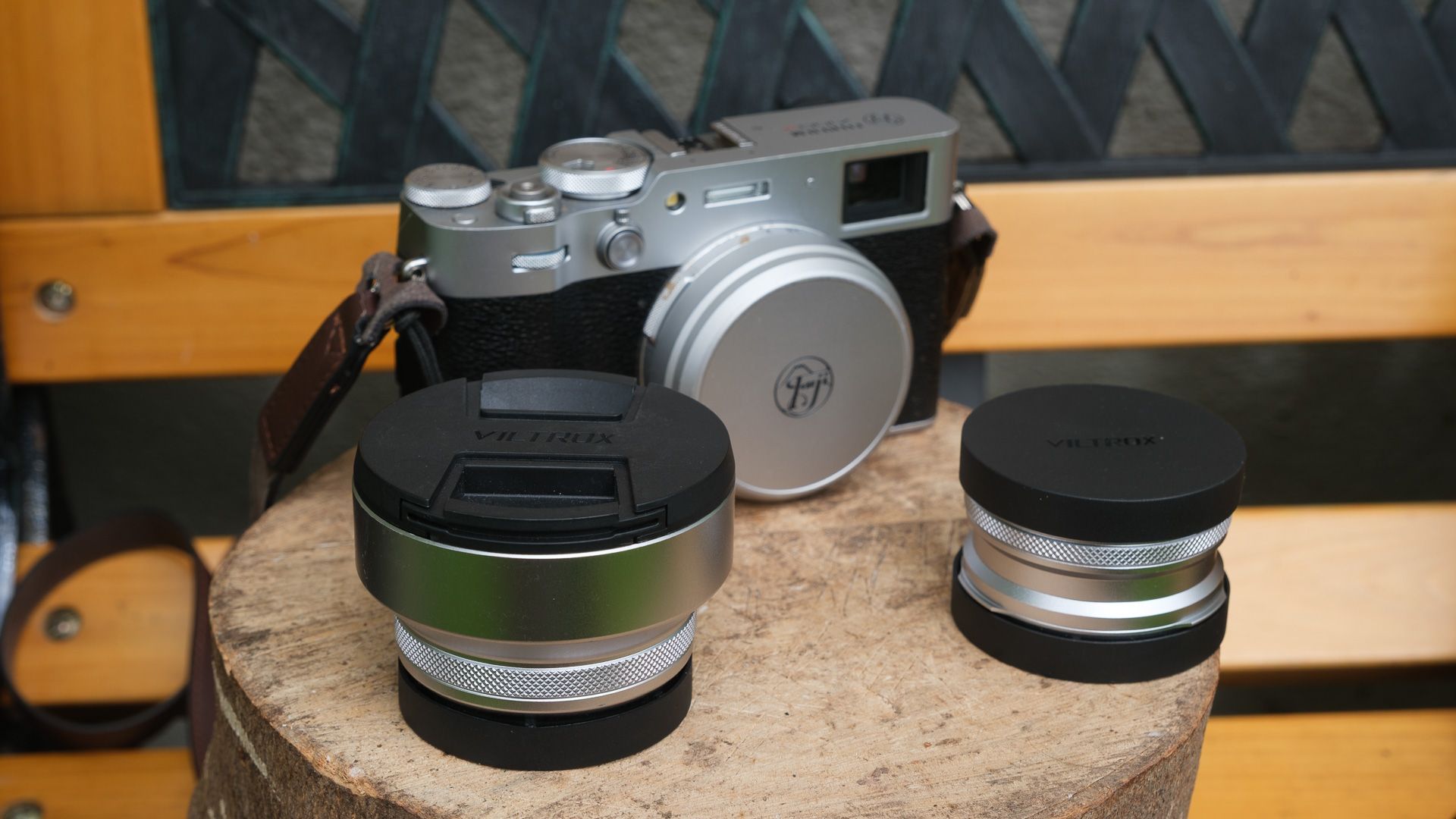
Viltrox converter lenses for the Fujifilm X100VI are screw-on tele and wide adapters designed to extend the camera’s fixed 23mm lens to a 28mm wide and 50mm-equivalent tele view while keeping size, weight, and handling close to the original camera package. At their price, they are more than "good enough"; they are strong alternatives to Fujifilm’s own adapters for most travel, street, and hybrid shooters. You get converter lens quality that closely matches the native options, autofocus behaviour remains unchanged, and the build feels solid and well-finished. The trade-off is a little extra weight and a specific flare issue in strong backlight, but the savings compared with native Fujifilm accessories are hard to ignore. If you are not a perfectionist pixel peeper, these third-party camera optics make a convincing case for skipping native glass.
Pros
- Converter lens quality that easily competes with Fujifilm’s own wide and tele adapters.
- Significantly lower prices than native Fujifilm X100VI accessories, with Viltrox often running sales.
- Solid build, with colour-matched silver and black versions that look and feel at home on the X100VI.
- Nano coating to help retain sharpness and minimise aberrations and chromatic dispersion.
Cons
- Noticeable flare when the sun is centred in the frame, which can be hard to control in some scenes.
- Rear caps on both Fuji and Viltrox adapters can wear and become loose over time.
- Metal-on-metal screwing raises a small risk of cross-threading if you are not careful.
Design, Build, and Handling: Third-Party That Looks Native
From the outside, the Viltrox WCL-X100VI wide converter and TCL-X100VI tele converter are clearly built to blend into the X100 series system. They come in silver and black finishes that match the camera closely, and they echo Fujifilm’s own adapters while adding a knurled ring for better grip, which also visually distinguishes them. Inside, both lenses use 5 elements in 4 groups, compared with Fujifilm’s 4-element designs, which explains roughly 50g of extra weight for the tele version. According to the review, "given the solid nature of the adaptors, and the amount of glass, I think the build quality exceeds the listed price." The screw-on mount is metal-on-metal, so Viltrox warns users to attach them carefully to avoid cross-threading. In daily use they feel secure and well balanced on the X100VI, but the rear caps could be better, as both brands’ caps tend to wear and loosen over time.
| Spec | Viltrox TCL-X100VI | Viltrox WCL-X100VI |
|---|---|---|
| Lens elements / groups | 5 elements in 4 groups | 5 elements in 4 groups |
| Effective focal length with X100VI | ≈32.3mm (50mm equivalent) | ≈18.6mm (28mm equivalent) |
| Diagonal field of view | 45° | 75° |
| Lens size | Φ69.2 × 45mm | Φ53 × 36.6mm |
| Weight | ≈230g | ≈130g |
| Filter thread | Φ67mm | Φ49mm |
Optical Performance: Close to Fujifilm, With One Gotcha
Converter lens quality is where these Viltrox optics stand out: in A/B comparisons against the native Fujifilm adapters, images were surprisingly similar once white balance was matched. The tele converter is described as "wonderfully sharp" in studio use and directly comparable to the Fujifilm TCL, with Viltrox clearly aiming to match that look and succeeding. You may see a touch more vignetting on the Viltrox tele converter, but it is subtle and far less intrusive than the dark corners observed with some other third-party camera optics such as Freewell. Both converters include nano coatings to keep sharpness high and reduce aberrations and chromatic dispersion. The big caveat is flare: in scenes with the sun centred in the frame, the reviewer found dramatic flare patterns that were unlike anything they had seen before. Tilting the camera helped, but if you often shoot backlit landscapes or sun-in-frame travel imagery, this is the main optical compromise you will need to manage.
Integration, Autofocus, and Value for X100VI Shooters
Mounted on the X100VI, the adapters screw on cleanly and are recognised by the camera, which displays a W or T icon on the screen. Viltrox achieves this through a magnetic mount and an integrated chip, embedding metadata so software like Lightroom Classic can automatically apply the correct lens correction and record the proper focal length (for example, 33mm for the tele). Autofocus speed and behaviour are essentially unchanged, since the adapters sit in front of the existing lens rather than replacing it. For travel shooters, the wide converter’s low weight makes it easy to carry as a near-weightless landscape option, while you can skip the tele and rely on digital zoom when you need reach, trading some of the X100VI’s 40MP resolution for packable simplicity. On price, the WCL-X100VI lists for USD 159 (approx. ₱8,900) and the TCL-X100VI for USD 189 (approx. ₱10,600), while Fujifilm’s equivalents are listed at USD 399 (approx. ₱22,400) each. That gap, combined with the strong optical performance, is the core of their value proposition.
Buy if / Skip if
- Buy the Viltrox converter lenses if you want Fujifilm-level converter lens quality at a much lower price and can accept minor vignetting.
- Skip the Viltrox converter lenses if flare control with the sun in the frame is critical to your work and you prefer the safest optical behaviour.
- Buy the Viltrox converter lenses if you shoot travel and street, need wider 28mm and longer 50mm views, and care about keeping your kit compact.
- Skip the Viltrox converter lenses if you are uncomfortable with metal-on-metal screw mounts and worry about possible cross-threading over time.
- Buy the Viltrox converter lenses if you already own an X100VI and want colour-matched, solid-feeling Fujifilm X100VI accessories that integrate well with metadata and corrections.
- Skip the Viltrox converter lenses if you rarely leave the native 35mm-equivalent view and would rather invest in a separate interchangeable-lens body instead.