

What the Tamron 12-20mm f/2.8 Is – And Who It Beats
The Tamron 12-20mm f/2.8 is a full-frame ultra-wide zoom lens available for Sony E and Nikon Z mounts that combines a fast constant f/2.8 aperture, compact dimensions, and a lower price than native pro zooms to give photographers a practical alternative for landscape, architecture, and night photography.
If you need an ultra-wide zoom lens that balances weight, cost, and professional control, the Tamron 12-20mm f/2.8 is the most compelling all-rounder. It undercuts Sony’s 12-24mm f/2.8 GM and Nikon’s 14-24mm f/2.8 S by a large margin while staying noticeably lighter in the hand. In return, you give up a bit of zoom reach and accept minor optical quirks at the long end and towards the edges. Photographers who live at 12–20mm and value portability will gain more than they lose; those who constantly need 24mm or museum-grade corner sharpness might be happier with the native giants.
Build, Handling, and Autofocus: Tamron’s New Direction
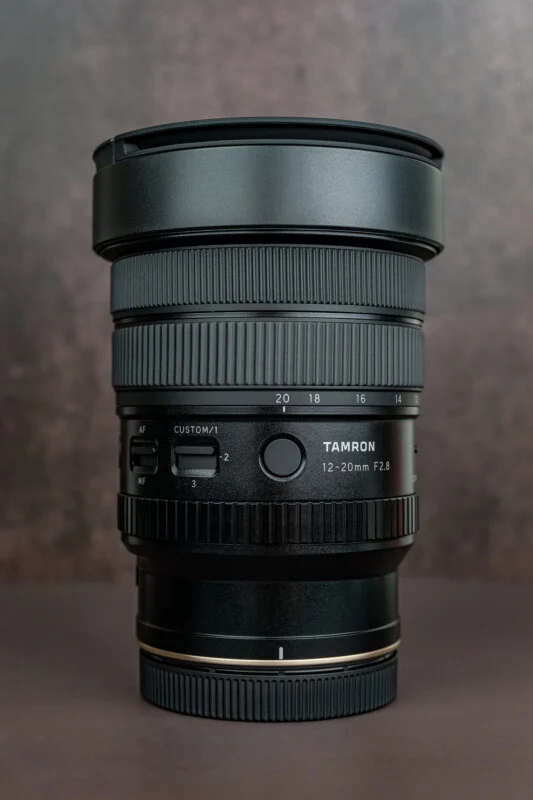
Tamron has redesigned this lens from the ground up, dropping the old naming maze and introducing a cleaner, darker finish with sleek lines and a feature-packed barrel. Despite its pro intent, the 12-20mm f/2.8 keeps weight to around 20 oz (about 570–585g), so it feels compact compared with native ultra-wide zooms. The fixed hood and internal zooming keep the length steady, which helps when working on gimbals or with carefully balanced tripod heads.
Controls are closer to flagship lenses than to budget third-party glass. You get a zoom ring, focus ring, customizable control ring, de-click switch, multiple programmable buttons, AF/MF switch, zoom lock, focus lock, and a USB-C port for configuration through Tamron’s utility app. According to the review sources, “this lens absolutely fits the bill of a professional optic” thanks to both weather sealing and the deep customization on offer. Autofocus uses Tamron’s fast linear voice-coil motor, delivering quiet, smooth, and quick jumps from near to far focus, which is a clear step up from older ultra-wide designs.

Weight, Price, and Hard Specs: Where Tamron Wins on Paper
On paper, the Tamron 12-20mm f/2.8 is built to undercut native Sony and Nikon options on both mass and money while retaining a professional constant aperture zoom specification. The Sony E-mount version weighs 20.2 oz (570g) and the Nikon Z version 20.7 oz (585g), which leaves them substantially lighter than Sony’s 12-24mm f/2.8 GM and Nikon’s 14-24mm f/2.8 S, both of which are heavier despite similar pro aspirations. You pay USD 1,699 (approx. ₱95,000) for E-mount and USD 1,799–1,800 (approx. ₱100,000–₱101,000) for Z-mount, around half the price of Sony’s 12-24mm f/2.8 GM and still USD 600–700 (approx. ₱33,000–₱39,000) less than Sony’s 12-24mm f/4 G and Nikon’s 14-24mm f/2.8 S in the same market.
| Spec | Tamron 12-20mm f/2.8 | Typical native ultra-wide 2.8 zoom |
|---|---|---|
| Focal length range | 12–20mm ultra-wide zoom | 12–24mm or 14–24mm ultra-wide zoom |
| Max aperture | Constant f/2.8 across the zoom range | Constant f/2.8 across the zoom range |
| Weight | Approx. 570–585g depending on mount | Heavier than 650g in comparable lenses |
| Mounts | Sony E, Nikon Z full-frame | Native Sony or Nikon only |
| Approx. price (USD) | USD 1,699–1,800 (approx. ₱95,000–₱101,000) | Around double or USD 600–700 more in the same class |
Real-World Image Quality: Strengths and Trade-Offs
In the field, the Tamron 12-20mm f/2.8 is tailored to landscape, architecture, and astrophotography, where its ultra-wide coverage and fast aperture matter most. Reviewers logged hundreds of frames of stars, landscapes, and close-up foregrounds, praising the mix of perspective, brightness, and close-focus ability for a varied portfolio. The constant f/2.8 aperture keeps exposure consistent across the zoom range, which is valuable when working through changing light or blending clips in video.
Optically, the lens is sharp in the center without feeling clinically harsh, but edges can soften slightly, especially at the extremes. There is light vignetting at 12mm and noticeable field curvature around 20mm, meaning the focus plane bends more than on some native peers. Bokeh is described as distracting and harsh, so this is not a lens you buy for creamy background blur. For sweeping scenes shot stopped down, these issues are minor; for flat copy work or subjects on the edge of the frame at wide apertures, native lenses still have the edge. If your work is dominated by stopped-down landscape and architectural images, the Tamron’s balance of detail and price is very hard to argue with.
Buy if / Skip if
- Buy the Tamron 12-20mm f/2.8 if you want a lighter ultra-wide zoom that is easier to carry than native f/2.8 competitors while keeping a professional feel.
- Skip the Tamron 12-20mm f/2.8 if you often shoot at 24mm and prefer a single lens that covers 12–24mm or 14–24mm without gaps.
- Buy the Tamron 12-20mm f/2.8 if you care about value and need pro-level control at a lower price than Sony and Nikon native ultra-wide zooms.
- Skip the Tamron 12-20mm f/2.8 if your work demands the flattest possible field and tack-sharp corners at 20mm for critical architectural or reproduction work.
- Buy the Tamron 12-20mm f/2.8 if you shoot a lot of landscapes, architecture, or astrophotography where a constant f/2.8 aperture and fast, quiet autofocus make a clear difference.
- Skip the Tamron 12-20mm f/2.8 if you prioritize smooth, attractive bokeh over wide-angle coverage, as its background rendering can be harsh.