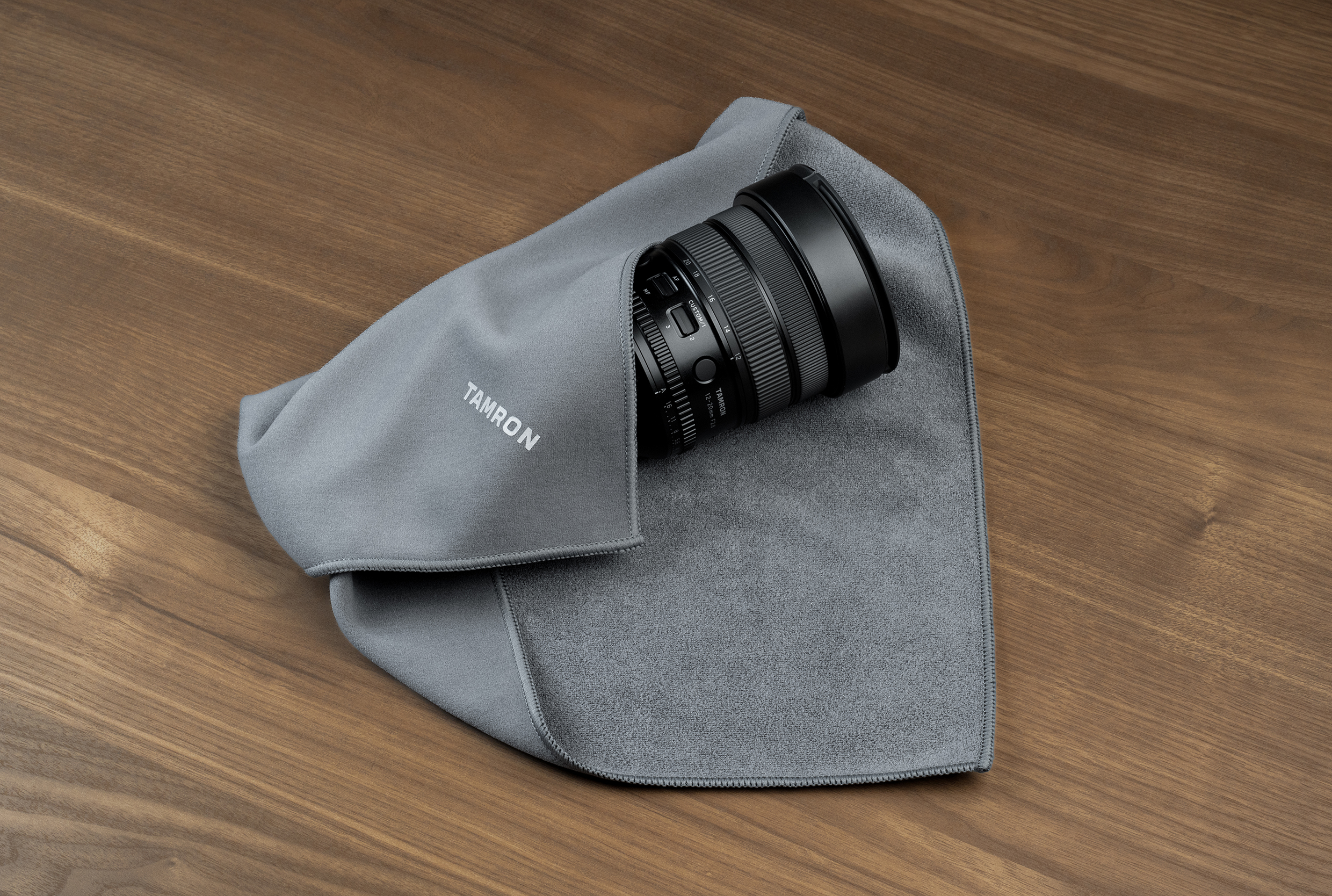

A 12mm Constant f/2.8 That Changes the Baseline
Tamron’s 12-20mm f/2.8 is a constant-aperture ultra-wide zoom lens for full-frame Sony E-mount and Nikon Z mount cameras, covering a 12–20mm focal range at f/2.8 throughout to deliver a lighter, more affordable alternative to existing ultra-wide options while still targeting demanding uses like astrophotography, interiors, and travel work. This lens matters because it pushes the category’s starting point from the usual 14mm down to 12mm, without dropping to a slower aperture or ballooning in size. By launching the Sony version on July 30 at USD 1,699 (approx. ₱95,000) and the Nikon Z version on August 27 at USD 1,799 (approx. ₱101,000), Tamron is not merely filling a gap; it is challenging the assumption that you must pay roughly double and carry an 800g-plus lens to get 12mm at f/2.8. For many shooters, that trade-off is no longer acceptable.
| Spec | Tamron 12-20mm f/2.8 | Typical Native Rival |
|---|---|---|
| Focal range | 12–20mm constant f/2.8 | 12–24mm or 14–24mm constant f/2.8 |
| Weight | 570g (Sony), 585g (Nikon) | Often 800g+ at similar specs |
| Price | USD 1,699–1,799 (approx. ₱95,000–₱101,000) | Around USD 3,000 for a 12–24mm f/2.8 (approx. ₱168,000) |
Constant Aperture and Compact Design: Why 12–20mm at f/2.8 Matters
The headline feature is simple but powerful: this is a constant aperture zoom that stays at f/2.8 from 12mm through 20mm. In practical terms, that means consistent exposure and faster shutter speeds across the range, which is crucial when you are shooting fast-changing light or pushing ISO at night. For astrophotography and nightscapes, holding f/2.8 lets you keep exposures shorter, limit star trailing, and avoid cranking ISO so high that noise takes over. For interior, architecture, and real estate work, 12mm pulls in tight rooms without forcing you to back against a wall, while the bright aperture helps in dim spaces where flash is either unwelcome or impossible. The impressive part is that Tamron delivers this in a lens that is only 4.7–4.8 inches long and weighs 570g for Sony and 585g for Nikon, far lighter than many constant-aperture ultra-wide rivals.
Tamron achieved this by limiting the zoom ratio to 1.67:1 (20 ÷ 12) instead of stretching to 2:1, and by using 17 elements in 12 groups, fewer moving groups than some competitors. It also omits optical stabilization on the premise that modern Sony E and Nikon Z bodies already provide in-body stabilization and that at 12–20mm, lens-based stabilization brings marginal benefits for the intended use cases. According to one early review, this “lets Tamron hit 570g and around USD 1,700 (approx. ₱95,000) where rival designs need roughly 847g and about USD 3,000 (approx. ₱168,000).” That quote underscores the point: Tamron is trading a slightly shorter zoom range and in-lens stabilization for weight and cost savings that most users will feel every day.
VXD Autofocus, Weather Sealing, and Real-World Reliability
On paper, the Tamron 12-20mm f/2.8 looks like a travel lens; in practice, the spec sheet says professional tool. Autofocus is driven by Tamron’s VXD (Voice-coil eXtreme-torque Drive) linear motor, which uses an electromagnetic principle similar to a loudspeaker coil to move focus elements quickly and quietly. For events, interiors, and video, that combination of speed and low noise is not optional—it is table stakes. The minimum focus distance of 7.1 inches at 12mm gives useful close-up capability for dramatic foregrounds or tight interior details. The barrel carries the expected rings and switches despite its compact size, and the lens includes moisture-resistant construction with a fluorine-coated front element, signaling that Tamron expects it to live on cameras in demanding conditions, not stay in a studio. In other words, the company is not treating this as a budget compromise; it is pitching it as a reliable daily driver.
Real-world feedback backs this up: early hands-on reviews are broadly positive, with autofocus behavior described as confident and consistent, and build quality judged to be in line with professional expectations at this price tier. The one caveat is filters. Because of the integrated, non-removable petal hood, you cannot screw standard front-thread filters onto this lens. Instead, you must cut sheet gel filters to fit a rear holder system, which is an undeniable workflow shift for landscape and architecture shooters who rely on ND or grad filters. Tamron has already acknowledged this friction and confirmed it is working with third-party filter manufacturers to create purpose-built inserts. That is a pragmatic response, but it also reveals the lens’s priorities: optical performance and compactness came first, convenience second.
Sagittal Coma Control and the 12mm Advantage for Sony and Nikon
Where the Tamron 12-20mm f/2.8 truly earns its place is in its optical ambitions. The lens uses one XGM (eXpanded Glass Molded Aspherical) element, three GM (Glass Molded Aspherical) elements, and multiple low-dispersion elements to suppress peripheral blur, color fringing, and, critically, sagittal coma flare. Sagittal coma is the aberration that turns stars near the corners into smeared bird-wing shapes at wide apertures—a long-standing headache for astrophotographers. Tamron claims to correct this at maximum aperture, and early reviewers have confirmed that stars stay point-sharp at f/2.8 instead of forcing you to stop down to f/4 or f/5.6. That single trait makes the lens compelling for anyone who spends nights under dark skies. At the same time, the corrected edges and wide 12mm field are a gift for interior architectural work, where straight lines and sharp corners are non-negotiable.
The 12mm starting point itself is not cosmetic. On a full-frame sensor, 12mm gives a diagonal angle of view of about 122 degrees, which can make a small room feel several feet larger and can fit a Milky Way arch plus foreground into a single frame without stitching. The nearest constant f/2.8 alternatives on Sony and Nikon either start at 14mm, cost significantly more, or both. For Sony E users, this lens comes in at roughly half the price of the comparable 12–24mm f/2.8 option while undercutting it on weight. For Nikon Z shooters, the impact is even sharper: before this release, there was no third-party autofocus ultra-wide zoom at 12mm on Z at any price, and no native 12mm option in Nikon’s own f/2.8 zoom lineup. The A084 gives them access to a 12mm constant aperture zoom for less than Nikon’s own 14–24mm f/2.8, which does not reach 12mm at all.
A Third-Party Shot Across Sony and Nikon’s Ultra-Wide Bows
Tamron’s 12-20mm f/2.8 is more than another third-party ultra-wide; it is a direct challenge to the way Sony and Nikon have framed this category. By arriving on Sony E-mount at USD 1,699 (approx. ₱95,000) and on Nikon Z-mount at USD 1,799 (approx. ₱101,000), the lens positions itself as a credible alternative to native ultra-wide zooms that either cost far more or start at narrower focal lengths. For Sony shooters, it raises an uncomfortable question: when a lighter lens gives you 12mm at f/2.8 for about half the price of a native counterpart, how much are you willing to pay for a brand logo and a slightly longer zoom range? For Nikon Z users, the story is simpler and harsher. Tamron has delivered something Nikon has not—a 12mm f/2.8 ultra-wide zoom—forcing Nikon to decide whether to respond or cede that space.
What comes next is easy to predict: more third-party pressure at the top end. Tamron has already signaled its seriousness with the optical design, VXD autofocus, weather sealing, and a body that balances portability with performance for travel and professional applications. The compact size and roughly 20-ounce weight make it practical to carry for landscape and travel use, not just special shoots. Meanwhile, the company is collaborating with filter makers to smooth out the only major usability complaint. If you shoot Sony or Nikon and rely on ultra-wide angles, this lens forces a decision. You can cling to native glass and accept higher prices and heavier bags, or you can acknowledge that third-party lenses like the Tamron 12-20mm f/2.8 now define what a modern constant aperture zoom should look like in the ultra-wide space.