
Verdict: A Serious Workstation Mini PC, If You Can Use Its Muscle
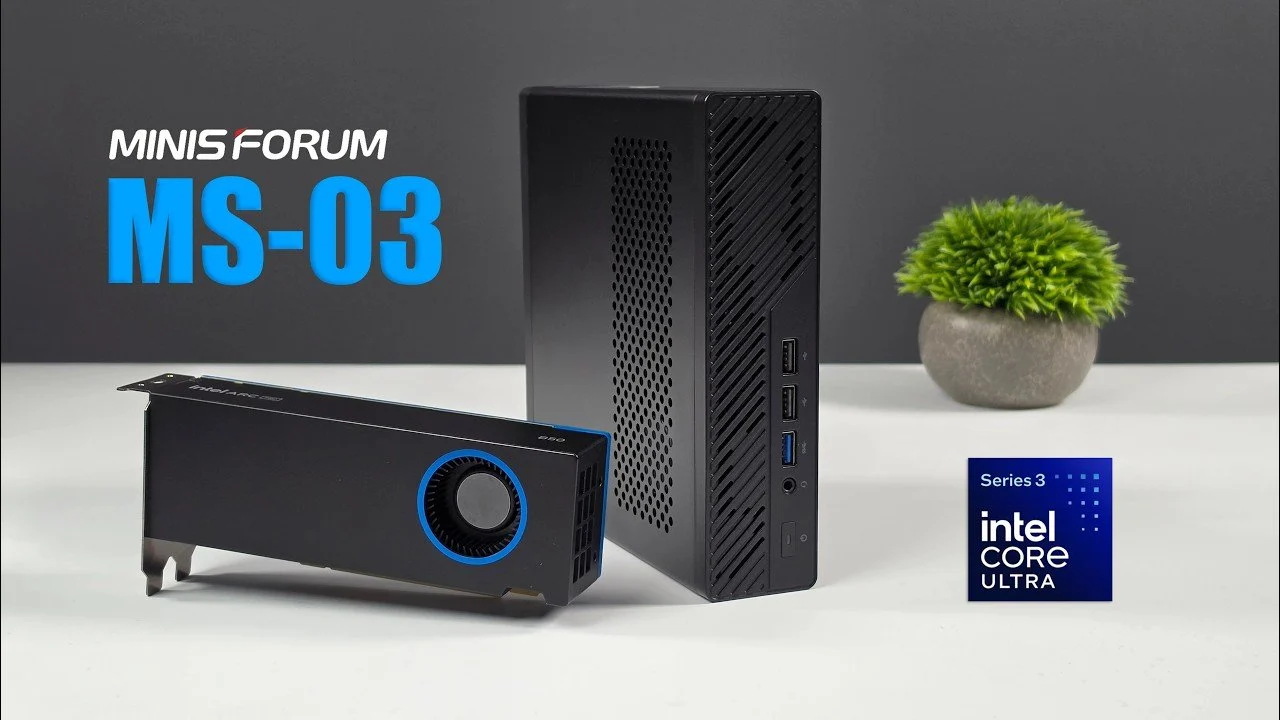
The Minisforum MS03 is a compact workstation mini PC built around Intel’s 16‑core Core Ultra 9 386H processor, combining high‑end multitasking performance, AI readiness, and advanced networking in a chassis far smaller than a traditional desktop tower, making it a realistic replacement for many full‑size workstations that need strong compute, fast storage, and serious connectivity in limited space. In practice, this is not a cute living‑room mini; it is a workstation for developers, virtualisation labs, and creative pros who benefit from dense compute and I/O more than from a big GPU and cosmetic flair. With the right workloads—AI inference, multiple VMs, high‑bandwidth storage, or 10G networking—the MS03 feels like overkill in the best way. For everyday office work, on the other hand, its capabilities will go underused and the premium it commands will be hard to justify, especially when pricing and full configurations are still to be announced.
Pros
- Desktop‑level performance from the Intel Core Ultra 9 386H in a compact form factor
- Designed for AI inference, virtualization, and enterprise networking workloads with advanced expansion options
- Extensive connectivity including dual 10Gb SFP+, 10GbE RJ45, 2.5GbE, Wi‑Fi 7, and USB 4
- Thoughtful thermal design with efficient cooling and dedicated M.2 cooling for sustained performance
- Highly upgradeable with up to 128GB DDR5 RAM, three PCIe 5.0 M.2 slots, and PCIe expansion for GPUs or accelerators
Cons
- Overkill for simple office or media‑consumption use where cheaper mini PCs suffice
- Full pricing, configurations, and international availability are not yet disclosed, making value hard to judge
Core Ultra 9 Performance: Pocket‑Sized, Workstation‑Grade
At the center of the Minisforum MS03 is the Intel Core Ultra 9 386H, a 16‑core chip engineered for demanding workloads and heavy multitasking. It combines four performance cores up to 4.9 GHz for tasks like 3D rendering and video editing, eight efficiency cores at 3.7 GHz for everyday compute, and four low‑power cores at 3.5 GHz to keep lighter tasks energy‑efficient. According to hands‑on benchmark testing, the MS03 posts Geekbench 6 scores of 2727 in single‑core and 15,323 in multi‑core, putting it solidly in workstation territory for a mobile‑class CPU. In real use, that means you can run several VMs, compile large codebases, or process high‑resolution media without the stutter you expect from typical mini PCs. The 80W TDP paired with a 240W power supply gives it room to sustain performance while maintaining reasonable power draw and thermal behaviour. For users who equate mini PCs with compromised speed, the MS03 proves that compact workstation performance is now very real.
Design, Thermals, and Expandability: A Mini That Thinks Like a Tower
What sets this workstation mini PC apart is how much tower‑class flexibility it squeezes into a compact shell. The MS03 supports up to 128GB of DDR5‑7200 SO‑DIMM memory across two slots, letting you build serious virtualisation or data analysis rigs. Storage is equally ambitious, with three PCIe 5.0 M.2 NVMe slots and an adapter for U.2 enterprise SSDs, so you can combine ultra‑fast scratch drives with high‑endurance, server‑style storage. Unlike most mini PCs, the MS03 includes a PCI Express x16 slot (used as PCIe 5.0 x8 in hands‑on testing) that accepts low‑profile, single‑slot GPUs, AI accelerators, or storage and networking cards. The removable top cover and efficient cooling system—including dedicated cooling for M.2 drives—make upgrades straightforward while keeping components within safe temperatures under load. Customisation extends to accessories and even 3D‑printed add‑ons, giving tinkerers room to adapt both function and style to their setup.
Connectivity, AI, and Networking: Built for the Lab, Not the Couch
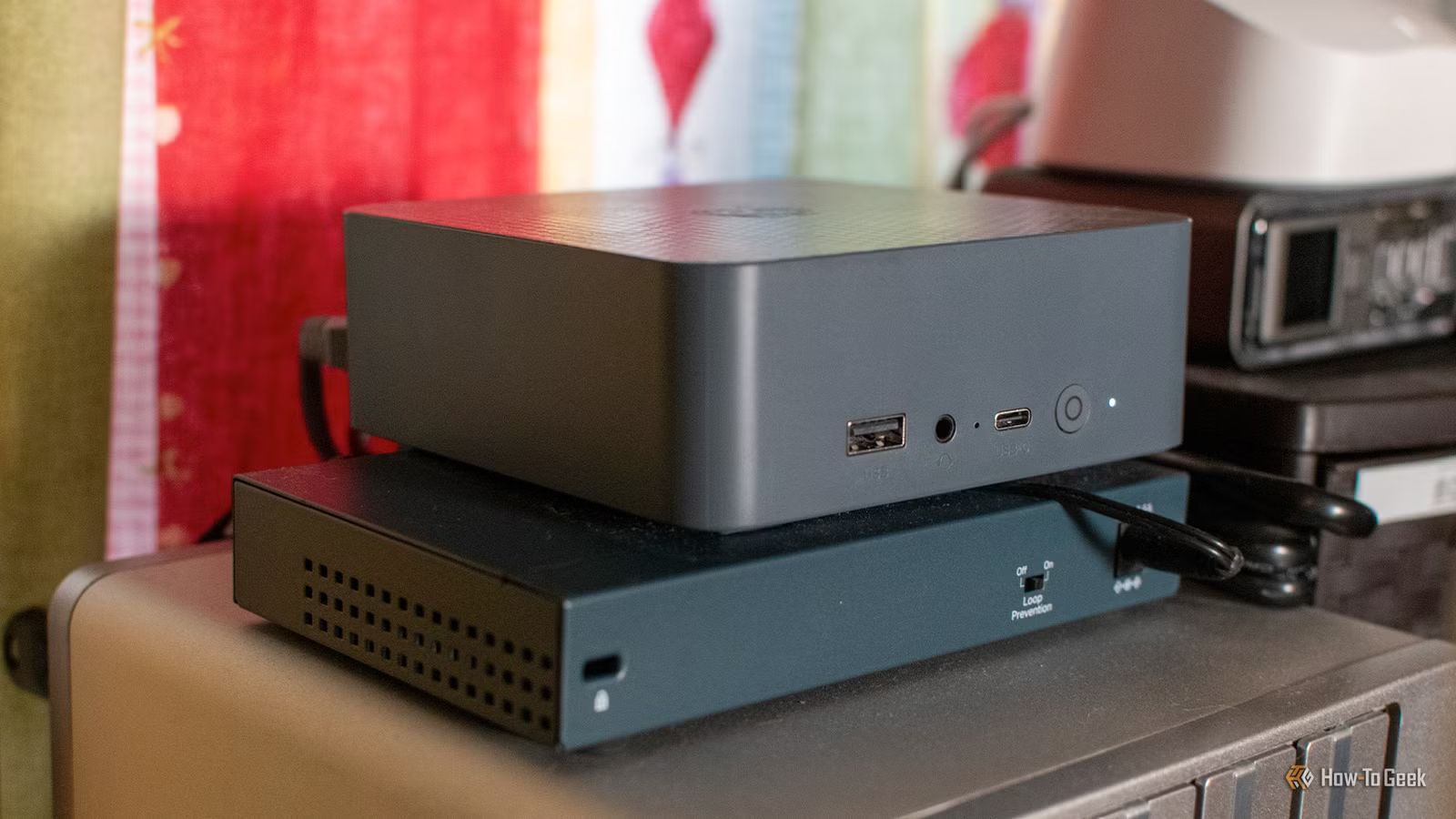
The Minisforum MS03’s connectivity is where it stops being a generic mini PC and starts looking like an edge server. On the front you get convenient access to the power button, audio jack, and USB ports, while the rear packs two USB 3.2 ports, dual 40Gbps USB 4, HDMI, plus dual Ethernet at 10Gbps and 2.5Gbps. The headline feature is dual 10Gb SFP+ ports driven by an Intel X710 controller, suitable for high‑bandwidth storage arrays and enterprise infrastructure, alongside dedicated 10GbE RJ45 and 2.5GbE ports and Intel BE211 Wi‑Fi 7. This network stack makes the MS03 ideal for AI inference nodes, virtualisation labs, and advanced home or office networking. In hands‑on tests, it delivers smooth 1440p gaming in titles like Cyberpunk 2077, Forza Horizon 6, and Red Dead Redemption 2 when paired with a suitable GPU, and it handles machine‑learning workloads efficiently, giving developers and researchers a compact local AI workstation that can run models such as Qwen3.5‑35B, Gemma‑4‑26B, and GPT‑OSS‑20B without relying fully on the cloud.
Value, Use Cases, and Availability
From a value perspective, the MS03 is clearly targeted at users who can exploit its workstation‑class features—AI developers, network administrators, homelab enthusiasts, and creative professionals who need dense compute and high‑speed storage rather than oversized GPUs. Its compact workstation performance stands out compared to traditional mini PCs that focus on basic office or media tasks. The promotional information so far mentions an ¥8,000 discount coupon for users registering via the company’s website, but beyond that, full pricing, configuration options, and broader availability have not yet been disclosed. Until those details are published, it is hard to say whether the MS03 will beat DIY small‑form‑factor builds on cost. Functionally, though, it already competes: if you need dual 10G SFP+, PCIe expansion, three PCIe 5.0 NVMe drives, and up to 128GB of fast DDR5 RAM in a mini PC, the MS03 is one of the few systems designed from the ground up for that role rather than treating expansion as an afterthought.
| Component | Key Spec | Workstation Angle |
|---|---|---|
| CPU | Intel Core Ultra 9 386H, 16 cores (P/E/LP mix) | Multitasking, rendering, AI workloads |
| Memory | 2× DDR5‑7200 SO‑DIMM, up to 128GB | Large datasets, many VMs |
| Storage | 3× PCIe 5.0 M.2 NVMe + U.2 SSD support | High‑speed scratch and enterprise drives |
| Expansion | PCIe x16 slot (PCIe 5.0 x8 use) | Low‑profile GPU or AI accelerator support |
| Networking | Dual 10Gb SFP+, 10GbE RJ45, 2.5GbE, Wi‑Fi 7 | Enterprise networking and edge computing |