
FSR 8x Multi-Frame: AMD’s Boldest Performance Bet Yet
AMD FSR 8x multi-frame technology refers to experimental driver-level settings for FidelityFX Super Resolution that promise to multiply a game’s base frame rate by up to eight times using multi-frame generation, dramatically increasing apparent smoothness without requiring equivalent raw rendering power from the GPU.
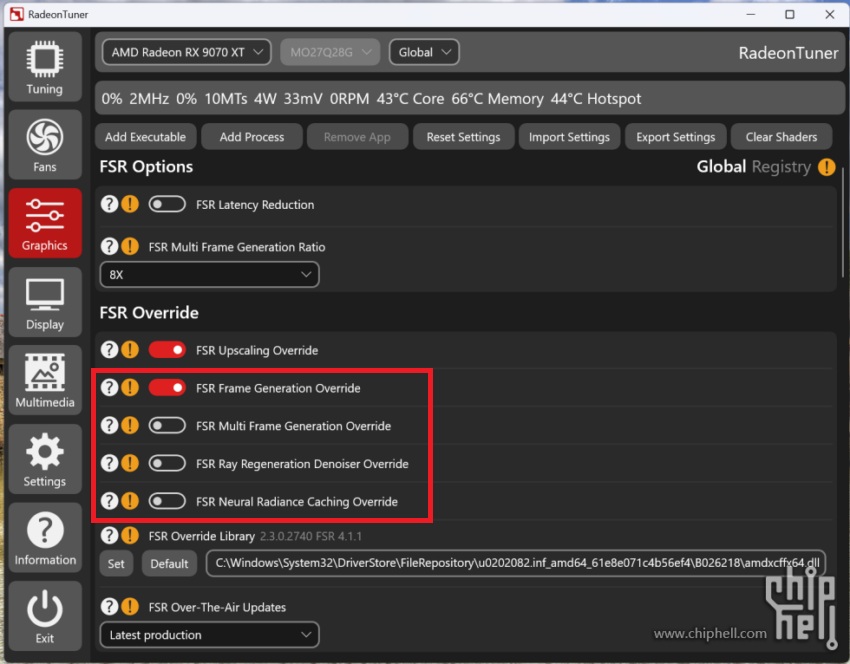
The headline is not the existence of frame generation technology; it is how far AMD seems willing to push it. Hidden variables discovered in the Adrenalin Edition 26.6.2 Radeon driver through a third-party tool reveal new overrides for FSR Ray Regeneration, Neural Radiance Caching, and Multi-Frame Generation. Those options include ratios from 1x all the way to 8x, theoretically turning 60 FPS into 480 FPS. This is AMD’s clearest statement yet that FSR is meant to become a full-stack performance platform, not just an upscaler. If even a conservative slice of that promise ships, the balance of power in high-end gaming could shift fast.
What the Hidden Radeon Driver Update Really Tells Us
The discovery matters less for what works today and more for what it confirms about AMD’s roadmap. The new Multi-Frame Generation, Ray Regeneration, and Neural Radiance Caching toggles appeared as non-functional, hidden options starting with AMD Software Adrenalin Edition 26.6.2. They were exposed by RadeonTuner, an open-source alternative control panel that surfaces internal driver variables. According to the RadeonTuner developer, the 1x–8x ratios are placeholders that AMD sometimes seeds months before real functionality appears. In other words: this is not a marketing slide, it is plumbing being laid in the driver stack. The fact that AMD is wiring in overrides for all three pieces—upscaling, ray-related reconstruction, and multi-frame generation—strongly suggests a coordinated next-generation FSR release rather than a one-off experiment.
Up to 8x Frames: Ambition, Not Guaranteed Reality
The raw numbers are wild: AMD’s internal interface exposes Multi-Frame Generation ratios of 1x, 2x, 3x, 4x, 5x, 6x, 7x, and 8x, enough to turn 60 FPS into 480 FPS. That theoretical ceiling is about twice what current rival frame generation solutions on recent GPUs are said to reach. One clear quotable takeaway is this: “In theory, FSR Multi-Frame Generation could boost a base frame rate of 60 FPS to as high as 480 FPS, which is around 2x higher than what Nvidia currently offers on its RTX 50 series GPUs.” But that “in theory” caveat is everything. The driver entries are explicitly experimental, and there is no promise that an 8x mode will ever ship in consumer-ready form. Expect AMD to dial these ratios back to what is visually acceptable and technically reliable, rather than chase headlines at any cost.
FSR as AMD’s Full Answer to Rival Frame Generation
This is the most aggressive sign so far that AMD intends FSR to stand toe-to-toe with competing frame generation ecosystems, not play catch-up indefinitely. The hidden driver work closely mirrors an AI-powered rendering suite recently confirmed for a next Xbox platform—codenamed Project Helix—which will feature FSR Diamond, including machine learning upscaling, ray regeneration, and Multi-Frame Generation. Put bluntly, AMD is converging on the same three pillars: upscale fewer pixels, reconstruct lighting, and fill in extra frames. The twist is that FSR has always been pitched as vendor-agnostic, and planting these hooks in the Radeon stack hints at an attempt to unify console and PC technology. If AMD manages to align FSR Diamond and these Radeon driver capabilities, rival ecosystems will face a far broader and more flexible performance solution than a single, GPU-locked feature.
Still in the Lab, But the Direction Is Clear
For now, Multi-Frame Generation in the driver is nothing but scaffolding. The options do not function without future FSR libraries, and the higher 3x–8x modes are reportedly limited to RDNA 4 and newer GPUs. AMD has not committed to shipping 8x frame generation, yet the presence of these hooks signals that the company is testing exactly that, with a broader FSR update hinted for later this year. The more interesting quote is implicit: AMD is tired of incrementalism. Instead of cautiously matching a rival’s features, it is experimenting with frame multiplication levels that, if viable, would redefine what a “gaming performance boost” looks like. Whether the final release lands at 2x, 4x, or beyond, the message from the driver code is unmistakable—FSR’s next chapter is about scale, not subtlety.