

Steam Frame Is Quietly Turning Into A Full VR Platform
The Steam Frame VR headset is Valve’s upcoming standalone device that can run games on its own hardware, play standard PC titles on a virtual screen, and stream more demanding PC VR games over a dedicated wireless link, signaling a push toward a flexible, PC-connected virtual reality platform rather than a single-purpose gadget.
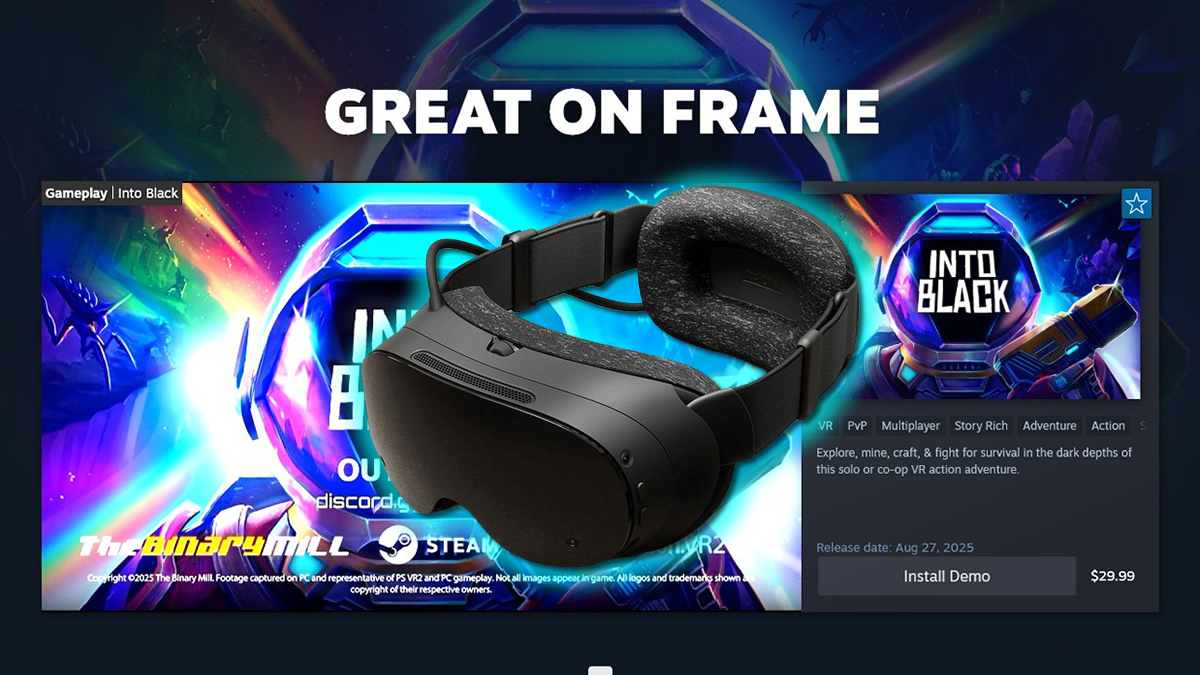
The important news is not that Valve has a new headset, but that it is already treating Steam Frame as a curated ecosystem. Valve has launched a “Great on Frame” page on Steam to highlight games that run well on the device, echoing the “Great on Deck” strategy it used to turn a quirky handheld into a serious platform. This is a clear statement of intent: Valve wants players to feel confident that Steam Frame will work on day one, with a guided library instead of a random pile of VR experiments.
From Four Titles To Eight: Early Library Growth Matters
At launch, the Great on Frame page carried only four titles: Portal 2, Into Black, Aperture Hand Lab, and The Lab. That list looked more like a proof of concept than a platform pitch, especially since two of them are Valve’s own VR tech demos and Portal 2 is not even a VR-native game. It suggested Valve was still in the “make sure it runs” phase rather than building a system people can live in.
Now the page lists eight titles, with new additions Ancient Dungeon and Underdogs bringing fresh, third‑party VR content into the mix. Both have earned the Steam Frame Verified badge, meaning they are fully compatible with default controls, graphical settings, controller icons, and legible text. That is more than a headcount milestone. It shows external developers are willing to target the Valve VR platform early, trusting that Steam Frame will be relevant enough to justify native support, including an Android build in Ancient Dungeon’s case.

“Great on Frame” Is VR Game Optimization As A Selling Point
The Great on Frame page is not a marketing banner; it is an optimization promise. Games that appear there have been rated Playable or Verified for the Steam Frame, with Verified indicating they behave as expected without tinkering. One quotable takeaway is: “Both of these games were given the Steam Frame Verified badge, marking that both of them are completely compatible with the default controller configuration and graphical settings, it shows the correct controller icons, and the text is legible.”
In a VR market where users are tired of tweaking supersampling sliders and controller bindings, this matters. VR game optimization is being turned into a front‑end feature: click into the store on FrameOS and you land on a curated page that leads you toward experiences that feel built for the headset instead of barely supported ports. Combined with Valve’s PC wireless adapter for stable, low‑latency streaming, the message is blunt: this is a Valve VR platform with standards, not an open‑ended compatibility lottery.
Why Ordinary Players Should Care About Curation
For everyday players, the most important part of Steam Frame is not raw specs but predictability. The Great on Frame list gives buyers a simple filter: if it is on the page, it should run well on the headset. That cuts down on refund roulette and Reddit troubleshooting, the two hidden taxes of early VR adoption. It is also similar in spirit to the Steam Deck’s “Great on Deck” entry point, which turned a chaotic PC library into a console‑like experience without abandoning openness.
Steam Frame’s ability to run both dedicated VR experiences and standard PC games on a virtual screen broadens its appeal beyond VR enthusiasts. Pair that with microSD storage expansion, something competitors skip, and the value proposition becomes clearer: this is a flexible, user‑friendly device that respects your existing library and your need for space. Curation here is not about locking people in; it is about making the PC‑grade freedom of Steam less painful to use in a headset.
A Growing Catalog Points Toward An Imminent Launch
Valve has not announced a release date, but its behavior around the Great on Frame page reads like a countdown. Observers note that “every day, we are moving closer and closer to the Steam Frame release announcement,” and that while there is no firm date, it looks likely to land “very soon.” The slow but steady trickle of new Verified titles supports that reading: Valve seems to be staging its ecosystem so that the store and catalog feel alive the day hardware preorders open.
Valve itself expects to add more games to the Great on Frame list over time, and the total has already doubled from four to eight. That is still small compared to established VR ecosystems, but the pattern matters more than the absolute number. Third‑party developers are shipping native builds; Valve is formalizing VR game optimization as a visible badge; and the store already has a default landing page for the headset. All signs point to Steam Frame launching not as an experiment, but as a confident new pillar of the Valve VR platform.