
Verdict: A Mainstream 3D V-Cache CPU That Finally Makes Sense
The Ryzen 7 7700X3D is an 8-core, 16-thread Zen 4 AM5 processor with 3D V-Cache that targets gamers and efficiency-focused users who want near-flagship frame rates and strong performance-per-Watt at a more accessible USD 329 (approx. ₱19,300) price point. From a value perspective, this chip lands in an interesting spot: it delivers roughly 98% of the Ryzen 7 7800X3D’s overall performance while drawing less power and undercutting it on price. For a budget gaming CPU, that is a convincing pitch. However, the 7700X3D is built on older Zen 4 rather than Zen 5, and in some markets it currently sells close to newer X3D models, which dulls its value story. My bottom line: if you are building a mainstream AM5 gaming rig and care as much about efficiency and platform longevity as pure frames, the 7700X3D is easy to recommend; if you chase the latest architecture at any cost, it is not.
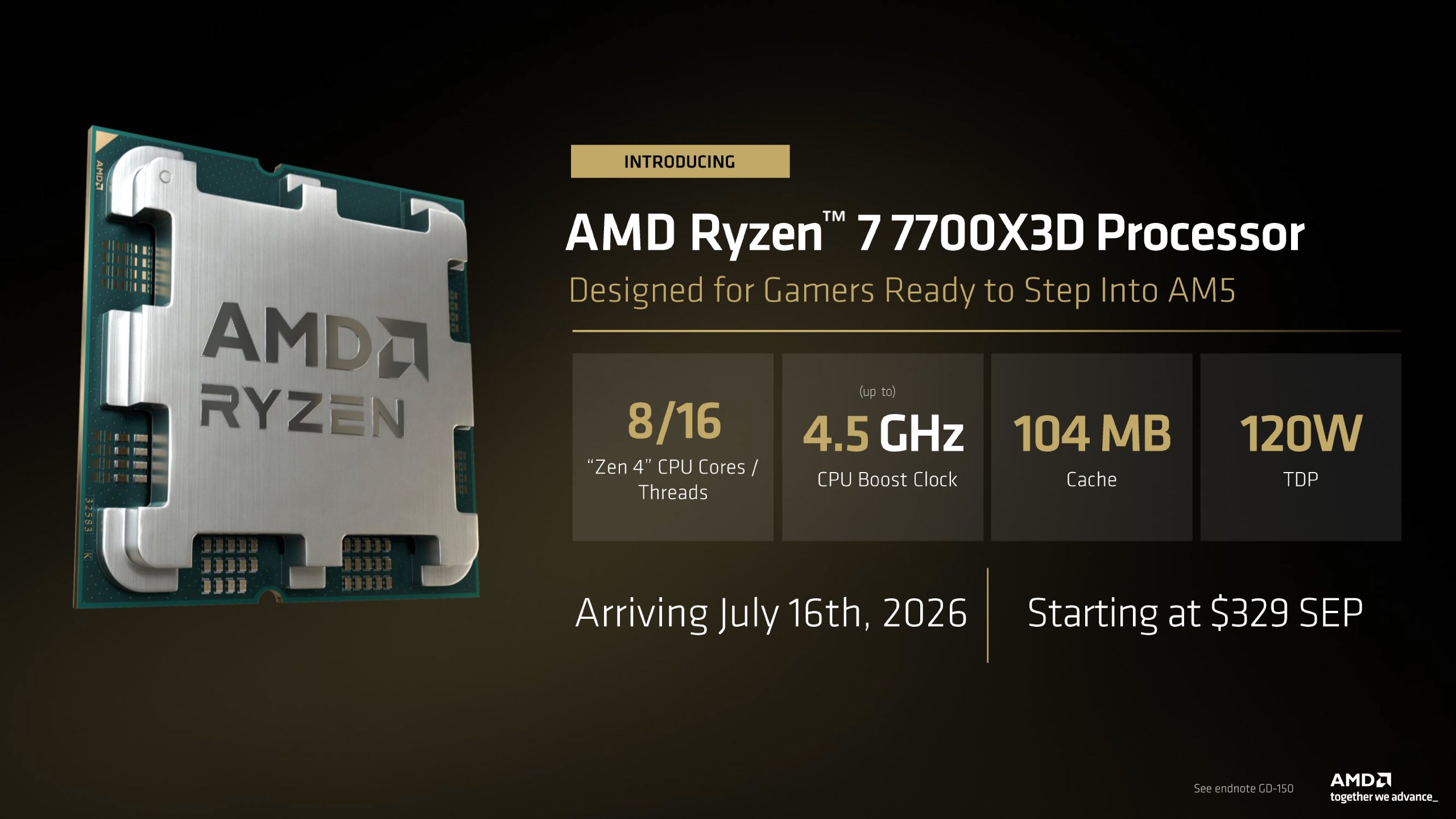
| Spec | Ryzen 7 7700X3D | Notes |
|---|---|---|
| Architecture | Zen 4 | Single CCD with 3D V-Cache stack for gaming workloads. |
| Cores / Threads | 8 / 16 | Same core count as 7700X and 7800X3D. |
| Base / Boost Clock | 4.0 / 4.5 GHz | Lower boost than 7800X3D, tuned for efficiency. |
| Total Cache | 96 MB L3 + 8 MB L2 (104 MB total) | Large 3D V-Cache for cache-sensitive games and HPC. |
| Socket / Memory | AM5, DDR5-5200 | Fits AMD’s long-lived AM5 platform roadmap. |
| TDP | 120 W | Real-world loads stay well below this. |
| Launch Price | USD 329 (approx. ₱19,300) | Cheapest 8-core X3D chip on AM5 to date. |
Architecture, Design and Platform Value
Under the heat spreader, the Ryzen 7 7700X3D combines AMD’s Zen 4 architecture with a single CCD and one 3D V-Cache stack. This single-CCD layout matters: game threads stay on one die, avoiding cross-CCD latency and scheduling complexity that can hurt consistency in some titles. The chip keeps the familiar 8-core/16-thread configuration but adds 64 MB of extra L3, bringing total L3 cache to 96 MB plus 8 MB of L2, for a 104 MB aggregate cache pool. It runs at a 4.0 GHz base and 4.5 GHz boost frequency, clearly tuned below the Ryzen 7 7800X3D and other Zen 4 8-core parts, trading a bit of peak clock for cooler operation. As an AM5 processor, the 7700X3D plugs into a platform AMD plans to support through at least 2029, which significantly improves its long-term value for builders planning future CPU upgrades. Combined with official DDR5-5200 support, it pairs well with affordable midrange boards and memory kits, making the jump from AM4 less painful.

Gaming and 3D V-Cache Performance: Near-Flagship Frames
The core reason to consider the Ryzen 7 7700X3D is 3D V-Cache performance. AMD positions it squarely as a gaming CPU, and the formula is familiar: large L3 cache helps keep more game data close to the cores, improving frame rates in cache-sensitive titles. Despite the lower 4.5 GHz boost clock, independent testing shows the 7700X3D delivering 97.8% of the Ryzen 7 7800X3D’s performance on a geometric mean across a diverse Linux benchmark suite. That result covers both gaming-related and productivity workloads, indicating that the trimmed clocks do not meaningfully blunt its appeal for mainstream gaming. 3D V-Cache also shines outside games; in computational fluid dynamics workloads such as OpenFOAM, Incompact3D and CloverLeaf, the chip performs above its price class thanks to the large cache pool. In CPU-based AI inference using OpenVINO, the combination of single-CCD design and AVX-512 support cuts latency, further expanding the chip’s use cases beyond entertainment. For most builders, this means near-flagship gaming performance plus credible HPC and AI capabilities in a single budget-friendly package.
Power Efficiency: Less Heat, Cheaper Cooling
Where the Ryzen 7 7700X3D manages to stand apart is efficiency. Its rated thermal design power is 120 W, but in a wide Linux test suite run on Ubuntu 26.04 with a modern kernel, it never exceeded 90 W under load. Average draw across tests landed at just 61 W, peaking at 90 W, compared with the Ryzen 7 7800X3D’s 68 W average and 95 W peak. Intel’s Core Ultra 5 245K, by contrast, averaged 85 W and spiked to 159 W in the same suite, showing how comparatively power-thrifty the 7700X3D can be. A default Linux kernel build completed in 96 seconds on this chip, only a hair behind the 7800X3D, while again consuming less power—68 W on average versus 75 W. Similar behavior appeared in SVT-AV1 video encoding: the 7700X3D slightly trails the 7800X3D in speed but saves energy. For real users, this translates into easier cooling, quieter systems, and lower electricity use, especially in always-on roles like CI/CD farms, small office servers or compact gaming PCs where thermal headroom is limited.
Pros
- Near-flagship 3D V-Cache gaming performance at a lower USD 329 (approx. ₱19,300) price point, delivering 97.8% of Ryzen 7 7800X3D performance while costing about 78% as much.
- Best-in-class efficiency for an X3D chip, with average power draw around 61 W and peak under 90 W in comprehensive Linux testing.
- Cheapest 8-core X3D processor on the AM5 platform, easing the upgrade path for existing and prospective AM4 owners.
Cons
- Built on older Zen 4 architecture and slower boost clocks than newer Zen 5 X3D models, so it is not the fastest choice.
- Launch and early street pricing can overlap with the superior Ryzen 7 9800X3D, making it a weaker value until its price settles below that chip.
Market Position: Budget Champ With Pricing Caveats
On paper, the Ryzen 7 7700X3D is the budget X3D champ for AM5: it is the cheapest 8-core 3D V-Cache CPU on the platform so far, intended to entice the large AM4 audience to upgrade. According to one technical review, "If you are a student or hobbyist, the 8-core Ryzen 7 7700X3D offers very nice value and efficiency," especially for CI/CD test farms where sheer throughput is not critical. Yet the real market is messy. The Ryzen 7 7800X3D’s street price has fallen around USD 419 (approx. ₱24,600), and the Zen 5-based Ryzen 7 9800X3D sits near USD 444 (approx. ₱26,000), putting the USD 329 (approx. ₱19,300) 7700X3D in a narrow gap between discounted older models and newer architecture. In some regions, local pricing even makes the 9800X3D cheaper at launch than the 7700X3D, prompting commentary that you "should choose the Zen 5-based Ryzen 7 9800X3D" unless you specifically need the 7700X3D’s efficiency characteristics. AMD’s own guidance compares it against higher-tier Intel Core Ultra 7 chips in gaming; when it wins there, lower-tier Intel parts are naturally covered. As pricing settles, the 7700X3D is poised to become a favorite among efficiency-minded builders who value AM5 processor value over bleeding-edge specs.
Buy if / Skip if
- Buy the Ryzen 7 7700X3D if you want a budget gaming CPU with 3D V-Cache performance that is within about 2% of a Ryzen 7 7800X3D while costing significantly less and drawing less power.
- Skip the Ryzen 7 7700X3D if you can afford a Zen 5 X3D chip such as the Ryzen 7 9800X3D, especially in markets where that newer part sells at a similar or lower price.
- Buy the Ryzen 7 7700X3D if you are a student, hobbyist or AM4 upgrader building an efficient AM5 system for gaming, CI/CD test farms or light HPC and AI workloads on a tight budget.
- Skip the Ryzen 7 7700X3D if you prioritize raw multi-threaded speed or the absolute highest clocks over efficiency and are willing to pay more for faster Ryzen 7000 or 9000-series alternatives.
- Buy the Ryzen 7 7700X3D if you care about AM5 processor value and long-term platform support through 2029+, and want cooler, quieter operation with simpler cooling requirements.