
Zen 6: AMD’s New Anchor for High-End x86 Computing
AMD Zen 6 processors are the company’s next-generation CPU architecture, confirmed to debut as the sixth iteration of its x86 Zen design and expected to underpin future desktop, server, and workstation chips with higher single‑threaded and multi‑threaded performance, larger cache configurations, and tighter integration with AI‑oriented hardware for demanding computing workloads. That matters because Zen has become the backbone of AMD’s comeback story; each generation has pushed performance and efficiency forward while keeping x86 compatibility intact. With Zen 6, AMD is not quietly iterating—it is signaling that x86 is still central to modern infrastructure and that the flagship CPU fight is far from settled. The key takeaway: if leaked data holds, Zen 6 could force both rivals and users to rethink what they expect from high-performance computing CPUs.
Official Debut at Advancing AI: A Strategic Stage for Zen 6
AMD has officially confirmed that processors based on the Zen 6 microarchitecture will make their debut at the Advancing AI 2026 conference on July 22–23. The launch timeline was first confirmed by Executive Vice President and Chief Technology Officer Mark Papermaster in an interview at the 2026 Paris AI Summit | RAISE Summit, marking the first public commitment to when Zen 6 will appear. This is not a casual venue choice. Advancing AI is AMD’s annual gathering for developers, enterprise customers, partners, and the wider tech industry, where the company introduces new CPU, GPU, AI accelerator, and platform technologies across multiple segments. By placing Zen 6 at the center of an AI-focused event, AMD is making a clear statement: x86 is not being sidelined by accelerators, but refined to sit alongside them as a primary engine for high-performance computing CPUs.
Papermaster emphasized that x86 computing remains fundamental to enterprise infrastructure, and that decades of software investment make ongoing performance and compatibility improvements non‑negotiable. Rather than positioning Zen 6 as an alternative to AI hardware, AMD describes it as a way to optimize conventional x86 workloads while complementing its expanding AI portfolio. The company has not yet revealed detailed architectural specifications or product names, but the confirmation strongly suggests deeper technical information will arrive during the Advancing AI keynote. In a market where client and server CPU competition continues to intensify, this flagship processor announcement looks designed to reassure enterprises that AMD will keep pushing its core architecture forward even as AI accelerators grab headlines.
Leaked Medusa Point Benchmarks: Early Signs of a Big Jump
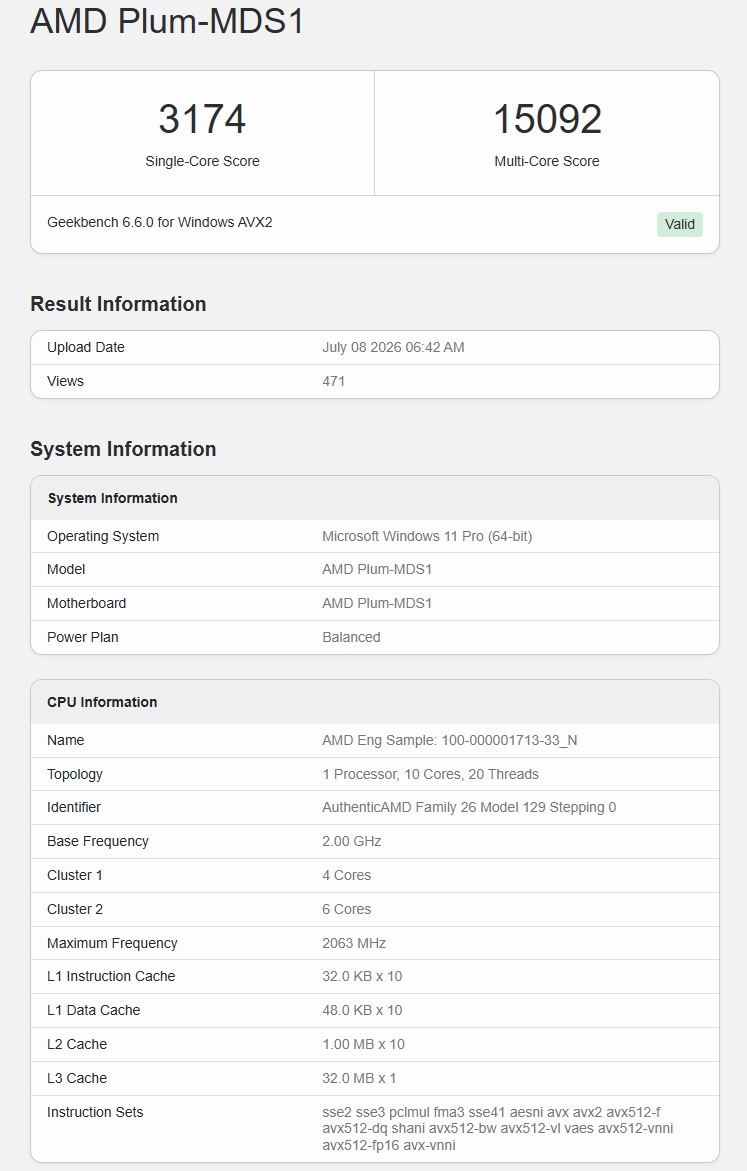
While AMD keeps official Zen 6 details close, leaked Geekbench results for an engineering sample called “AMD Plum‑MDS1” give an early look at what the new architecture might deliver. The chip, reportedly a Medusa Point design, appears to pair four Zen 6 CPU cores with six Zen 6c cores for a total of 10 cores, matching the core count of the Zen 5‑based Ryzen AI 9 HX 370 Strix Point processor. According to the leak, the existing Ryzen AI 9 HX 370 scores 2605 in single‑threaded tests and 13397 in multi‑threaded tests on Geekbench 6.6, while the Medusa Point sample reaches 3174 and 15092 respectively—a 21.8% single‑threaded and 12.6% multi‑threaded advantage. For an early sample, those numbers are not incremental; they hint at a meaningful uplift that could reshape expectations around next‑generation CPU architecture.
The benchmark also reports 32 MB of L3 cache versus 24 MB on Strix Point, along with support for new instructions such as AXV‑512‑fp16, though it remains unclear how accurately Geekbench detects cache sizes and features. Older Zen 6 leaks have suggested higher clock speeds across the range; if those reports align with the Medusa Point sample, the gains likely combine architectural improvements with frequency increases. Either way, more than 20% single‑threaded growth is a big deal in CPU land, where year‑over‑year jumps rarely look this aggressive. The unanswered question now is how far retail silicon will push these numbers—and whether desktop Zen 6 parts can replicate or exceed this performance trajectory without sacrificing efficiency.
| Metric | Ryzen AI 9 HX 370 (Zen 5) | Medusa Point Sample (Zen 6) |
|---|---|---|
| Core configuration | 10 cores (Zen 5) | 4 Zen 6 + 6 Zen 6c cores (10 total) |
| Geekbench 6.6 single-thread | 2605 | 3174 |
| Geekbench 6.6 multi-thread | 13397 | 15092 |
| L3 cache (detected) | 24 MB | 32 MB (detected) |
Positioning Zen 6 in the High-Performance CPU Arms Race
Zen 6 is expected to build on the current Zen 5 generation with improvements in performance, efficiency, and scalability across consumer and enterprise platforms. It is widely expected to underpin future Ryzen desktop processors, EPYC server CPUs, and workstation products, even though AMD has not formally announced those families yet. This broad footprint would give Zen 6 direct influence over everything from personal systems to high-performance computing CPUs in data centers. The timing is not accidental: competition in both client and server markets is intensifying, and AMD needs a clear architectural answer to rival flagship designs. If the leaked Medusa Point benchmarks reflect the overall direction of Zen 6, AMD is aiming for a generational leap that pressures competitors to respond on both single‑threaded speed and multi‑core throughput.
There is also an important strategic message in AMD’s insistence on x86 as a long‑term anchor. As AI accelerators grow more visible, some might assume general‑purpose CPUs will fade into the background. Zen 6 suggests the opposite: AMD plans to keep x86 at the center of its stack while extending outward with AI‑focused hardware, not replacing one with the other. That alignment matters for developers and enterprises who have decades of x86 software investment and need assurance that next‑generation CPU architecture will still prioritize compatibility as it chases performance. In short, Zen 6 looks designed not only to win benchmarks, but to make AMD’s CPU roadmap feel dependable in a period of rapid hardware change.
What to Watch When Zen 6 Steps Onto the Stage
With Advancing AI 2026 set for July 22–23, Zen 6’s launch is only days away, and the keynote is expected to bring more technical detail on the architecture and its product rollout. AMD has signaled that this will be one of its more important events of the year, which raises expectations for clarity around how Zen 6 will scale from client to server platforms. For now, the combination of official confirmation and early benchmarks paints a clear picture: AMD wants Zen 6 to be seen as a serious step forward, not a mild refresh. The stronger the real‑world numbers are relative to Zen 5, the more pressure AMD will put on its rivals in the flagship segment—and the more weight Zen 6 will carry as a foundation for future Ryzen and EPYC lines.
The conclusion is straightforward: Zen 6 is arriving at a moment when CPU performance, efficiency, and AI integration all matter at once. AMD’s decision to unveil its next-generation CPU architecture at an AI‑focused conference, supported by leaks hinting at more than 20% single‑threaded gains, signals a bid to own the narrative around high‑performance computing CPUs. Until AMD shows shipping silicon, healthy skepticism about early benchmarks is warranted—but if the company delivers close to what the Medusa Point sample suggests, Zen 6 will not simply join the flagship race; it will help redefine the pace at which that race moves.