
CXMT DDR5: What It Is And Why Enthusiasts Should Be Cautious
CXMT DDR5 memory refers to DDR5 DRAM chips manufactured by ChangXin Memory Technologies and used in modules from brands such as KingBank, aimed at delivering high data rates above 8000 MT/s but currently showing large batch-to-batch silicon variance, weaker performance than leading DDR5 vendors at the same clocks, and reliability questions that make aggressive overclocking and high-end workstation or gaming use a calculated risk rather than a safe upgrade.
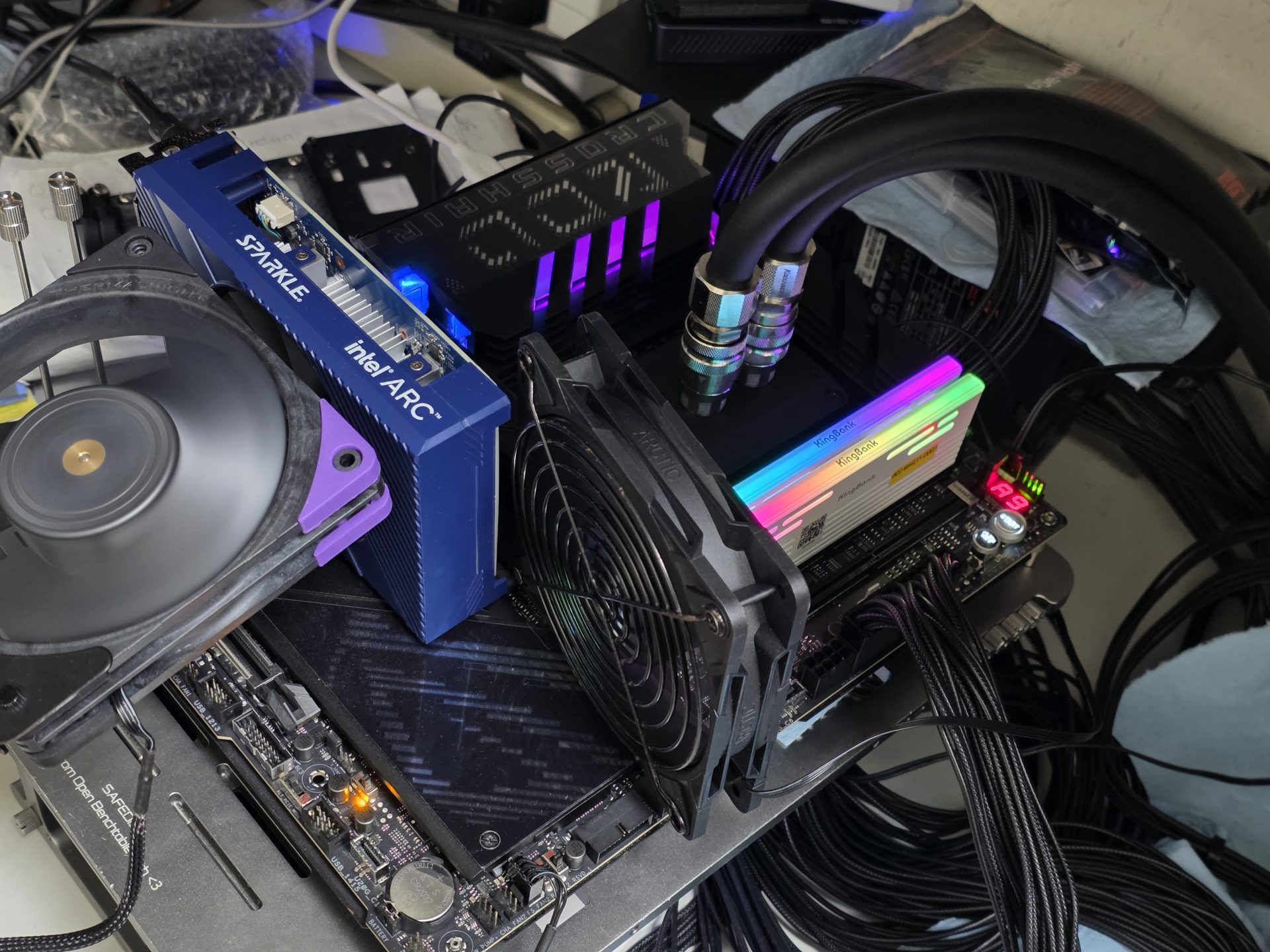
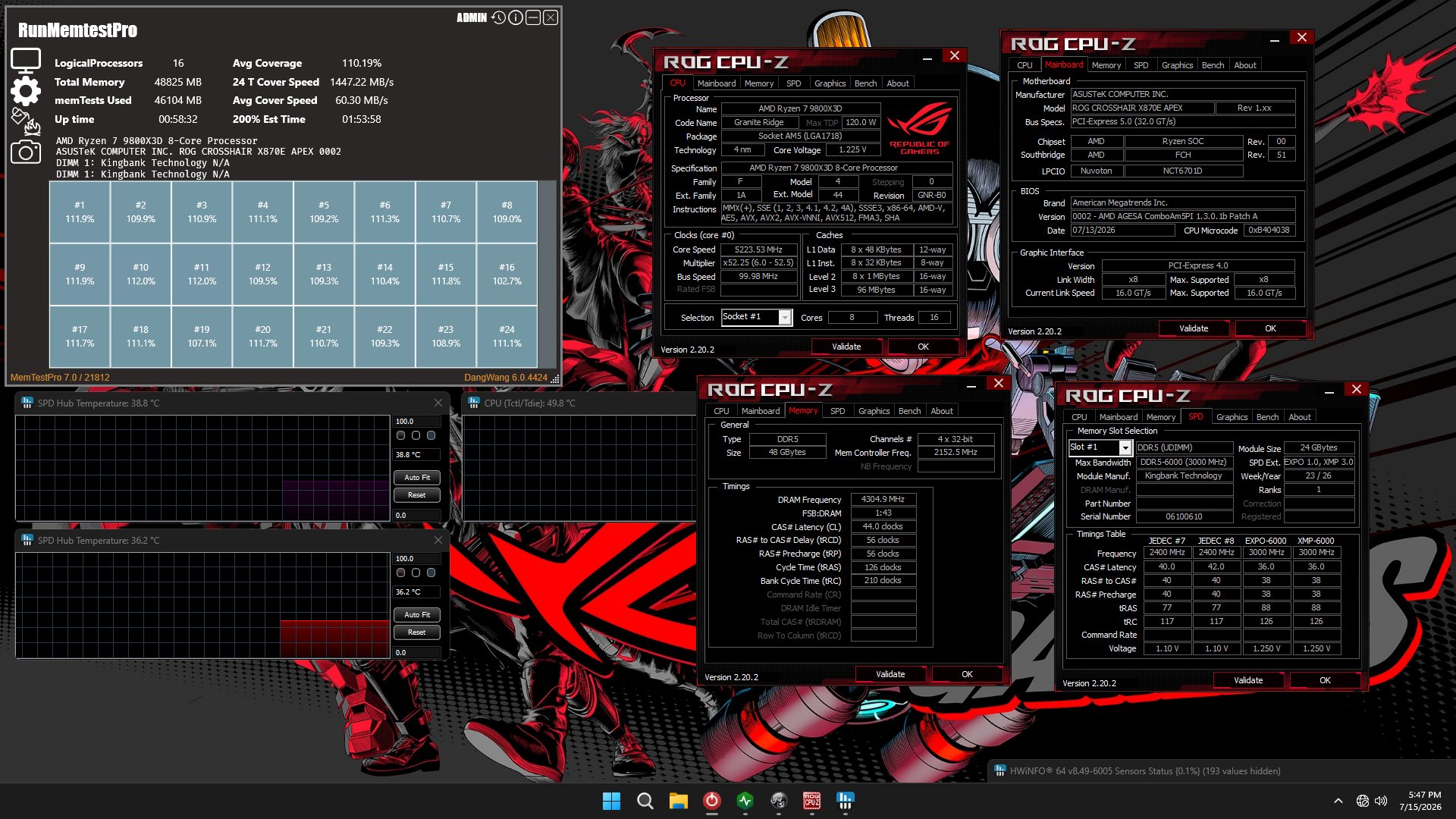
The headline figures around CXMT DDR5 are eye-catching, and that is exactly the problem. A 48GB KingBank kit using 24Gb CXMT dies has been pushed to around 8619 MT/s on an ASUS ROG Crosshair X870E Apex with manual tuning, far beyond the Ryzen 7 9800X3D’s official DDR5-5600 limit. Enthusiast feeds love this kind of record, but for buyers the key takeaway is different: CXMT DDR5 looks fast in a controlled showcase, yet the platform still suffers from serious quality control and consistency issues. If you care more about predictable performance than headline MT/s numbers, CXMT is not ready to replace SK hynix, Samsung, or Micron in your primary build.
Lab Records vs. Real Performance: Why 8600 MT/s Doesn’t Tell The Whole Story
The 8600 MT/s achievement came from a KingBank 48GB kit rated for DDR5-6000 CL36-38-38-88 at 1.25V, manually pushed to timing settings of 44-56-56-126 and verified by an overclocker using Memtest for roughly 59 minutes. That proves one specific combination of CPU, board, BIOS, and kit can complete a short test at extreme speed, but it does not prove long‑term stability or repeatability across retail modules. Even as voltage is increased, gains become harder to achieve and tightening timings is difficult on these CXMT dies.
Timing conversion makes the limitations clearer. When the kit jumped from 6000 MT/s 36-38-38-88 to 8600 MT/s 44-56-56-126, CAS latency in real time improved from 12.00 ns to 10.23 ns, but tRCD and tRP slightly worsened and tRAS stayed almost flat. In other words, most of the high‑frequency win is theoretical bandwidth, not balanced latency. According to the overclocker reporting these results, “at the same clock speed, this memory is slower than SK hynix DRAM”. Without published bandwidth and application benchmarks, we cannot put a percentage on the gap, but the direction is clear: CXMT DDR5 is behind at identical speeds.
Batch Variance And Overclocking Walls: The Real Risk For Enthusiasts
The single most worrying trait of CXMT DDR5 for builders is DDR5 batch variance. The overclocker who validated the 8600 MT/s run assessed silicon variance between CXMT batches as significant. Another analysis states that “the silicon performance varies massively between DRAM batches… sorting out good-quality IC from each batch is harder than with SK Hynix, Samsung, and Micron-produced DRAM”. This means even if one kit hits 8600 MT/s on your favorite motherboard, another kit with the same model number may fail at much lower settings or demand entirely different voltages and subtimings.
Overclocking risks here are not theoretical. There is a wall to how far CXMT DDR5 scales: reports indicate these modules do not respond well to increased voltage, and users cannot meaningfully tighten timings beyond baseline CL34–36 on most kits. MSI explicitly warns that overclocking results depend on the CPU’s memory controller quality, the module and IC batch, and overall system configuration. Combine that with a CPU whose official maximum is DDR5‑5600 and you are firmly in non‑warrantied territory when chasing 8000+ MT/s. For overclockers who enjoy fine‑tuning, CXMT currently feels less like a playground and more like a lottery.
Motherboard Support Improves, But Quality Control Still Lags
The platform story around CXMT DDR5 is improving, at least on paper. CXMT itself claims 16Gb and 24Gb DDR5 variants whose maximum data rate exceeds 8000 Mbps. Motherboard vendors have responded with targeted BIOS work. One vendor released a beta BIOS that “improves compatibility with CXMT chips, memory performance, and system stability” for a high‑end board. Another published verification showing Intel 800‑series boards with CXMT 24Gb chips passing MemTest at DDR5‑8600 46-56-56-134 in a 48GB configuration, and DDR5‑8200 44-56-56-132 in 32GB form.
According to one vendor, these gains come from memory training and timing adjustments specific to CXMT on Intel 800 series, and dedicated tuning that pushed past an earlier 6800 MT/s ceiling on AMD platforms. That is good progress, but it does not erase quality control concerns. As of mid‑July 2026, KingBank and CXMT still do not appear on the publicly available QVL for at least one flagship board. Vendors emphasise that platforms can now “handle CXMT DDR5 at the 8000 MT/s class”, yet repeat that overclocking outcomes vary with IC batch and controller quality. For buyers, motherboard support means “it can run,” not “it will be reliable at extreme profiles in every high‑end gaming or workstation build.”
Who Should Buy CXMT DDR5 Now—and Who Should Wait
Analysts describe CXMT DDR5 as “good for mainstream use, not so good for overclocking”. That is the most practical way to think about it. In markets facing DRAM shortages, domestic modules based on CXMT can fill a supply gap while big players chase AI demand. If your priority is simply having enough memory at rated EXPO or XMP speeds on a compatible board, and you are willing to treat the kit as a stock‑speed component, CXMT can be acceptable. In that scenario, your main tools are the profile printed on the product and the vendor’s QVL list, not some forum screenshot of an 8600 MT/s run.
But if you are building a high‑end gaming rig or workstation where memory stability and predictable latency matter more than headline MT/s, CXMT DDR5 is a poor bet today. Reaching 8600 MT/s once and reproducing that across mass‑produced kits are two different challenges, and the roughly hour‑long test runs used so far do not prove long‑term reliability across units. The next meaningful milestone is not an even higher single record; it is consistent profiles that match or beat SK hynix modules on bandwidth, effective latency, and real workloads under identical conditions. Until we see that, serious enthusiasts should treat CXMT as an experiment, not a foundation.