
Ryzen 7 7700X3D: The Budget Gaming Sweet Spot
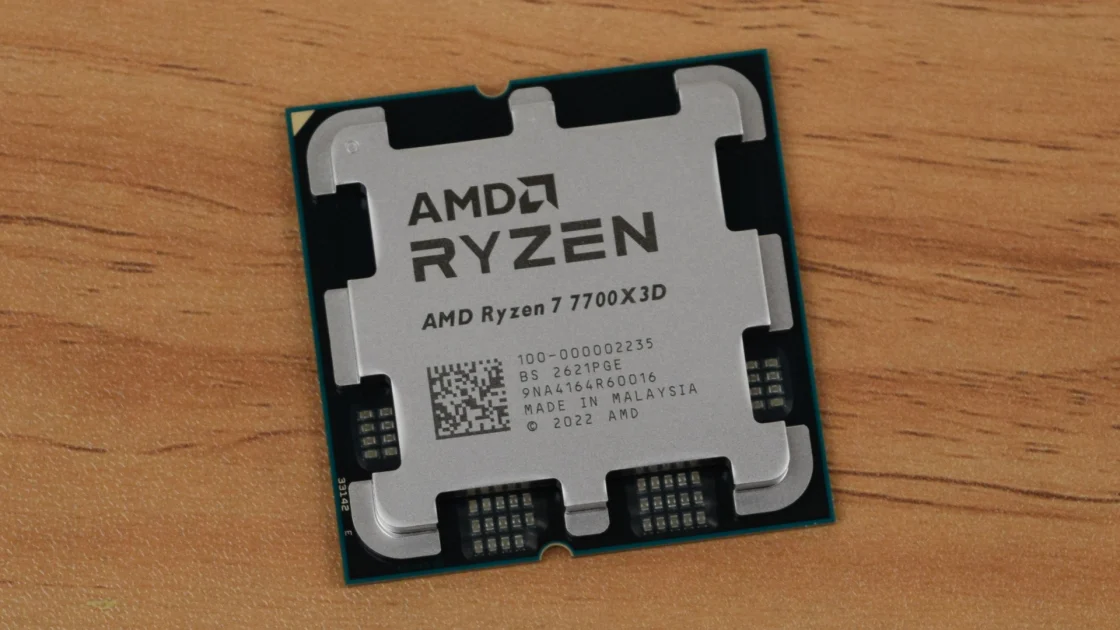
The Ryzen 7 7700X3D is an 8-core, 16-thread desktop processor built on AMD’s Zen 4 architecture and enhanced with 96MB of 3D V-Cache, designed to deliver high gaming frame rates at a lower price point than premium CPUs while remaining compatible with AM5 motherboards and modern DDR5 memory platforms. For most gaming PC builder projects focused on value, this is the chip to buy. At USD 330 (approx. ₱18,500), it is a downclocked version of AMD’s previous gaming flagship, the Ryzen 7 7800X3D, but keeps the same massive cache and 120W TDP for strong gaming performance. Testing shows that while Ryzen 7 7700X3D can be slower in general CPU benchmarks, its in-game results reveal a competitive edge that lets it compete with far more expensive processors. If you care about frames per second more than synthetic scores, this is the clear top pick.
3D V-Cache Performance and Real Gaming Results
The defining feature of the Ryzen 7 7700X3D gaming experience is its 96MB of shared L3 cache, with 32MB on-die and another 64MB stacked as 3D V-Cache and addressed as a single contiguous cache. This design lets the CPU keep far more game data close to the cores, which reduces memory latency and boosts frame rates in cache-sensitive titles. In Cyberpunk 2077, for example, the 7700X3D lands in the middle of the pack but outpaces powerful chips without 3D V-Cache, including the Ryzen 9 9950X and Intel Core Ultra 9 285K. In Total War: Three Kingdoms and Shadow of the Tomb Raider, 3D V-Cache CPUs as a group sit ahead of processors that lack this extra cache, highlighting how this technology translates into practical FPS gains. For gamers, that means smoother play at high resolutions with demanding GPUs.
CPU Value Comparison: Ryzen 7 7700X3D vs Intel and Other Ryzen
From a CPU value comparison standpoint, Ryzen 7 7700X3D is priced to undercut premium 3D V-Cache options while beating similarly priced Intel chips at gaming. It launches at USD 330 (approx. ₱18,500), sitting just above the Intel Core Ultra 7 270K Plus at USD 310 (approx. ₱17,400), with AMD’s stated aim that it outperform this Intel part in games while staying well below the Ryzen 7 9850X3D at around USD 490 (approx. ₱27,600). The 7700X3D is essentially a downclocked Ryzen 7 7800X3D—which streets at about USD 350 (approx. ₱19,700)—making that its most revealing comparison. You give up top-end clock speed (4.0GHz base, 4.5GHz boost vs 4.2GHz/5.0GHz on the 7800X3D), but keep the same 96MB L3 cache and 120W TDP. This balance is why it stands out as the budget gaming CPU to choose over both newer Intel Core Ultra options and pricier Zen 5 X3D models.
| Spec | Ryzen 7 7700X3D | Core Ultra 7 270K Plus |
|---|---|---|
| Price | USD 330 (approx. ₱18,500) | USD 310 (approx. ₱17,400) |
| Cores / Threads | 8 / 16 | 8+16 / 24 |
| Base / Boost Clock | 4.0GHz / 4.5GHz | 3.7GHz / 5.5GHz (P-cores) |
| L3 Cache | 96MB with 3D V-Cache | 36MB |
| TDP | 120W | 250W |
| Socket | AM5 | LGA 1851 |
Strengths and Trade-offs of the Older Zen 4 Design
Ryzen 7 7700X3D is built on the older Zen 4 microarchitecture but supercharged with 3D V-Cache and aimed squarely at a lower price point. This design trades some general CPU performance for specialized gaming optimization. In CPU-focused tests, it is often the slowest chip compared with newer high-core-count competitors, yet its gaming benchmarks show a competitive edge. That trade-off appears in specific titles: in Black Myth: Wukong at 1440p and 4K, its performance matches high-end chips lacking extra cache, such as Ryzen 9 9950X and Intel Core Ultra 9 285K, but at 1080p it delivered the worst result of all processors tested as weaker CPU performance bottlenecked the chip. Similarly, in F1 2024 it falls behind other 3D V-Cache CPUs, though Intel’s processors struggle even more and sit further behind the 7700X3D. You get targeted gaming benefits, but this is not the best choice for heavy productivity workloads.
Platform Practicalities for Gaming PC Builders
For a gaming PC builder, platform details matter as much as raw benchmarks. Ryzen 7 7700X3D fits into all Socket AM5 motherboards across AMD 600-series and 800-series chipsets, and AMD has standardized USB BIOS flashback to make pairing the chip with aftermarket boards straightforward. The processor’s dual-channel DDR5 memory interface and 28-lane PCIe Gen 5 root complex—with 16 lanes to the PEG slot and two Gen 5 x4 links for CPU-attached NVMe drives—provide a modern foundation for high-end graphics cards and fast storage. Cooling requirements are predictable, too: its 120W TDP matches the 7800X3D and 9850X3D, so any cooler rated for those parts will be appropriate. According to one review, "while the 7700X3D was often the slowest chip in the CPU tests, in-game benchmarks showed the 7700X3D's competitive edge," underscoring its focus on real-world gaming over synthetic metrics.
- Buy the Ryzen 7 7700X3D if you want a gaming-focused CPU with 96MB 3D V-Cache and strong FPS at a mid-range price.
- Skip the Ryzen 7 7700X3D if your workloads are mostly CPU-heavy productivity tasks and gaming is a minor concern.
- Buy the Ryzen 7 7700X3D if you are building on AM5 and want simple motherboard compatibility with USB BIOS flashback support.
- Skip the Ryzen 7 7700X3D if you play primarily at 1080p in titles where its weaker CPU performance can bottleneck frame rates.
- Buy the Intel Core Ultra 7 270K Plus if you prefer higher general CPU performance and accept lower gaming focus and a 250W TDP.
- Skip the Intel Core Ultra 7 270K Plus if you are chasing maximum gaming value per dollar instead of broad application speed.