
Verdict First: A Serious Ultra-Wide, Not a Budget Toy
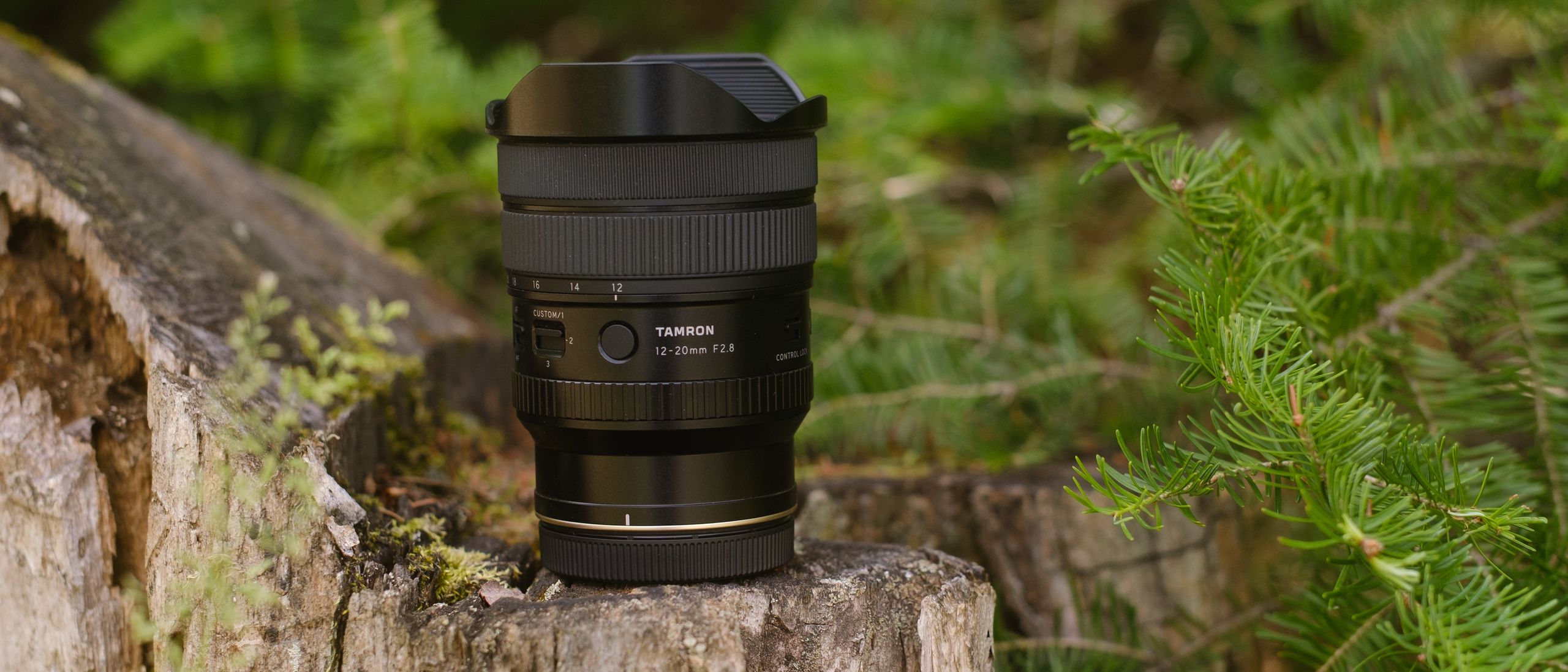
The Tamron 12-20mm f/2.8 is a full-frame ultra-wide zoom lens for Sony E and Nikon Z mounts that combines a 12mm field of view with a constant f/2.8 aperture, aiming to deliver professional zoom performance for landscape, architecture, astrophotography and video work at a lower price and weight than native brand alternatives. If you need the absolute best corners and flawless optics, Sony and Nikon’s top lenses still win – but for most photographers and hybrid shooters, this Tamron lands in the sweet spot where image quality, control layout and value line up. On E-mount, the lens lists at USD 1,699 (approx. ₱96,000); on Z-mount, about USD 1,799–1,800 (approx. ₱102,000–₱108,000), roughly half the cost of Sony’s 12-24mm f/2.8 GM and USD 600–700 cheaper than Sony’s 12-24mm f/4 G and Nikon’s 14-24mm f/2.8 S in the US. According to Digital Camera World, “the lightweight design and more affordable price are well worth the trade.”
| Spec | Tamron 12-20mm f/2.8 | Notes |
|---|---|---|
| Model | A084 | New simplified naming scheme. |
| Mounts | Sony E, Nikon Z | Full-frame mirrorless only. |
| Focal length | 12–20mm | Ultra-wide zoom coverage. |
| Angle of view (diag.) | 121°58′–94°30′ | For full-frame format. |
| Optical design | 17 elements in 12 groups | Complex ultra-wide construction. |
| Min focus distance | 0.18m (wide), 0.28m (tele) | Close-up capability. |
| Max magnification | 1:5.8 (wide), 1:9.1 (tele) | Useful for detail shots. |
| Filter options | Rear filter holder | Gel filters at the rear. |
| Length | 119.3mm (E), 121.3mm (Z) | Fixed hood; internal zoom. |
| Weight | 570g (E), 585g (Z) | Compact and relatively light. |
| Aperture | f/2.8–f/16, 12 blades | Bright and smooth rendering. |
Design, Handling and Controls: Tamron’s New Direction
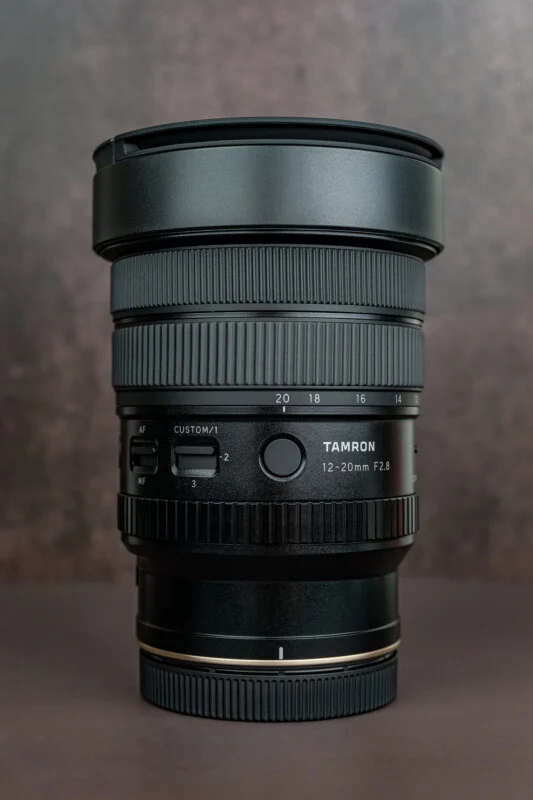
Tamron has redesigned the 12-20mm f/2.8 with clean lines and a shiny black or textured matte finish, giving it a streamlined look that still hides a surprising number of controls. The body is fully weather-sealed, and the hood is fixed; zooming does not extend the lens, which keeps the package compact and predictable in use. At about 4.7–4.8 inches long and a little over 20 ounces, it feels much smaller on a camera than Sony’s 12-24mm f/2.8 GM, which is described as huge and heavy by comparison. You get a manual focus ring, zoom ring and a dedicated control ring that defaults to aperture. There are customizable lens function buttons hooked to a three-position switch, an AF/MF switch, a manual focus lock, a zoom lock and a control lock. A USB‑C port supports firmware updates and fine-tuning via Tamron’s utility app. This is an ultra-wide zoom lens that behaves like a high-end cine and stills tool, not a stripped-down third-party option.
Pros
- Full set of customizable controls in a rugged, weather-sealed frame.
- Fast constant f/2.8 aperture without the bulk of some brand-name ultra-wide zooms.
- Lightweight design makes it easier to carry for travel and events.
- Integrated rear filter holder supports gels for creative work.
Cons
- No front filter thread; users must rely on rear gels or accessories.
- Design finish is darker and edgier; some may prefer Tamron’s older styling.
Optical Performance: Sharp, But With Quirks at the Edges
Optically, the Tamron 12-20mm f/2.8 delivers solid, professional zoom performance with a few trade-offs. Test charts show decent sharpness at 12mm wide open; stopping down lifts contrast and fine detail noticeably. However, extreme corners stay a bit blurry even at smaller apertures, and both sources note softer edges, especially visible in astrophotography where stars near the frame edges look smudged compared to the center. At 20mm, heavy field curvature appears, which means flat subjects can go out of focus toward the edges unless you refocus or stop down. Bokeh from the 12-blade diaphragm can look distracting and harsh when there are specular highlights, so this is not a lens for creamy background blur. According to PetaPixel, “some optical quirks aside, the Tamron 12-20mm f/2.8 performs extremely well and represents excellent value for the dollar.” In practical terms, the center is reliably sharp for landscapes, interiors and video, but perfectionists will notice the compromises off-axis.
Autofocus, Video and Creative Use: Where It Shines
Focusing is driven by Tamron’s linear voice-coil motor, even though the familiar VXD branding is gone from the name. In field use, autofocus locks onto typical ultra-wide subjects with minimal hunting and only a few misses across landscapes and perspective-heavy scenes. On a Nikon Z8, focusing was quiet, smooth and fast from near to far, with no compatibility issues. Manual focus controls, plus the focus lock switch, make it well suited to critical night work and controlled video focus pulls. The ultra-wide 12mm view combined with the f/2.8 aperture and close focusing distance opens up creative environmental portraits, dynamic interiors and low-light scenes. The lens’s great night capabilities and excellent video performance stand out: it is designed for landscape, astrophotography and architecture, but also doubles as a flexible tool for handheld vlogging and gimbal setups where weight and size matter. In that wide-angle lens comparison, Sony’s G Master may be optically cleaner, yet its bulk and cost make the Tamron more appealing to many hybrid shooters.
Buy if / Skip if
- Buy the Tamron 12-20mm f/2.8 if you want a fast ultra-wide zoom lens with professional zoom performance in a compact, weather-sealed body.
- Skip the Tamron 12-20mm f/2.8 if you demand pin-sharp corners and minimal field curvature for critical architectural or flat artwork shooting.
- Buy the Tamron 12-20mm f/2.8 if you are a hybrid shooter who values extensive physical controls, USB‑C customization and reliable autofocus for both stills and video.
- Skip the Tamron 12-20mm f/2.8 if your priority is smooth, creamy bokeh and subject isolation over wide-angle context in your images.
- Buy the Tamron 12-20mm f/2.8 if you want ultra-wide zoom coverage for landscape, astrophotography and architecture at a lower price than Sony and Nikon equivalents.
- Skip the Tamron 12-20mm f/2.8 if you prefer using front screw-in filters and do not want to deal with rear gels or matte boxes.