
What Makes the Ryzen 7 7700X3D Thermally Different
The Ryzen 7 7700X3D is a gaming CPU built around 3D V‑Cache, and its thermal behavior, clock limits, and overclocking profile make it behave very differently from typical high‑end chips, influencing cooler choice, case airflow, and even how builders should think about CPU overclocking performance and long‑term gaming stability. The key takeaway: this processor is defined less by how high it can boost and more by how consistently and efficiently it can hold its target clocks under realistic gaming loads. Under load, the 7700X3D runs a lower thermal target of 89°C because stacked cache can’t tolerate as much heat as bare cores, yet in practice it stays far below that ceiling thanks to modest power draw and a capped 4550 MHz boost. That conservative design reframes the usual race for peak clock speeds; instead of chasing voltage and frequency, the 7700X3D asks builders to optimize around cool, predictable gaming CPU cooling and stable clocks.
Ryzen 7700X3D Temperatures and Thermal Efficiency Comparison
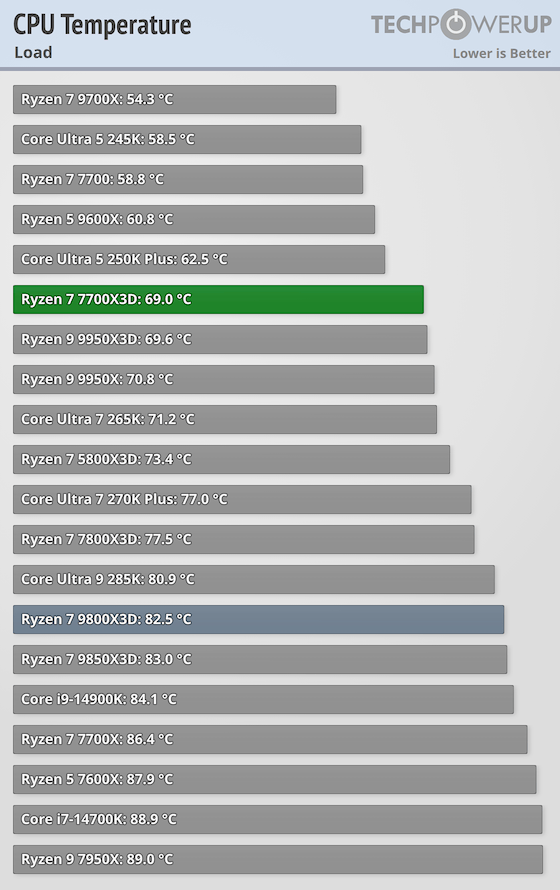
Where the 7700X3D separates itself from many high‑end gaming CPUs is how comfortably it sits under load. In a demanding rendering workload like Blender, it levels off at about 69°C, and during modern, multi‑thread‑aware gaming in Cyberpunk 2077, it hovers around 55°C. These numbers are not synthetic torture scenarios; they reflect how the chip behaves in realistic, sustained work and play. Compared with hotter‑running designs that often park themselves near throttle limits, this is a statement of intent: AMD is trading some top‑end frequency flexibility for thermal efficiency. When you can hold sub‑70°C in heavy all‑core work and mid‑50s while gaming, you reduce the pressure on case airflow and cooler performance. Thermal efficiency comparison becomes less about battling runaway temperatures and more about deciding how quiet and compact you want your gaming rig to be, since the CPU is not the main thermal bully in the system.
Locked Boost Behavior: How 3D V‑Cache Changes Clocks
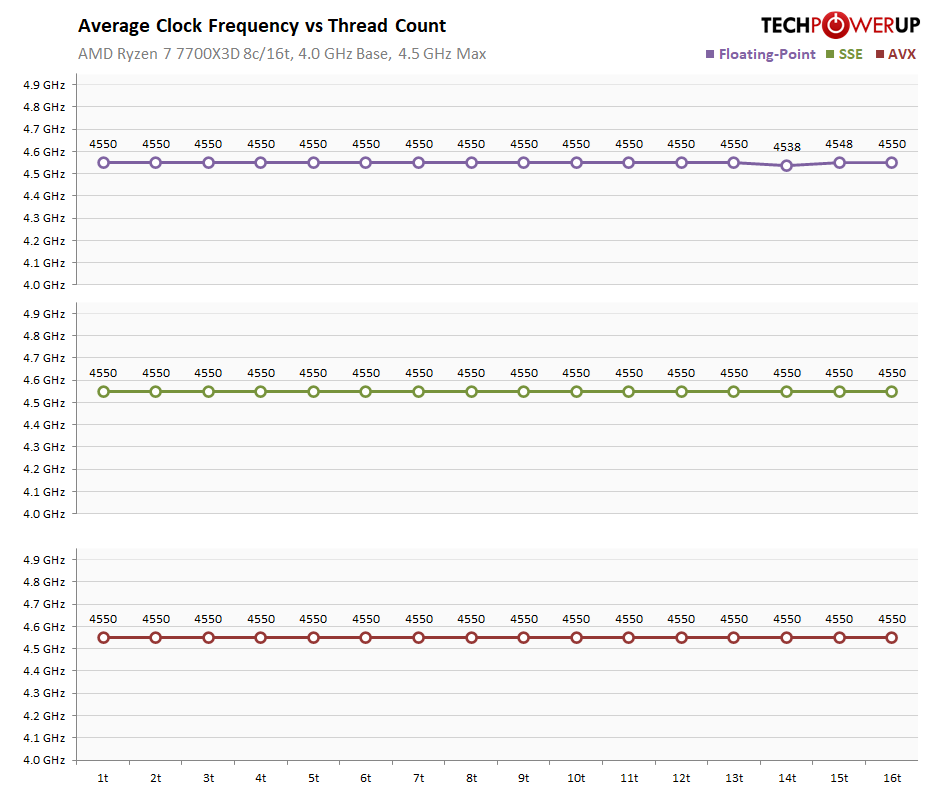
The most opinionated part of the 7700X3D’s design is its clock behavior. Instead of scaling up and down aggressively like many high‑end chips, it hits a boost ceiling of 4550 MHz and then holds that as a flat line, even under light multithreaded load. AMD has deliberately locked this maximum boost; the platform enforces a hard cap that applies to single‑core and all‑core behavior alike. In other words, the usual overclocking knobs do not exist in the way enthusiasts expect. This is where 3D V‑Cache and its thermal sensitivity show up in practice. By fixing the ceiling, AMD can protect the cache stack and still deliver strong gaming performance. It is telling that the closely related 7800X3D uses the same single‑CCD, 8‑core V‑Cache design, but with its boost ceiling set 500 MHz higher at 5050 MHz. That one number defines the performance hierarchy more than any traditional voltage‑and‑frequency tweaking.
Overclocking the 7700X3D: Efficiency Tuning, Not Speed Chasing
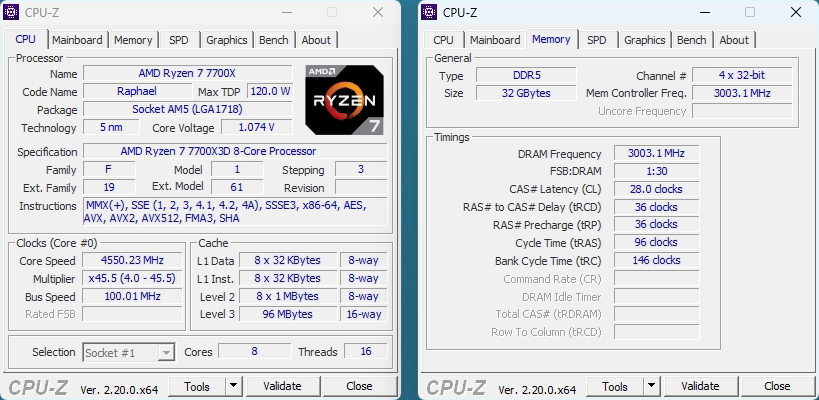
Enthusiasts who buy a high‑end gaming CPU expecting big frequency gains from manual tuning will find the 7700X3D almost stubborn. Precision Boost Overdrive and Curve Optimizer are present, but there is no real performance upside: lifting power and current limits and applying PBO with a positive offset fails to move performance beyond stock because the chip is already sitting at its 4550 MHz cap. Overclocking, in the traditional sense, is a dead end here. Yet this does not mean tuning is pointless; it means the goal must change. Used as an undervolt tool, Curve Optimizer can make the 7700X3D more thermally efficient without sacrificing frames. One tested sample ran fully stable at a -30 all‑core setting, dropping load temperature by about 10°C and reducing per‑test power consumption by roughly 15%, while performance stayed flat. That is the quote worth remembering: "Our sample ran fully stable at -30 all‑core, which dropped load temperature by about 10°C and per‑test power by roughly 15%—but performance stayed flat."
What This Means for Gaming CPU Cooling and Build Choices
Taken together, the 7700X3D’s behavior rewrites some assumptions about high‑end gaming builds. Instead of planning around a hot, spiky CPU, builders get a predictable chip that locks to 4550 MHz and runs at roughly 69°C in heavy rendering and 55°C in demanding games. Rather than hunting for headroom, your job is to keep the system quiet and well‑balanced. Because undervolting can shave about 10°C off load temperatures and trim power use by 15% without changing performance, the smartest tuning strategy is to treat the 7700X3D as an efficiency‑first platform. Gaming CPU cooling decisions become less about overkill and more about sensible balance with the GPU and case airflow. The verdict: if you want a chip whose thermal efficiency and fixed boost behavior simplify building and tuning, the 7700X3D is not a playground for frequency chasers but a reliable anchor for stable, cool, and efficient gaming rigs.