
Verdict: A Targeted Gaming Upgrade, Not a All‑Rounder
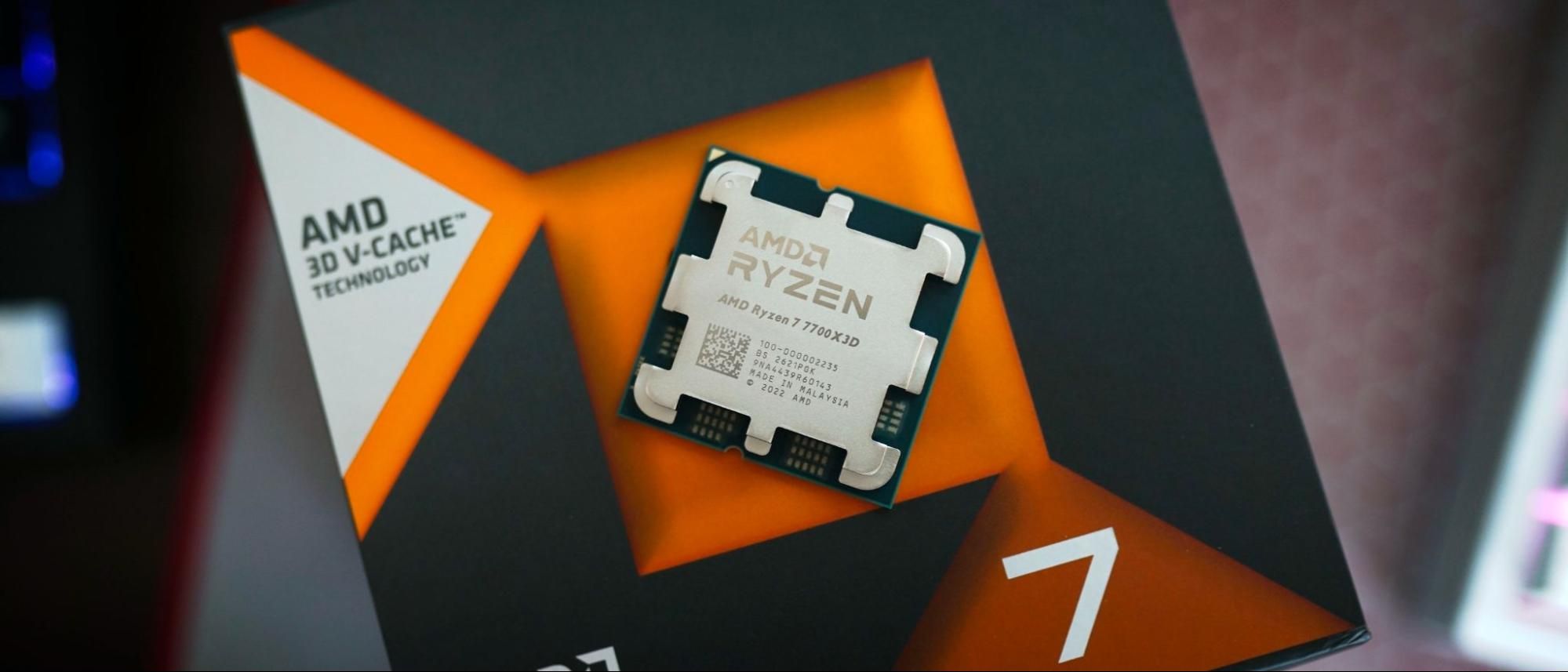
The Ryzen 7 7700X3D is an eight‑core Zen 4 3D V‑Cache gaming CPU for the AM5 platform, designed to deliver higher frame rates than non‑X3D chips while keeping the price and power demands lower than top‑tier processors. As a late addition to the Ryzen 7000 family, it lands at a suggested price of USD 330 (approx. ₱18,500), sitting in direct comparison with newer and faster alternatives. In plain terms: it is a very good gaming processor, a mediocre productivity chip, and a slightly awkward value play if you can afford to move up or down the stack. For AM5 builders who care most about smooth 1080p and 1440p gaming and want to limit spending, the 7700X3D is worth a serious look; mixed‑workload users should think twice.
Architecture, 3D V‑Cache and Platform Fit
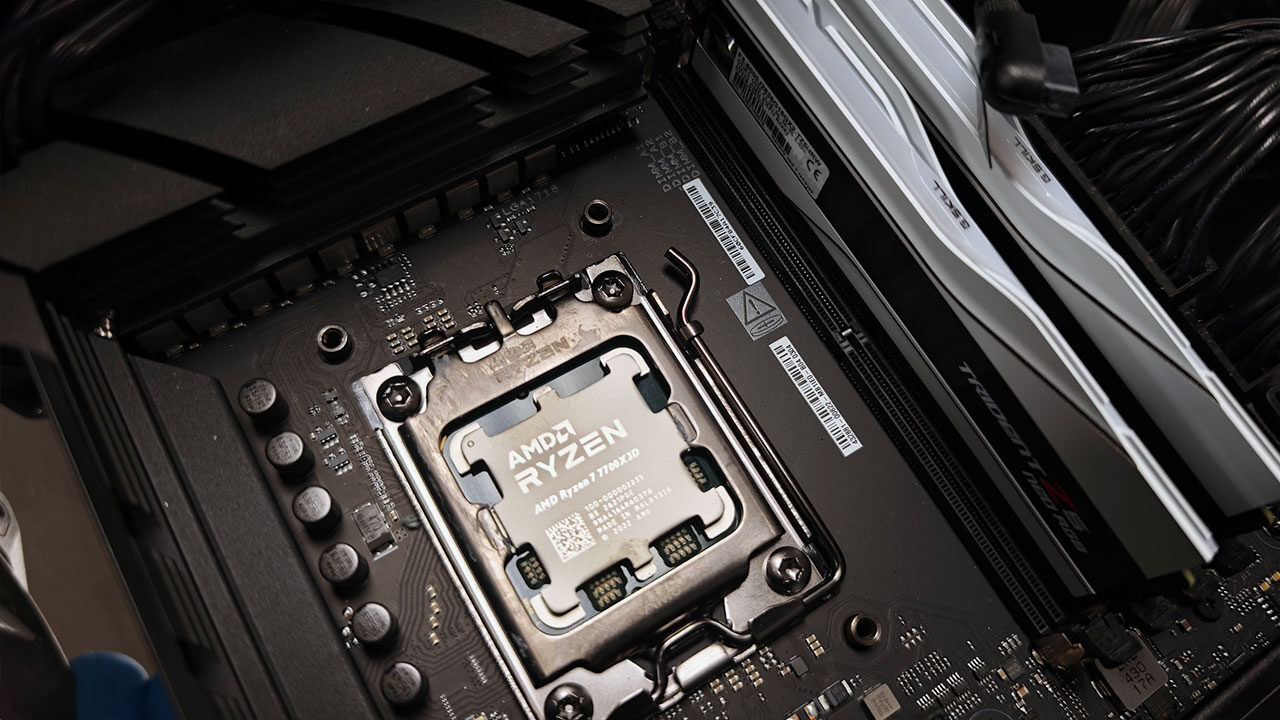
At its core, the Ryzen 7 7700X3D uses the older Zen 4 architecture paired with first‑generation 3D V‑Cache, stacking extra L3 cache directly on the compute die to keep more game data close to the cores and cut memory latency. You get 8 cores and 16 threads, a 4.0 GHz base clock, and up to 4.5 GHz boost, backed by 512 KB of L1, 8 MB of L2, and 96 MB of L3 for a total of 104 MB of cache. TDP is rated at 120 W, with a 162 W maximum power limit, though testing shows it typically stays below triple‑digit wattage in real use. The chip drops straight into existing AM5 motherboards from A620 through B650, X670 and the newer B840, B850, X870 and X870E chipsets, and it will boot on current BIOS images, though AMD recommends updating firmware for best results. There is also a small integrated Radeon graphics unit with two cores at 2,200 MHz for basic display output.
| Spec | Ryzen 7 7700X3D | Notes |
|---|---|---|
| Architecture | Zen 4 X3D | First‑gen 3D V‑Cache on AM5 |
| Cores / Threads | 8 / 16 | Single‑chiplet gaming focus |
| Base / Boost Clock | 4.0 / 4.5 GHz | Lower than 7800X3D for lower power |
| Total Cache (L2+L3) | 104 MB | Large stacked L3 for games |
| TDP / Max Power | 120 W / 162 W | Rarely hits triple‑digit draw in tests |
| Integrated GPU | 2 RDNA2 cores @ 2,200 MHz | For setup, not serious gaming |
Gaming Performance: Where 3D V‑Cache Pays Off
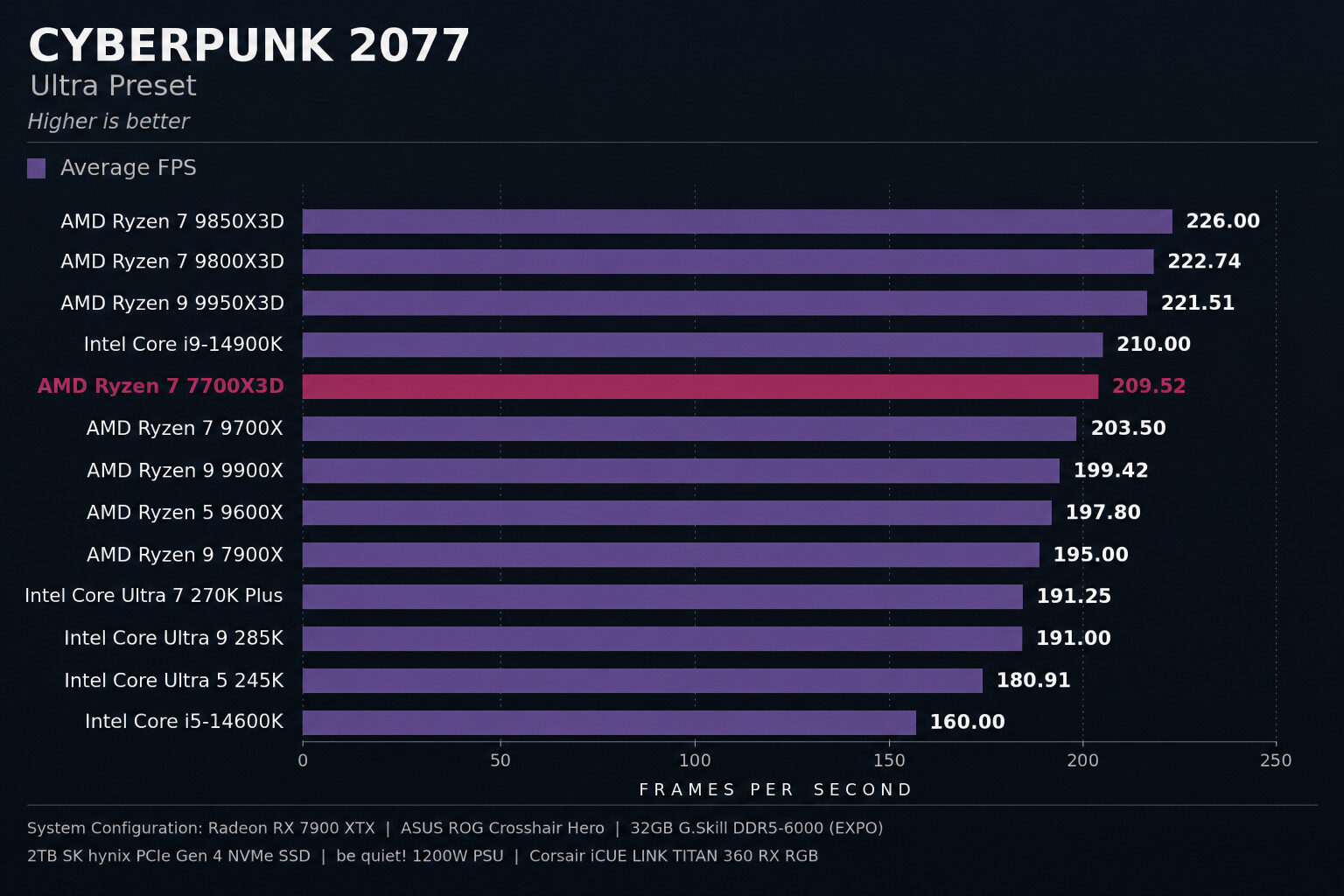
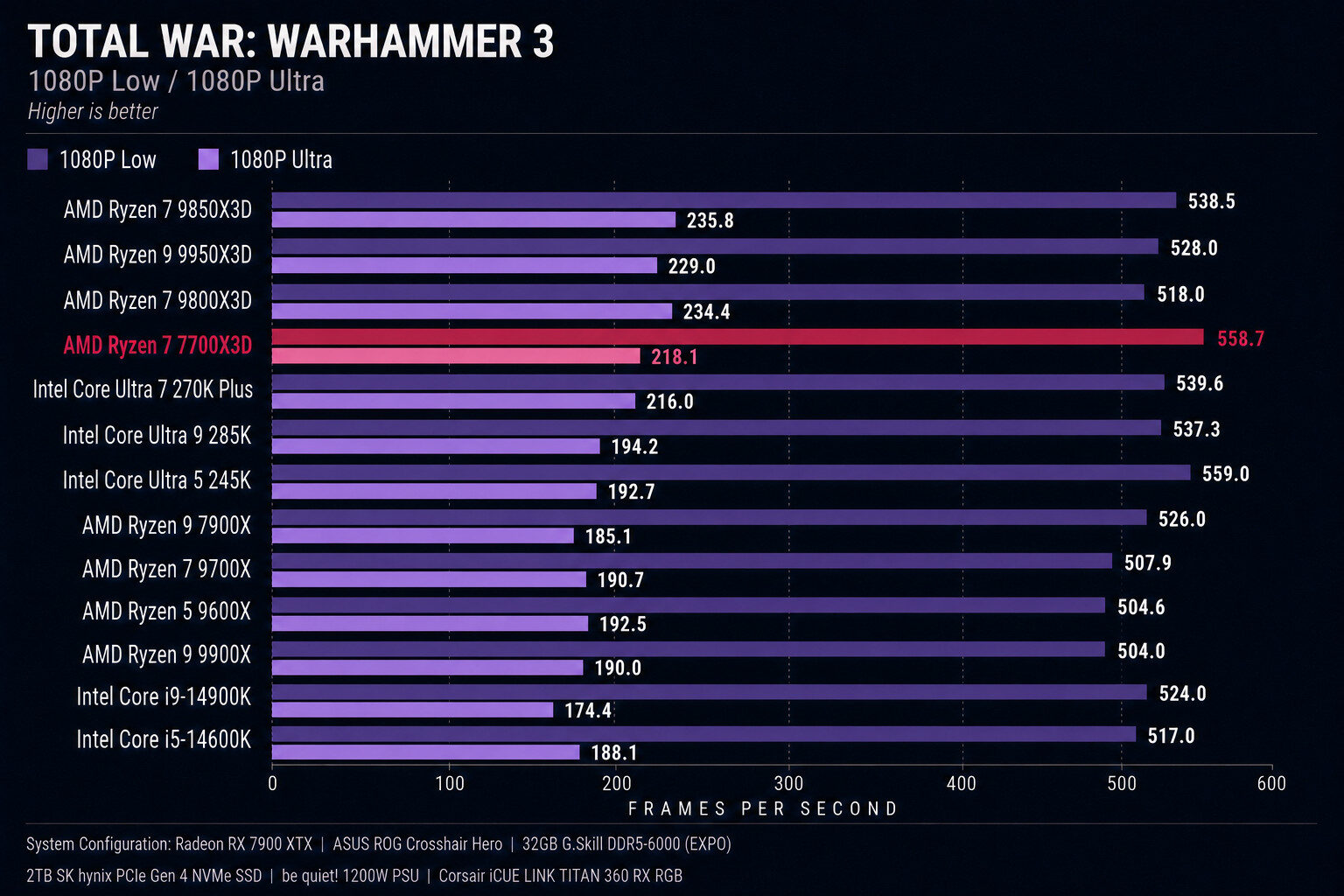
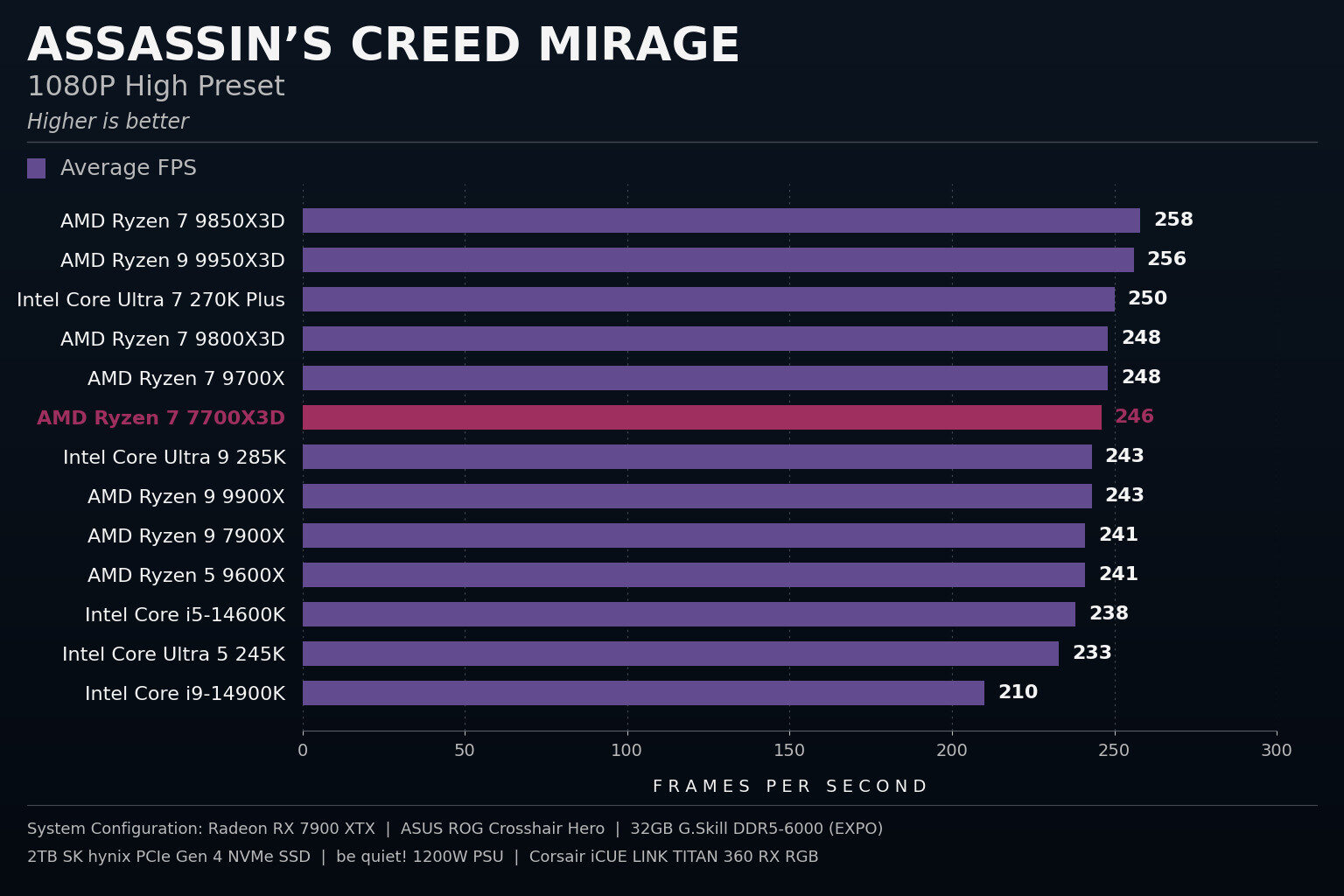
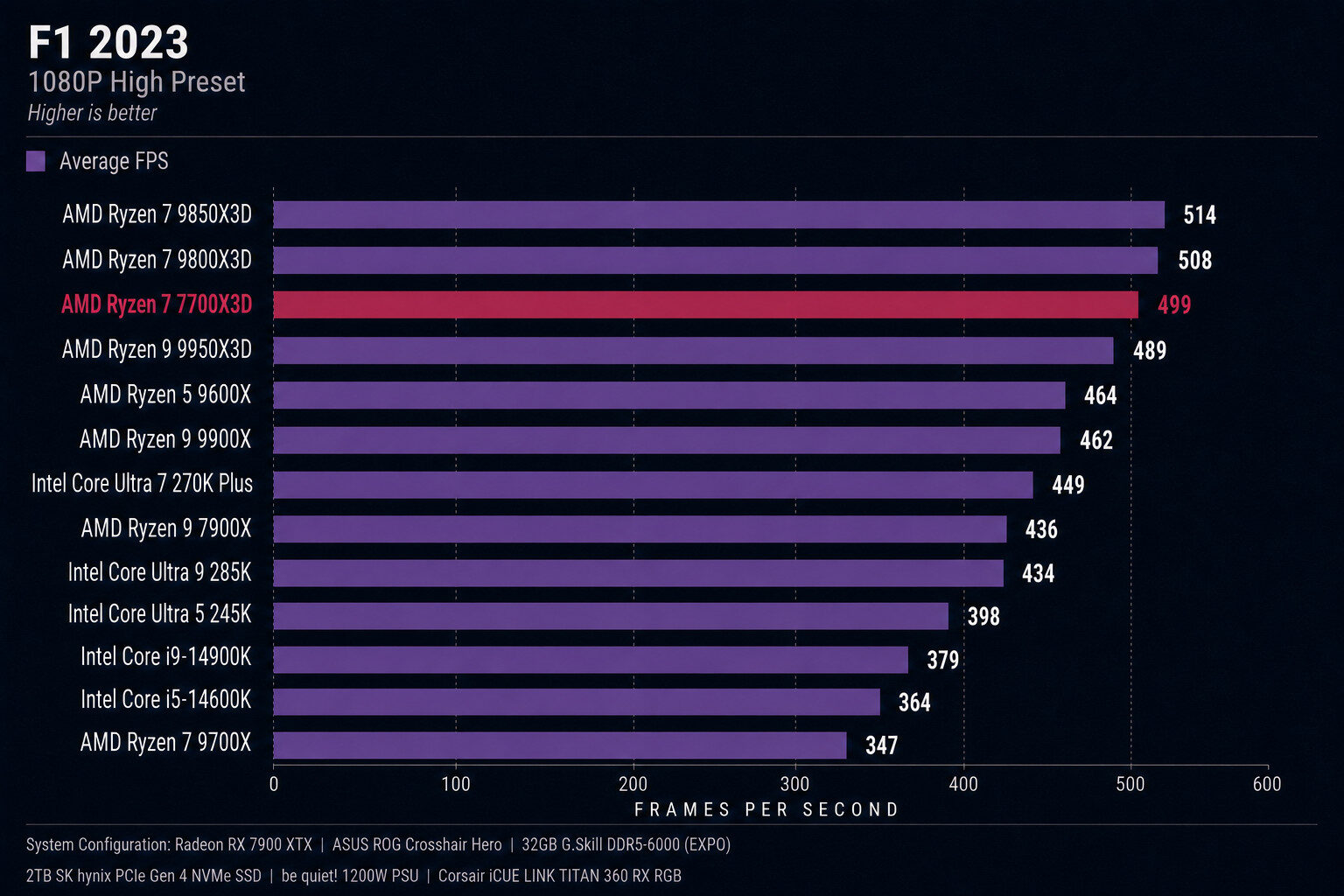
The 7700X3D behaves exactly like you would expect a mid‑bin X3D chip to: a little slower than the 7800X3D in absolute terms, but close enough in real gameplay that you will struggle to feel the difference in most titles. In Watch Dogs: Legion at 1080p and high settings, it reaches a solid 188 FPS, just below the flagship 9950X3D in the test stack. That pattern holds across Total War: Warhammer 3, Cyberpunk 2077 and Assassin’s Creed Mirage, where it tends to sit near the top of the chart, often just behind the newer 9000‑series X3D chips. According to one test set, AMD’s own data shows the 7700X3D averaging about 9% higher performance than the standard 7700X across 30 games at 1080p high settings when paired with RTX 5090 graphics and DDR5‑6000 memory. For someone building a pure gaming rig on AM5, the X3D range remains the best route, and the 7700X3D provides an impressive, value‑focused gaming experience that handles modern titles with ease.
Productivity, Pricing and AM5 CPU Value
Outside games, the picture changes quickly. In CPU‑Z, the 7700X3D posts a multi‑core score of 6,867.7 and single‑core 627.3, below the Ryzen 7 9700X but above the Ryzen 5 9600X. Cinebench R23 shows it last among the CPUs tested, with 16,595 multi‑core and 1,639 single‑core scores, again trailing the 9600X. In Blender, it finishes last because rendering workloads do not benefit from 3D V‑Cache, highlighting that it lags in content creation, rendering, and general computing tasks. Price is where debate heats up: the 7700X3D launches at a recommended USD 330 (approx. ₱18,500), placing it very close to the Ryzen 7 7800X3D, which has been seen at around USD 349 (approx. ₱19,600), and to Intel’s Core Ultra 7 270K Plus, which targets the same segment. Given its performance, some reviewers suggest an ideal band closer to USD 260–280 (approx. ₱14,600–₱15,700), but that is not the reality at launch. This means DIY builders must weigh its strong gaming performance against much stronger multi‑threaded rivals at similar prices.
Late Arrival and Real‑World Trade‑offs
The Ryzen 7 7700X3D arrives more than three years after the 7800X3D and as a “monumentally late” addition to the Ryzen 7000 family, landing in a market already dense with Zen 5 and updated Intel offerings. This timing is both a blessing and a drawback. On one hand, its USD 329–330 (approx. ₱18,500) MSRP and broad AM5 motherboard compatibility create a welcome mid‑range option for gamers who have waited out earlier price spikes. On the other hand, its proximity in price to faster chips, plus weaker performance in non‑gaming tasks, means it is not the best default choice if you render, stream, or code heavily alongside gaming. It supports Precision Boost Overdrive, Curve Optimizer and Ryzen Master for tuning, but AMD warns that overclocking or undervolting beyond published limits can void the warranty, so most buyers are better off focusing on a stable DDR5‑6000 EXPO profile rather than aggressive CPU tweaking. In short, the 7700X3D is a smart pick when you know your workload is games first; in more mixed scenarios, other AM5 CPUs deliver better overall value.
- Buy the Ryzen 7 7700X3D if your primary goal is higher FPS in modern games on an existing AM5 system and you rarely do heavy rendering or content creation.
- Skip the Ryzen 7 7700X3D if you can stretch your budget to a Ryzen 7 7800X3D or newer X3D chip, since their higher clocks and newer architecture deliver better performance for a small extra cost.
- Buy the Ryzen 7 7700X3D if you want a gaming‑first processor around the USD 330 (approx. ₱18,500) mark and value large 3D V‑Cache more than peak single‑core speeds.
- Skip the Ryzen 7 7700X3D if your workload includes regular Blender renders, video editing, or other multi‑threaded tasks where non‑X3D Zen 4 or rival CPUs offer clearly stronger performance.
- Skip the Ryzen 7 7700X3D if you are building a new PC and find the cheaper Ryzen 5 7600X3D attractive, as it offers similar gaming performance for roughly USD 100 (approx. ₱5,600) less.