
What the 7700X3D vs Core Ultra 7 270K Battle Is Really About
The comparison between AMD’s Ryzen 7 7700X3D and Intel’s Core Ultra 7 270K Plus is a choice between a cache‑optimized, gaming‑first CPU and a more general‑purpose productivity chip that happens to game well, both sitting in the same budget gaming CPU comparison bracket and targeting builders who care about high frame rates without paying flagship prices. At USD 330 (approx. ₱19,000), the Ryzen 7700X3D gaming performance target is clear: beat conventional high‑end chips in games through 3D V‑Cache rather than raw clocks. Intel answers with the Core Ultra 7 270K Plus at USD 310 (approx. ₱17,800), offering similar gaming results in many titles and a big lead in multithreaded workloads. The key takeaway: if your PC exists mainly to play games, the 7700X3D’s design and power draw are tailor‑made for you; if it must also earn its keep as a serious work machine, the Core Ultra 7 is the safer bet.
| Spec | Ryzen 7 7700X3D | Core Ultra 7 270K Plus |
|---|---|---|
| Street price | USD 330 (approx. ₱19,000) | USD 310 (approx. ₱17,800) |
| Design focus | Zen 4 with 3D V-Cache, gaming first | High core-count productivity with strong gaming |
| Gaming power draw | Well under 60 W in games | More than double the 7700X3D’s draw in games |
3D V-Cache: Why the 7700X3D Punches Above Its Weight in Games and Emulation
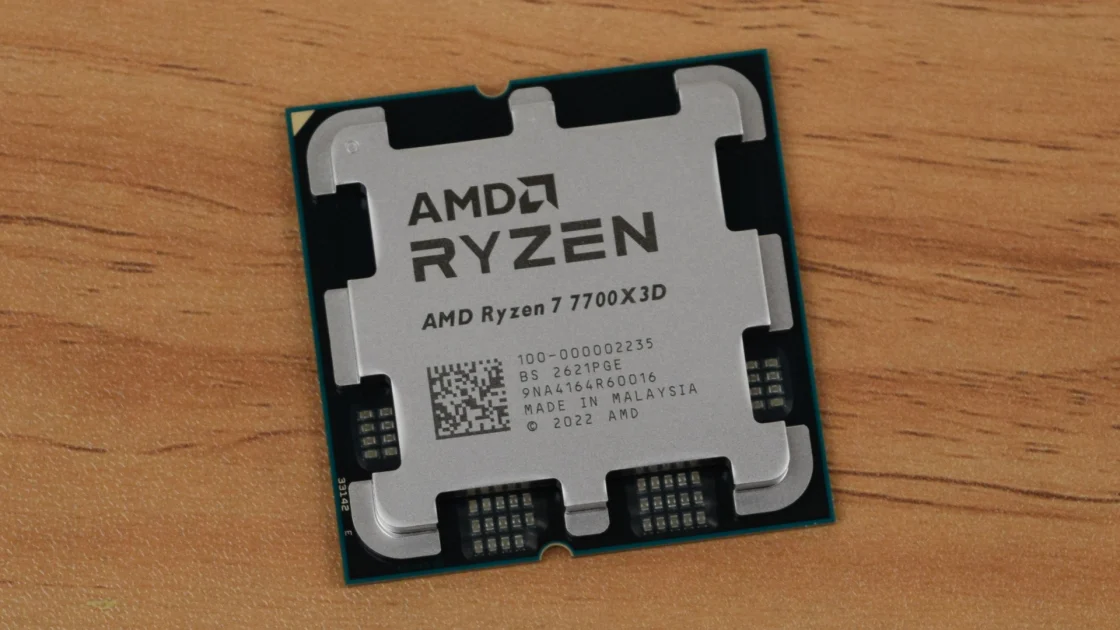
The Ryzen 7 7700X3D is, in essence, a lower‑clocked 7800X3D: the same 8‑core Zen 4 CCD, the same 96 MB of stacked 3D V‑Cache, but capped at a 4,550 MHz boost clock and built on the first‑generation X3D packaging. This older Zen 4 design trades CPU workload versatility for gaming‑specific optimization, relying on huge L3 cache rather than high clocks to drive frame rates. In CPU‑limited titles, that cache pays off: the 7700X3D comfortably beats every non‑X3D processor tested, including pricier chips such as Ryzen 9 7950X and Intel’s Core i9‑14900K, because many games respond more to cache size than clock speed. The 3D V-Cache gaming benchmark story extends to emulation: PlayStation 3’s RPCS3 and Nintendo Switch’s Ryujinx benefit directly from faster cache and memory, workloads where Zen 4 with AVX‑512 and 3D V‑Cache can sustain higher, more stable performance. In other words, this is a chip built to feed game engines and emulators, not render farms.
Real-World FPS: Ryzen vs Intel Gaming at 1080p, 1440p, and 4K
On paper, the Core Ultra 7 270K Plus is only slightly more affordable, and in many games it does not fall far behind the Ryzen 7700X3D. In practice, the cache‑heavy Ryzen often nudges ahead when the GPU is not the bottleneck. In Cyberpunk 2077, the two chips essentially tie at lower resolutions, but the 7700X3D edges ahead at 4K, showing how its cache narrows the gap to more expensive CPUs. In F1 2024, the 7700X3D’s frame rates sit around those of the Ryzen 9 9950X, while Intel’s processors struggle more, ending further behind. The picture is less flattering in Black Myth: Wukong: at 1080p, the 7700X3D turns in the worst result among tested CPUs, likely bottlenecked by its weaker general CPU performance, though at 1440p and 4K it returns to parity with high‑end non‑X3D chips. Importantly, these results were measured with an RTX 5090; drop to a weaker GPU and the Ryzen vs Intel gaming deltas shrink.
Productivity, Power Draw, and Long-Term Build Considerations
As a productivity chip, the Ryzen 7 7700X3D is competent but clearly behind both its 7800X3D sibling and Intel’s Core Ultra 7 270K Plus. Its 4,550 MHz ceiling leaves it roughly 6% slower than the 7800X3D in applications and about 9% behind in single‑threaded work, mirroring the gap in clock speed. Higher‑core Ryzens and Intel’s Core Ultra 7 pull far ahead in rendering, compression, and other heavily multithreaded jobs; an eight‑core X3D part is built for games, not throughput. According to one review, "if you do serious application work, or a genuine mix of apps and gaming, the similarly‑priced Core Ultra 7 270K Plus is the much better choice—Intel’s lead in productivity is large." Where the 7700X3D hits back is efficiency: it is the most energy‑efficient processor in the test group, drawing well under 60 W in games—less than half the Core Ultra 7 270K Plus—and around 66 W in Cinebench multithreaded. That low power makes cooling easy and favors quiet or small‑form‑factor gaming builds over hot, power‑hungry all‑rounder rigs.
Verdict: Who Should Buy the Ryzen 7700X3D and Who Shouldn’t
By design, the Ryzen 7 7700X3D is ideal for dedicated gaming PC builds, less so for mixed workloads. It is an excellent gaming CPU that beats non‑X3D rivals in many CPU‑bound titles and offers standout energy efficiency that makes it practical for long‑term gaming use. But older Zen 4 limits its versatility: heavy multithreaded applications and serious content creation are better served by chips with more cores and higher clocks, where the Core Ultra 7 270K Plus and larger Ryzens clearly lead. Buyers should also remember that its price overlaps with faster options: at USD 330 (approx. ₱19,000), it sits only USD 20 (approx. ₱1,150) below the quicker 7800X3D at USD 350 (approx. ₱20,100), while the Core Ultra 7 270K Plus undercuts it slightly at USD 310 (approx. ₱17,800). If budget drops further, the Ryzen 5 9600X at USD 180 (approx. ₱10,300) and Core Ultra 5 250K Plus at USD 220 (approx. ₱12,600) keep frame rates high for far less money, and the 6‑core Ryzen 5 7600X3D around USD 240 (approx. ₱13,800) is the cheapest way into 3D V‑Cache if you can live with fewer cores.
- Buy if: You want top‑tier Ryzen 7700X3D gaming performance and care more about FPS and efficiency than raw productivity.
- Skip if: You routinely run heavy multithreaded workloads; the Core Ultra 7 270K Plus is much better here.
- Buy if: Your priority is a quiet, cool, long‑term gaming rig with low power draw.
- Skip if: You need a balanced chip for both serious work and play; X3D parts are built for games, not throughput.
- Skip if: You can stretch to a 7800X3D; at USD 350 (approx. ₱20,100) it is faster in everything and holds value better.
- Buy if: You’re a budget‑conscious gamer comparing Ryzen vs Intel gaming and value AM5’s upgrade path to future X3D chips.