
From warehouses to warships: what military 3D printing really changes
Military 3D printing at sea is the use of onboard additive manufacturing systems and autonomous delivery drones to fabricate and move mission-critical parts directly on deployed vessels, bypassing traditional shore-based supply chains and cutting weeks of delay from the naval logistics process while keeping equipment in service at the point of need. This is not a niche experiment; it is a deliberate attempt to break the old habit of waiting for warehouses, depots, and contractor backlogs to catch up with a ship in the middle of an operation. In an era where a broken fitting or obsolete bracket can sideline a system, the key takeaway is blunt: fleets that can print, prototype, and receive parts on demand will outlast fleets that cannot. The naval supply chain is moving from centralized stockpiles to distributed, floating factories.
USS Essex turns into a floating factory
The amphibious assault ship USS Essex and Combat Logistics Battalion 13 have stopped waiting in line for the naval supply chain and started printing their own answers. Embarked 3D printers now produce replacement parts and tools on demand instead of relying on orders that can take weeks to arrive, if they arrive at all, because many components are no longer manufactured. The workflow is lean: sailors and Marines measure the failed part, design a digital model, print a fast plastic prototype to confirm fit, then produce the final version. These plastic test pieces are quicker than metal, cut waste, and avoid rework. According to Supply Officer Cmdr. Jason Pirrallo, bringing the entire manufacturing process onto the ship has reduced administrative hurdles, cut the workload tied to parts orders, and freed funds for other priorities. In plain terms, fewer forms, more functioning gear.
The operational payoff is stark at sea. As Gunnery Sgt. Samuel Margarini puts it, “If we’re in the middle of the ocean and something breaks, instead of waiting a week or two for a replacement, we’re able to get our equipment operational right there.” That is equipment readiness translated into hours and days instead of weeks. It matters most for systems where the original manufacturer has disappeared or the part is obsolete; onboard manufacturing keeps those legacy systems alive when traditional logistics would quietly retire them. The Essex team is already experimenting beyond pure mechanics, printing room thermostat covers and oxygen storage components for the ship’s medical facilities when replacements were unavailable. Their next ambition—printing sterilizable medical equipment for patient care—signals how mainstream this capability is about to become.
RIMPAC’s experiment: pairing printers with autonomous drone delivery
If the Essex is a proof-of-concept factory, the Rim of the Pacific exercise is the full-scale stress test. The defense department is running its largest-ever combined test of 3D printing and autonomous drone delivery during this year’s RIMPAC, pairing onboard manufacturing with unmanned resupply runs to cut turnaround time for replacement parts. At the Joint Advanced Manufacturing Center ashore, staff receive repair requests, design components, and coordinate both printing and delivery into the fleet. Containerized platforms like Firestorm Labs’ xCell printer, installed aboard Essex, have already produced more than 1,000 parts for the Navy, Marines, Coast Guard, and Army while underway, even in seas with waves up to 12 feet. For the first time, a portable 3D manufacturing platform capable of producing metal components is also embarked on a carrier, the USS Theodore Roosevelt, turning it into a serious node of onboard manufacturing rather than a passive consumer.
Autonomous drone delivery closes the remaining gap. Surface drones have delivered components through heavy seas where small boats would be risky and helicopters overkill. Splash Industries reports that its 10-foot Typhoon water drone delivered a needed component to the Essex in fully autonomous mode, docking itself inside the ship’s intake bay while the vessel moved at about 10 knots, then took cargo back on its return trip without any remote pilot input. Another drone ran an 85‑mile mission through terrible seas at night to reach the Roosevelt, operating for close to 24 hours without an escort vessel. In a RIMPAC involving 38 countries, 31 surface ships, five submarines, more than 30,000 personnel, and nearly 180 aircraft, Rear Admiral Michael Mattis calls this “the largest advanced manufacturing event across the Department of War ever held,” a deliberate experiment in how to sustain a joint force at scale.
Distributed hulls and faster boats: Voltage Vessels’ RHIB rethink
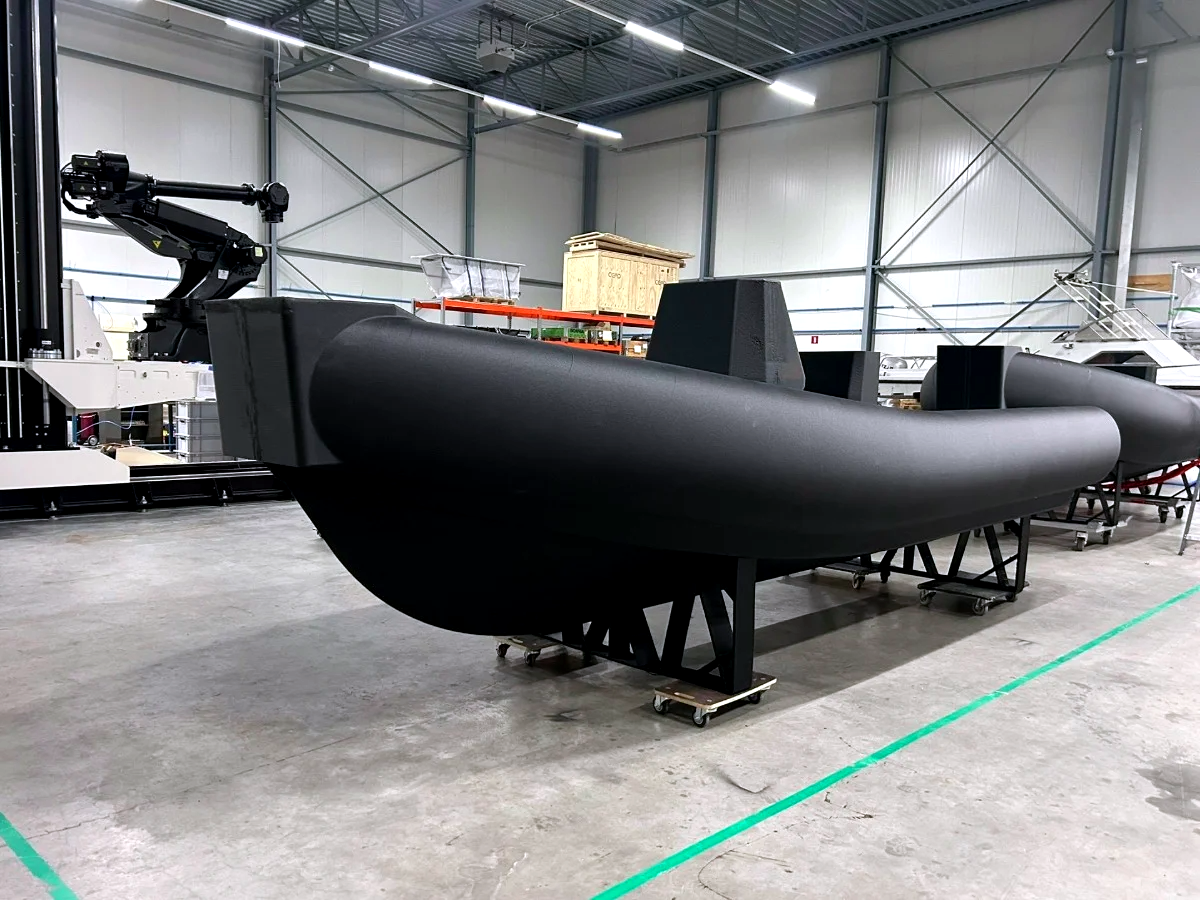
The same logic reshaping spare parts is now coming for entire small craft. In defense operations, supply chains that add weeks or months of lead time create dangerous gaps when forward-deployed units need to replace damaged systems or vehicles. Rigid hull inflatable boats are a perfect example: elite units cannot afford to wait for a distant shipyard when a hull is damaged. Voltage Vessels is answering that by moving to a distributed manufacturing model for RHIBs, using additive manufacturing and a composite reinforced with basalt fiber, a material with a long history in military armor and infrastructure. By 3D printing a six‑meter RHIB hull on demand, they aim to deliver boats at the point of need instead of shipping them from central factories. The implication for the naval supply chain is profound: every forward base or larger ship equipped with the right printer becomes a potential production site, cutting weeks from traditional production and transport cycles.
Critically, this is not a boutique design exercise. It is a direct response to the recognition that in the defense sector “there is often no time to wait,” and that long lead times create serious logistical vulnerabilities. A printed RHIB hull is both a product and a signal: the fleet is moving from buying finished platforms to owning the recipes and machines that can recreate them anywhere. That shift favors militaries that invest in design libraries, material science, and operator training over those that cling to centralized shipyard capacity. Distributed manufacturing of hulls sits on the same curve as onboard printers replacing obscure brackets on the Essex; what changes is scale and consequence.
The new logistics doctrine: print where you fight
All of these efforts point to a simple but disruptive doctrine for military 3D printing: print where you fight, and use autonomous drones to bridge whatever distances remain. Onboard manufacturing on ships like the Essex shortens the path from problem to part by removing entire layers of paperwork and shipping, keeping equipment operational instead of waiting powerless for external resupply. Drone resupply then handles the edge cases, moving custom parts across rough seas when even onboard printers are not enough. Distributed approaches such as Voltage Vessels’ RHIB hulls extend the same logic to complete platforms, shrinking lead times that once stretched to weeks or months. The practical impact is already visible in freed logistics workload, lower parts spending, and higher equipment readiness across departments. The bigger impact is strategic: fleets that master additive manufacturing and autonomous delivery will be much harder to exhaust.
The transition is not finished. Medical teams aboard Essex are only beginning to explore printed equipment for patient care, and officers like Margarini argue that many still underestimate what the technology can do. They are right to insist on wider understanding; the more sailors, Marines, and engineers grasp the possibilities, the more they will push the systems and discover new applications that logisticians ashore have not imagined. The conclusion, however, is already clear. The naval supply chain is being re-written from the edge inward, turning ships into factories, drones into couriers, and design files into some of the most valuable munitions afloat. Militaries that treat additive manufacturing as an optional upgrade will find themselves outpaced by those that make printing at sea a core part of how they fight and sustain forces.