
Thermal stability: the real barrier to scalable metal AM
Thermal stability metal printing refers to the ability of metal additive manufacturing processes to keep temperatures in precise, predictable ranges so that the material flows, solidifies, and transforms without clogging, distortion, or uncontrolled microstructure changes across the entire printed part.
Metal additive manufacturing has already proven that it can produce complex, near‑net‑shape geometries, internal channels, and topology‑optimized structures that conventional machining cannot match. The unsolved problem is not shape; it is heat. Every layer, track, and voxel carries a thermal history that defines defects, residual stresses, and microstructure, yet most systems still treat temperature as something to endure rather than something to design.
This is why recent work on thermal stability in metal extrusion additive manufacturing, alongside advances in laser control and microstructure design, matters more than another incremental hardware upgrade. It signals a shift from printing geometry to printing properties, and that is what scalable production demands.
Johns Hopkins puts failure modes at the center of metal extrusion
Metal extrusion additive manufacturing promises a cheaper, wire‑fed path to metal parts, but molten aluminum does not behave like obedient plastic. Low viscosity, high thermal conductivity, and high surface tension shrink the viable process window for high‑melting alloys, making thermal failure the norm rather than the exception.
Researchers at Johns Hopkins University confronted this head‑on by building a thermally informed, simulation‑guided process framework tuned to thin‑walled aluminum alloy structures. Instead of tweaking knobs blindly, they defined two brutal failure modes: underheating, which cools the melt too fast, freezes material at the nozzle, and causes clogs; and overheating, which outpaces cooling in previous layers, remelts walls, and leads to collapse.
Their answer is unapologetically process‑centric: vary the print bed temperature layer by layer while holding nozzle temperature and speed constant, and enforce a minimum cooling time so each layer reaches solidus before the next is deposited. With ER4043 aluminum alloy wire feedstock, roughly 5% silicon and 95% aluminum by weight, the framework produced thin‑walled structures with consistent surface roughness and repeatable geometry through the build height.
Laser control and microstructure: KU Leuven turns the second laser into a metallurgist
While metal extrusion additive manufacturing struggles with keeping walls standing, laser powder bed fusion fights a subtler battle inside the material. Duplex and super duplex stainless steels rely on a carefully balanced microstructure—roughly equal parts ferrite and austenite—for strength and corrosion resistance. High cooling rates in LPBF suppress austenite, leaving parts strong but brittle with weaker corrosion performance in the as‑built state.
A KU Leuven research team attacked this problem by using laser control microstructure strategies rather than post‑build furnaces. Their approach, published in October 2025, uses a dual‑laser configuration where the second laser trails the first as a controlled heat source. By keeping super duplex stainless steel in the critical 800–1200 °C window where austenite can form, they trigger phase transformation during the build itself.
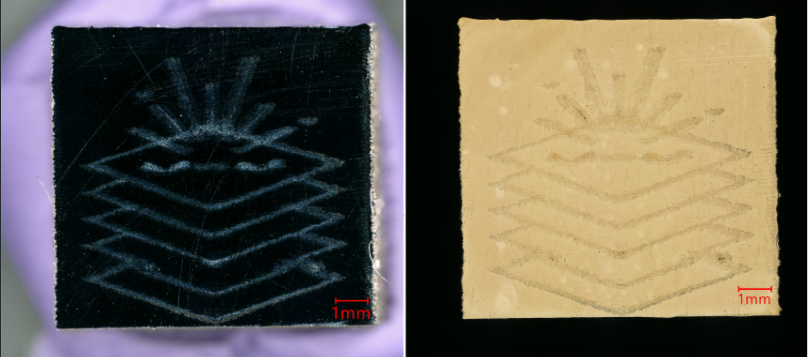
By tuning trailing laser power and offset, the team dialed austenite content from 0% under high‑speed single‑laser conditions to 48% with optimized dual‑laser settings, an in‑process control level not previously shown for this alloy. They even printed parts where a logo appears only in the microstructure—near‑duplex in the pattern, fully ferritic in the background—demonstrating local influence over material properties inside a single part.
From geometry to property‑driven design
Taken together, these studies argue that reliable metal additive manufacturing will not come from marginally faster machines, but from thermal strategies that treat temperature as a primary design variable. In extrusion, that means building process frameworks that start from failure modes and work backwards to layer‑by‑layer control. In powder bed fusion, it means exploiting multi‑laser systems not only for throughput but as precise, mobile heat sources that set local microstructure by design.
One quotable lesson stands out: “We introduce a Metal Extrusion Additive Manufacturing framework that enables stable and (somewhat) high-fidelity thin-walled aluminum prints by precisely controlling various process parameters to eliminate nozzle clogging and part collapse.” Replace “thin‑walled aluminum” with almost any demanding alloy, and the logic still holds.
If metal AM is to move from spectacular prototypes to dependable production tools, the industry must stop treating thermal behavior and microstructure as afterthoughts. The path forward is clear: design the heat first; the part will follow.