
Designing 3D‑Printed Concrete for the Machines That Must Build It
Design optimization frameworks for 3D printed concrete are computational tools that search for the most material‑efficient structural shapes while embedding the physical limitations of concrete 3D printers, so that the resulting forms are both strong and directly manufacturable without extensive manual redesign or post‑processing.
The key shift in the latest work from MIT is harsh but overdue: in concrete 3D printing, hardware is now the bottleneck, not material science. Researchers there have built a design framework that optimizes concrete structures while accounting for the physical limits of large‑scale printers, baking bead thickness, turning radius, and continuous printing paths into the structural optimization itself. That means the output is not a fragile, mathematically elegant fantasy, but a geometry a real machine can print without days of digital cleanup. In an industry where concrete is both indispensable and one of the largest sources of carbon emissions, treating printer constraints as first‑class design inputs is less a technical tweak than a climate necessity.
From Spider‑Web Sketches to Printable Bridges
For years, structural optimization in concrete 3D printing has meant running topology optimization to get intricate, spider‑web forms and then spending days forcing them into something a printer can survive. Existing methods separate "ideal" shape from manufacturability, which is precisely why so many designs stay on paper. MIT’s framework refuses that split: it folds printer limits directly into the optimization, so structural and manufacturing constraints are solved together.
To find the real limits, the team embedded themselves with operators of large concrete printers, who flagged sharp angles and risky paths that no one wanted to run in the field. Those conversations distilled three decisive constraints: minimum bead thickness, allowable turn sharpness, and the requirement to print in one continuous line. Each became a mathematical rule in the framework. The payoff is speed and realism: instead of multi‑day post‑processing, fully printable designs emerge in about two minutes, and late design changes can be recomputed in under ten minutes on a laptop. This is structural optimization growing up—less academic sculpture, more practical sustainable construction.
A 30‑Minute Bridge That Exposes the Real Bottleneck
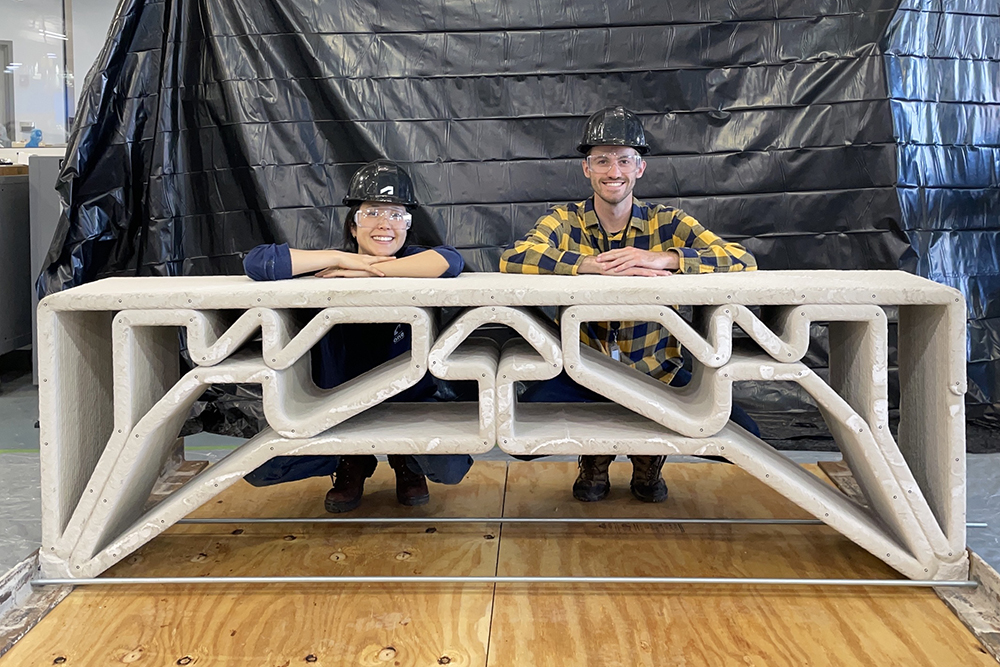
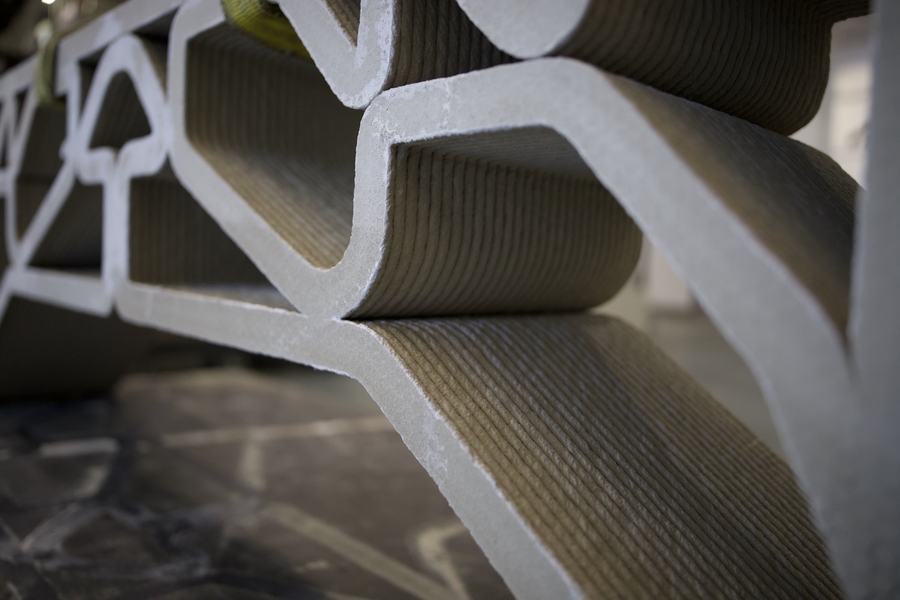
The framework’s credibility does not rest on pretty renderings but on a 2.3‑meter concrete bridge the team designed, printed, and load‑tested using off‑the‑shelf mortar. The bridge, weighing roughly 900 pounds, took about 30 minutes to print and carried more than 2,000 pounds spread across it with no measurable bending, closely matching simulation. That is proof that structural optimization and concrete 3D printing can meet in the real world without a safety penalty.
The surprise was not that the bridge stood, but that it was overbuilt. From zero to 200,000 pounds of applied load, the design was governed almost entirely by “can I build it or not” constraints; only beyond that did material physics matter. In short, the printer’s limits, not concrete’s strength, dictated how efficient the bridge could be. This is a damning verdict on the current state of hardware. As long as designers ignore the printer in the optimization loop, they waste much of concrete’s potential efficiency—and lock in higher emissions for every span and wall.
Why Hardware Matters More Than Mix Design for Sustainability
Sustainable construction with concrete has focused heavily on mix design: low‑clinker cements, supplementary materials, and other chemistry tweaks. The MIT work argues that is only half the story. By using mixed‑integer optimization to compute global optima, the team can put a hard number on what each hardware limit costs in extra material. Their analysis shows that using a 4‑centimeter‑wide bead, as in the test bridge, locks in far more concrete than necessary; a printer that could reliably lay a 1‑centimeter bead would cut material use by as much as 76 percent while staying well within safety margins.
That single statistic should be a wake‑up call for equipment makers and builders alike. Geometry, materials and machines are converging on the same goal: less carbon per structure. Printing concrete bead by bead already removes formwork and places material only where the structure needs it. But unless hardware is refined—narrower beads, better control, safer turning—the promised savings of concrete 3D printing will remain theoretical. As one quotable takeaway from the research puts it, “the printer’s limits, not concrete’s strength, dictated how efficient the bridge could be.”
Toward Greener, On‑Demand Structures
The practical impact of this framework goes beyond academic bridges. For ordinary users of the built environment, it points toward faster, cleaner infrastructure. Printing structures bead by bead removes labor‑intensive molds and cuts waste by putting concrete only where it is structurally useful. Savings grow for one‑off shapes, and the researchers see promise in disaster relief scenarios, where you can quickly put up new infrastructure without needing to make formwork. In other words, structural optimization that respects the printer could make concrete 3D printing both cheaper to deploy and easier to adapt on site.
This is not the endgame. The team’s next target is reinforced concrete, acknowledging that pure concrete designs are rarely optimal in mainstream construction and that feeding rebar into printed forms is a serious challenge. Better hardware, not just better concrete, may unlock the largest gains. The lesson is clear: sustainable construction will come from co‑designing structures, materials, and machines. As design frameworks start to treat manufacturing constraints as equal partners to physics, 3D printed concrete can move from novelty projects to a low‑carbon workhorse of everyday building.