
Marine 3D Printing: From Floating Warehouses to Floating Factories
Marine 3D printing is the use of additive manufacturing systems on ships, in ports, and across distributed shore facilities to produce on-demand spare parts, tools, and even hull structures, cutting dependence on centralized inventories and long, fragile supply chains while keeping vessels and marine equipment operational in isolated or time-critical conditions.
The key shift is simple: instead of sending parts to the sea, we send designs. That reverses decades of thinking in naval manufacturing and supply chain optimization. On a Wasp‑class amphibious assault ship, embarked printers now produce replacement parts and tools so crews do not wait on the traditional supply chain. When some components can take weeks to arrive or are no longer manufactured at all, printing at the point of need stops being a novelty and becomes an operational necessity. This is not a marginal efficiency play; it signals the beginning of distributed production as a core logistics strategy for both defense forces and everyday boat owners.
USS Essex: Supply Chain Optimization at Sea, Not in a Warehouse
On board the USS Essex, the supply chain no longer ends at the loading dock; it ends at the print bed. The ship and Combat Logistics Battalion 13 use embarked 3D printers to produce replacement parts and tools instead of waiting on shore-based depots. When equipment breaks in the middle of the ocean, the crew can restore it in hours or days instead of “a week or two” for a replacement to arrive. This is the practical face of on-demand spare parts: less radio traffic with supply, more uptime for critical systems.
The workflow is telling. Technicians measure a failed item, create a digital model, print a plastic prototype to confirm fit, then move to a final version. More complex parts are scanned for accurate digital recreation. That iterative loop, run entirely on the ship, slices out the administrative steps that used to slow every request: the department’s job submission, supply’s tracking, receiving, and issuing. According to the ship’s supply officer, this capability keeps the “entire manufacturing process” on board and cuts both workload and spending across departments. That is supply chain optimization measured not in PowerPoint charts, but in fewer forms, fewer emails, and more working gear.
Voltage Vessels: Distributed Production of Whole Boat Hulls
If printing a thermostat cover on a ship sounds impressive, printing a six‑metre rigid hull inflatable boat hull on demand is a different order of ambition. In the defense sector, long lead times of weeks or months for critical equipment create “serious logistical vulnerabilities,” especially for forward‑deployed forces that need to replace damaged parts, systems, or vehicles. Navy special operations units cannot afford to wait while a factory slot opens and a hull ships across an ocean. That vulnerability is precisely what Voltage Vessels targets.
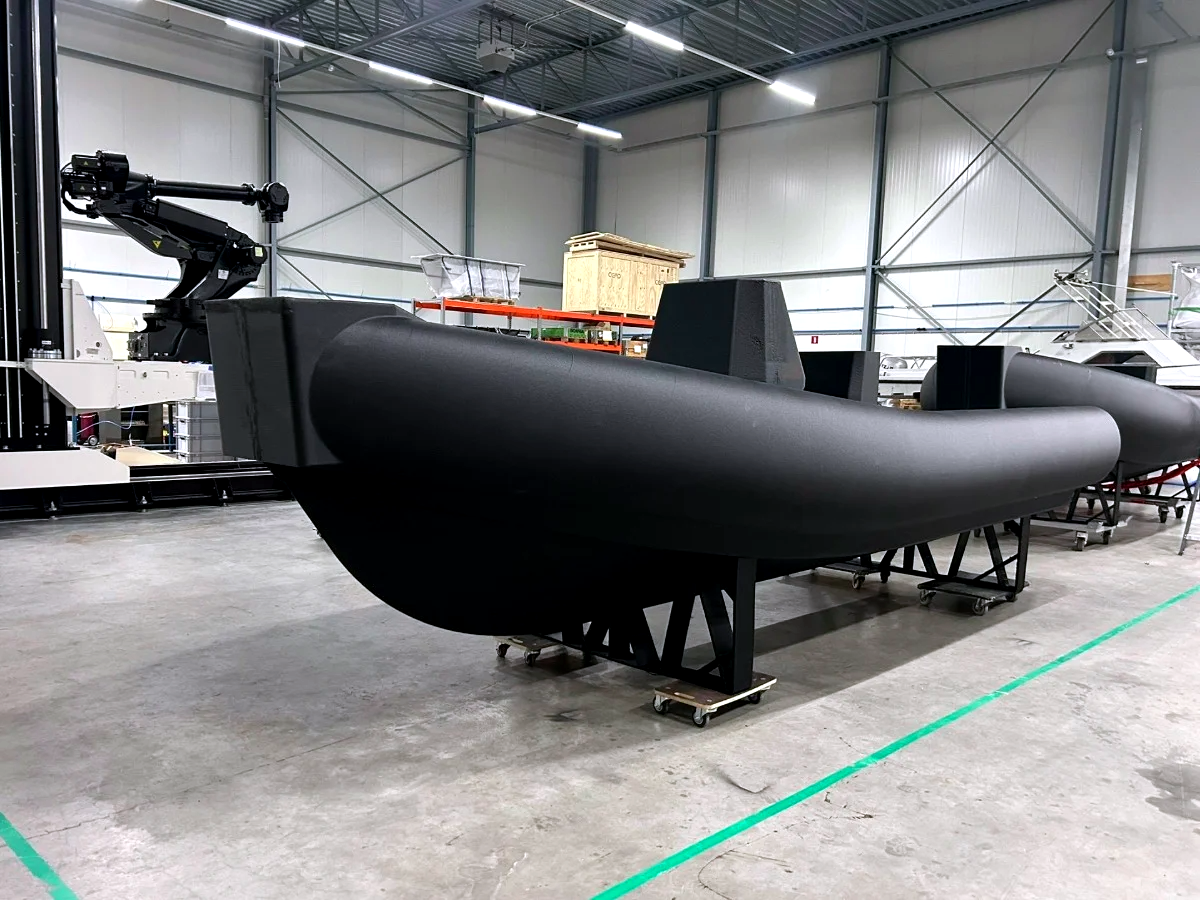
Voltage Vessels is developing a distributed manufacturing approach for RHIBs, using composite material reinforced with basalt fiber and additive manufacturing so hulls can be delivered on‑demand and at the point of need. Here, additive manufacturing is used to produce a six‑metre RHIB hull. Instead of a single central boatyard, any qualified node with the right printer and material can become a micro‑shipyard. The likely impact on marine 3D printing is profound: fleets could treat hulls almost like consumables, ordered as digital packages, built where they are required, and slotted straight into service without the weeks‑long logistics drag that now defines hull replacement.
MarineLab3D: Turning Every Boatyard into a Design Office
Distributed production only works if designs flow as easily as fuel and food. That is where MarineLab3D’s marketplace signals the next phase of naval manufacturing. It offers 3D‑printable marine parts as parametric designs rather than fixed STL files. A buyer enters dimensions such as diameter, thread size, length, and even a name to emboss, and the system generates a JSCAD‑based model on demand, runs a watertight mesh check, then releases the download. In effect, MarineLab3D is selling adaptable recipes, not frozen meals.
This matters because boat hardware wears out in a market with little standardized supply: fittings, caps, and mounts are often specific to a hull or a discontinued product run, leaving owners with no manufacturer to call. MarineLab3D’s approach is to bridge that gap with one design per part type instead of one file per boat. At the time of review, the storefront lists 52 products across engine and propulsion (17 designs), interior and cabin (22), plumbing and pumps (18), deck and rigging (16), and tools (14), with 15 offered free. Materials range from ASA, PETG, carbon‑fiber‑reinforced nylon, and TPU to SLA and SLS resins, plus CNC‑machined steel or aluminum for select parts. For boat owners, that means a cracked cap or worn mount becomes a design query, not a dead end.
The Real Prize: No Inventory, Faster Fixes, and Smarter Fleets
The strategic value of marine 3D printing is not the printers themselves; it is the on-demand manufacturing model they make possible. When a ship can restore broken equipment in the middle of the ocean without waiting one or two weeks for a replacement, logistics ceases to be a constraint on operations. When RHIB hulls can be produced on‑demand and at the point of need, forward‑deployed units are less exposed to the long, fragile chain between factory and frontline. When boat owners can call up parametric spare parts tailored to their hull’s dimensions, the aftermarket stops being a scavenger hunt for obsolete stock.
On-demand spare parts cut the need to carry large physical inventories and reduce the workload tied to parts orders, freeing funds for other priorities. They also unlock new domains: Essex’s medical team already prints thermostat covers and oxygen storage parts that are unavailable to buy, and the senior medical officer hopes to manufacture sterilizable pieces of medical equipment for patient care in the future. As more designers submit models that MarineLab3D can convert into parametric designs with no exclusivity requirement, the library of printable parts will grow. The industry should treat this not as a side project, but as the foundation of a new operating model: distributed production, near‑zero inventory, and fleets that are limited more by imagination than by shipping schedules.