
From melting powder to designing microstructure
Advanced beam control in metal 3D printing is the use of tightly coordinated laser or electron beam strategies to tailor local thermal history during the build, so the microstructure—and therefore the properties—of the material can be designed directly inside a part instead of being treated as a side-effect of melting powder.
Metal additive manufacturing has spent a decade proving it can print almost any geometry; the real fight now is over what happens inside those shapes. Microstructure, not geometry, decides strength, ductility, fatigue life, and corrosion resistance. That makes beam control metal printing the next competitive battleground. If your process can steer thermal history with precision, you are no longer just building parts—you are engineering material behavior at the voxel level. Laser control metal AM and electron beam powder bed fusion (EB-PBF) are converging on the same idea: the beam is not only a heat source, it is a design instrument. The companies that treat it that way will set the rules for high-performance metals in aerospace, defense, and critical industry.
KU Leuven’s dual-laser breakthrough: when the second beam becomes a metallurgist
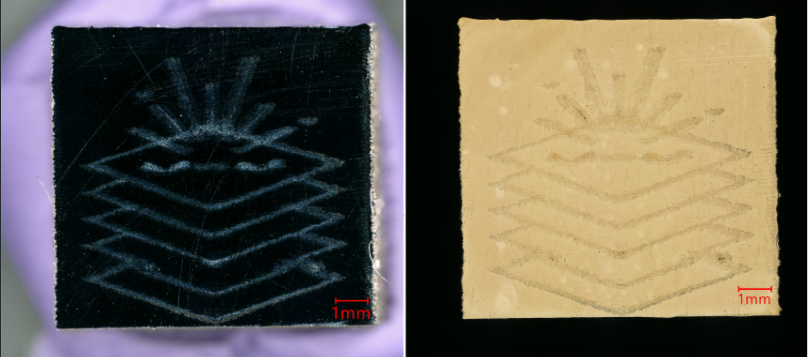
The clearest proof that microstructure design additive manufacturing is no longer theory comes from a KU Leuven team that has shown local microstructure control inside a single metal part during the build, without any post-build furnace heat treatment. Their October 2025 study uses a dual-laser configuration where the second laser trails the first as a controlled heat source, reheating the freshly solidified track into the 800–1200 °C window where austenite can form in super duplex stainless steel.
By tuning the trailing laser’s power and offset, the team could vary austenite content from 0% under high-speed single-laser conditions to 48% with optimized dual-laser settings, achieving in-process control never before reported for this alloy system. Thousands of parameter combinations were screened computationally, and only a small subset was tested experimentally on tracks and 8 mm cubes, showing sharp interfaces between microstructural zones with no added defects or density loss. Beam control here turns a multi-laser system from a throughput upgrade into a property-design platform—and that is a much bigger deal than shaving hours off build time.
Electron beam powder bed fusion: from hot black box to precision instrument
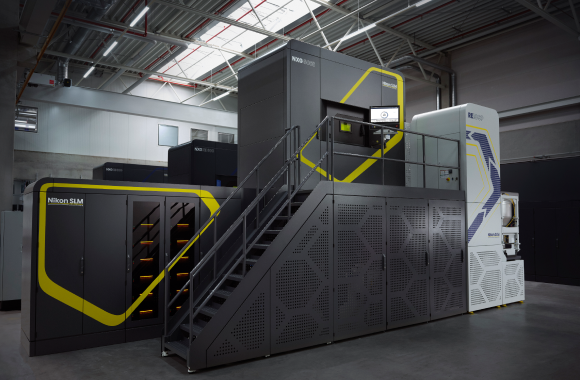
While lasers are learning metallurgy, electron beam powder bed fusion is rediscovering itself as a beam control platform rather than a niche for “hotter, cleaner, lower-stress” parts. EB-PBF runs in vacuum at elevated bed temperatures and uses electromagnetic steering plus electron-based observation, giving it a different operating logic from laser systems. Recent work has focused on point melting strategies, process monitoring, and beam control to shape thermal histories more deliberately, changing how engineers think about EB-PBF.
This shift matters most for difficult materials—tungsten, refractory metals, titanium aluminides, and crack-sensitive superalloys—where thermal control, cracking, evaporation, and microstructure are central problems. Research on tungsten, for example, has centered on process window control across beam power, preheating, localized heating, scan strategy, and total thermal input, proving EB-PBF can maintain a stable enough thermal environment to print demanding components with low residual stress and less warpage. The message is blunt: a customer evaluating EB-PBF is really evaluating a way to control material formation, not a generic metal printing machine. Beam strategy and process evidence, not melt rate alone, will decide its industrial future.
Why microstructure design is the real productivity game-changer
The metal AM narrative has been trapped in build speed charts and machine-hour comparisons. That misses where advanced beam techniques create most value: in predictable, application‑ready material performance. For super duplex stainless steels, LPBF’s rapid cooling yields nearly fully ferritic parts—strong but brittle, with worse corrosion resistance—so users have had to rely on furnace heat treatments that add time, cost, distortion risk, and a uniform microstructure everywhere, even when properties should vary by location.
Beam-controlled microstructure design changes that equation. If LPBF can dial phase balance layer by layer and EB-PBF can hold difficult alloys inside safe thermal windows, the “route from powder to qualified part” becomes shorter and more reliable. According to Ulf Lindhe, productivity in EB-PBF should be measured as the whole path to a qualified part, not only machine-hour cost or melt rate. For aerospace, implants, energy systems, and defense components, where strength, fatigue life, and corrosion resistance are non‑negotiable, beam control metal printing offers a path to skip or simplify post-processing while hitting property targets by design.
What comes next: connecting beam strategy to qualification
The hardest work now is not inventing new beam tricks; it is turning them into qualified, production‑scale practice. For EB-PBF, the immediate challenge is to connect beam strategy, layer-wise process evidence, and qualification rules in a way users can trust. The same is true for laser systems exploiting dual-beam and advanced laser control metal AM: parameter sets, monitoring data, and microstructure outcomes must be linked tightly enough that auditors and engineers see a controllable manufacturing platform, not a black box that happens to melt powder.
The next question is what these machine architectures and beam strategies unlock in real applications. Microstructure design additive manufacturing is already being discussed for refractory materials, crack‑sensitive alloys, copper alloys, high‑temperature parts, aerospace hardware, implants, energy systems, and defense‑related components. If laser and electron beam systems can reduce defects, hold density, and produce sharp microstructural transitions without warpage or stress, the line between “printer” and “metallurgical production line” starts to blur. The winners in metal AM will be the ones who treat beam control as a core design axis, right alongside geometry and topology.